
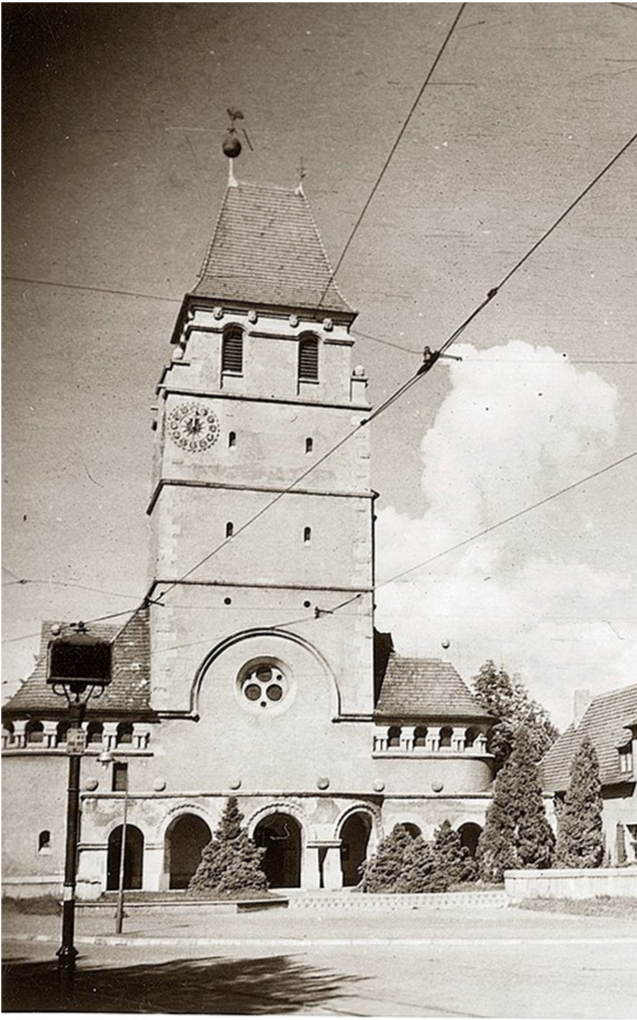
A Neo-Romanesque parish church built for Königsberg’s expanding Maraunenhof quarter, named for the Lutheran duke Albert I, and lost to war and demolition within six decades of its dedication.
At a glance
Built between 1911 and 1913, the church served the northern district of Maraunenhof in what was then Königsberg. Damaged in the 1945 Battle of Königsberg, its ruins stood for decades before Soviet authorities cleared them in 1972. Only the rectory survives, repurposed today as a children’s music school.
History
By the early twentieth century, the parish churches of Tragheim and Neurossgarten sat too far from Maraunenhof’s growing population. Planning for a new church began in 1908, on König-Ottokar-Platz. Architects H. Mattar and E. Scheler designed the building. Construction started on 19 May 1911. Consecration followed on 12 January 1913, under the name New Tragheim Church. The parish gained independence from Tragheim in 1928, prompting a new name: Maraunenhof Church. Locals also called it the König-Ottokar-Kirche, after the Bohemian king who gave Königsberg its name. In 1933, amid celebrations marking 450 years since Martin Luther’s birth, the church was rededicated as the Herzog-Albrecht-Gedächtniskirche, honoring Duke Albert I of Prussia, an early champion of the Reformation. War arrived in 1945. The Battle of Königsberg left the building badly damaged. It stood in ruin for over two decades. Kaliningrad’s Soviet administration finally demolished the remains in 1972.
What you see
The church itself no longer stands. Its Neo-Romanesque form is known only through description and photographs. Inside, life-size bronze figures of Saints John and Paul once flanked the nave. A wooden crucifix, carved by Georg Grasegger, hung within. None of this survives on site today. The rectory does. Built alongside the church, it later served as a movie theatre. It now houses a children’s music school named for E. T. A. Hoffmann, whose own Königsberg roots give the building a quiet literary echo.
Cultural significance
The church’s shifting names trace the political and religious currents of its short life. Named first for a medieval king, then for a Lutheran duke during a nationalist Reformation anniversary, it absorbed the ideological weight of interwar Germany. Its destruction, first by Allied and Soviet bombardment, then by deliberate postwar demolition, mirrors the fate of much of old Königsberg’s ecclesiastical architecture. The surviving rectory, repurposed for music education, stands as one of the few physical threads connecting Kaliningrad’s Soviet-era cityscape to its German past.
Key facts
- Original name: New Tragheim Church (1913)
- Architects: H. Mattar and E. Scheler
- Construction began: 19 May 1911
- Consecrated: 12 January 1913
- Renamed Herzog-Albrecht-Gedächtniskirche: 1933
- Damaged: 1945, Battle of Königsberg
- Demolished: 1972
- Surviving structure: rectory, now a children’s music school
Practical information & getting there
No church building remains to visit. The site lies in Kaliningrad’s Maraunenhof district, near the coordinates 54.7365, 20.5249. You can seek out the former rectory, now a music school, as the one tangible remnant of the parish complex. Street patterns in the surrounding neighborhood still hint at the prewar layout of König-Ottokar-Platz.
Sources & resources
Find it on the map
See this place and what’s around it →📷 Become a Cultural Heritage Online photographer
Share your photos of places: they stay published under your name as the author. The more they're seen, the more you get noticed — and soon a contest will reward the most appreciated photos.
Log in or sign up free to add a photoIs this page about you?
This page is read by travellers and heritage enthusiasts who find it on Google. Tell us how you are connected to this place and we will take it from there.