
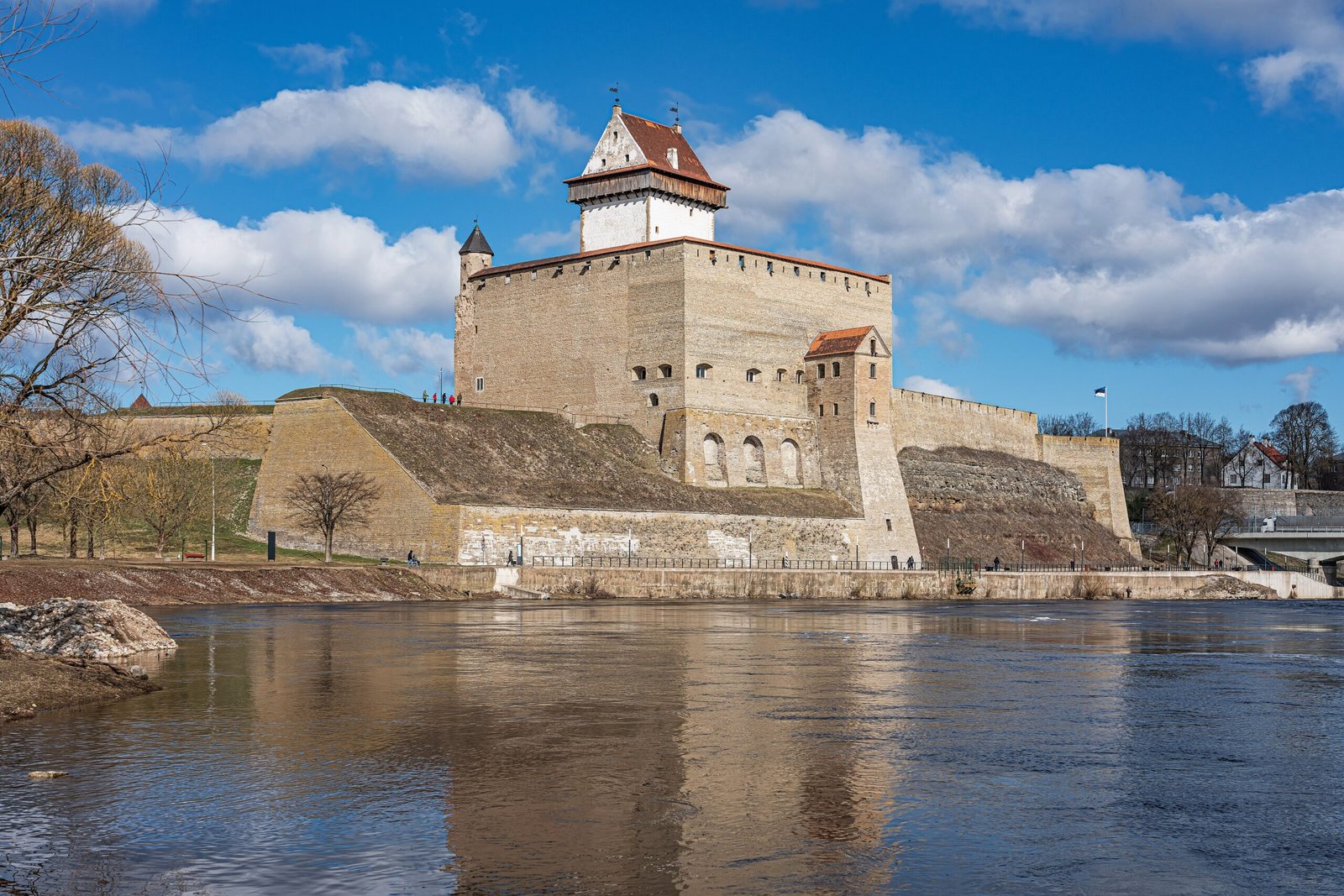
A medieval fortress anchoring northeastern Estonia’s border, Hermann Castle rose from Danish foundations to become a seat of power under the Teutonic Order.
At a glance
Hermann Castle stands in Narva, Estonia’s easternmost city, commanding views across the Narva River toward Russia. Built in phases across four centuries, it survives as one of the Baltic region’s most important medieval military structures.
History
The castle was established around 1256, when Narva lay within the Danish Realm. Stone fortifications followed in the early 14th century, replacing earlier wooden structures. In August 1346, the Livonian branch of the Teutonic Order acquired the castle and maintained control through much of its subsequent history, using it as a stronghold on the contested eastern frontier.
What you see
The earliest visible masonry dates to the 14th-century construction phase. The castle’s layout reflects medieval military engineering, designed to command both the river crossing and the surrounding territory. Its fortifications evolved through successive occupations and sieges.
Cultural significance
Hermann Castle embodies the medieval power struggles that shaped northeastern Europe. It marks the intersection of Scandinavian, German, and Russian spheres of influence—a frontier post that changed hands repeatedly. The castle remains central to Narva’s identity and to understanding the region’s complex history.
Key facts
- Country: Estonia
- City: Narva
- Established: c. 1256
- Stone fortifications: early 14th century
- Acquired by Livonian Teutonic Order: August 1346
- Coordinates: 59.38°N, 28.20°E
Practical information & getting there
Narva lies on Estonia’s eastern border, approximately 210 kilometers northeast of Tallinn. The castle is accessible by car, bus, and train. Contact local tourism information for current visiting hours and entry fees.
Sources & resources
Find it on the map
See this place and what’s around it →📷 Become a Cultural Heritage Online photographer
Share your photos of places: they stay published under your name as the author. The more they're seen, the more you get noticed — and soon a contest will reward the most appreciated photos.
Log in or sign up free to add a photoIs this page about you?
This page is read by travellers and heritage enthusiasts who find it on Google. Tell us how you are connected to this place and we will take it from there.