
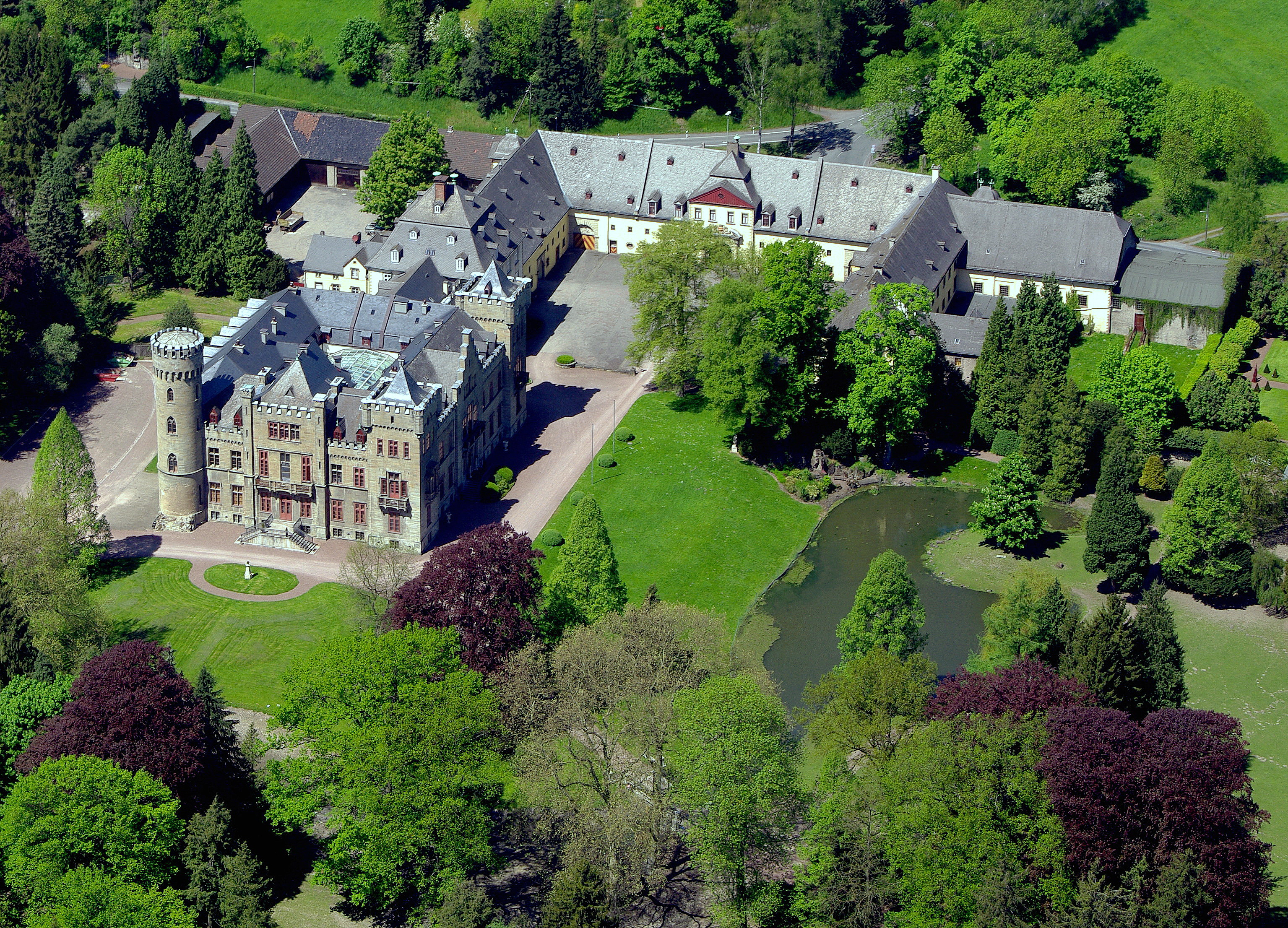
A striking Gothic Revival fortress designed by Ernst Friedrich Zwirner, Herdringen Castle stands as one of Westphalia’s most significant secular interpretations of medieval architectural language.
At a glance
Herdringen Castle occupies the Ortsteil (district) of Herdringen within Arnsberg. Built between 1844 and 1853, it remains the seat of the Fürstenberg-Herdringen family. The castle is recognized as one of the region’s most important secular Gothic Revival structures.
History
Construction began in 1844 under the architectural direction of Ernst Friedrich Zwirner and continued for nine years until 1853. The project was undertaken for the Fürstenberg-Herdringen family, whose ancestral estates were centered in this corner of Westphalia.
What you see
Zwirner’s design interprets Gothic Revival principles through a secular lens, departing from the ecclesiastical conventions that dominated his earlier cathedral work. The building synthesizes medieval aesthetic sensibilities with 19th-century construction methods and residential requirements. Turrets, crenellations, and pointed-arch detailing distinguish the façade, creating a picturesque silhouette characteristic of Romantic-era castle revival.
Cultural significance
Herdringen Castle exemplifies the 19th-century European fascination with Gothic medievalism. As both a family residence and architectural statement, it demonstrates how the Gothic Revival transcended religious contexts to reshape secular aristocratic commissions. Its prominence in Westphalian architectural history reflects the period’s cultural aspirations and regional pride.
Key facts
- Country: Germany
- City: Arnsberg
- Coordinates: 51.42055556, 7.97027778
- Construction: 1844–1853
- Architect: Ernst Friedrich Zwirner
- Current use: Seat of the Fürstenberg-Herdringen family
Practical information & getting there
Herdringen Castle is located in the Herdringen district of Arnsberg in the Sauerland region of North Rhine-Westphalia. As a private residence, visiting requires prior arrangement. Arnsberg is accessible by regional rail and road connections from major Ruhr Valley cities.
Sources & resources
Find it on the map
See this place and what’s around it →📷 Become a Cultural Heritage Online photographer
Share your photos of places: they stay published under your name as the author. The more they're seen, the more you get noticed — and soon a contest will reward the most appreciated photos.
Log in or sign up free to add a photoIs this page about you?
This page is read by travellers and heritage enthusiasts who find it on Google. Tell us how you are connected to this place and we will take it from there.