
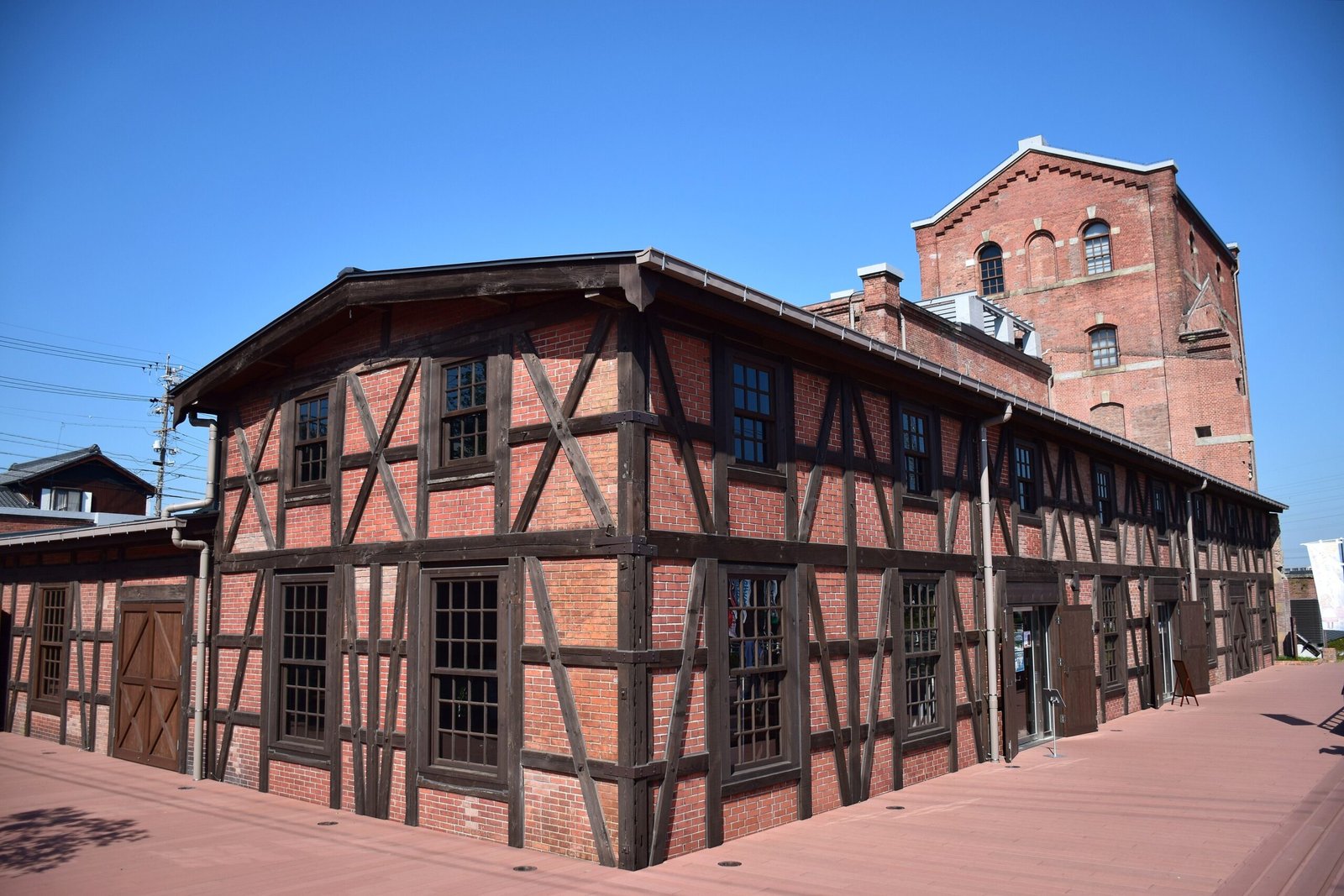
A vast Meiji-era brewery of some 2.4 million bricks, built for beer and later hollowed out by war, now stands open to the public as Handa’s most stubborn survivor.
At a glance
The Handa Red Brick Building is a former beer factory in Aichi Prefecture, designed by architect Tsumaki Yorinaka, who also worked on the Yokohama Red Brick Warehouse. It comprises three structures: a main building, a storage building, and a half-timbered building. Bullet scars from a 1945 air raid still mark its walls.
History
Construction finished in 1898 for Marusan Beer, a brand soon rebranded as Kabuto Beer. Brewing continued until 1943. During World War II the site switched to storing uniforms for the Nakajima Aircraft Company, a use that made it a target. It survived the 1944 Tōnankai Earthquake, the 1945 Mikawa Earthquake, and machine-gun fire from P-51 fighters during the Handa Air Raid. After the war it found new purpose as part of a corn starch plant. That industrial life ended in 1994, when the factory closed and demolition loomed the following year. Handa City instead bought roughly 34,000 square metres of the site in 1996. A citizens’ group, the Handa Red Brick Club, formed in 1997 to push for preservation, and the building opened to the public for a two-day event in 2002 that drew 8,600 visitors.
What you see
The building was raised using a British bricklaying method, its walls composed of an estimated 2.4 million bricks. Scale is the first impression. Inside, the permanent exhibition room traces the site’s history and the story of Kabuto Beer, while a special exhibition space, Re-BRICK, serves draft beer and snacks made with Chita Peninsula ingredients. A clubhouse offers four rooms used for studios and performances. Outdoors, Marche Square and a lawn square give the grounds room to breathe. In 2022 the city added a full-scale replica of the old Kabuto Beer advertising tower that once stood at Nagoya Station, a Meiji-period landmark familiar to some from its appearance in the Ghibli film The Wind Rises.
Cultural significance
The three buildings were registered as tangible cultural properties of Japan on July 23, 2004. In 2009 the Ministry of Economy, Trade and Industry named the site a Heritage of Industrial Modernization property. Its survival owes less to official protection than to local persistence, from the citizens’ club of the late 1990s to the seismic reinforcement and refurbishment carried out between 2014 and 2015. The building has also entered popular culture, appearing as a location model in the anime series Violet Evergarden. It stands, quite literally scarred, as physical testimony to Handa’s industrial and wartime past.
Key facts
- Location: Handa City, Aichi Prefecture, Japan
- Built: 1898, as a beer factory for Marusan/Kabuto Beer
- Architect: Tsumaki Yorinaka
- Materials: approximately 2,400,000 red bricks, British bonding method
- Registered tangible cultural property of Japan: 2004
- Heritage of Industrial Modernization site: designated 2009
- Reopened to the public daily: July 18, 2015
Practical information & getting there
You can reach the building on foot, about five minutes from Sumiyoshicho Station on the Meitetsu Kowa Line, or roughly fifteen minutes from Handa Station on the JR Taketoyo Line. The site is open daily except New Year’s Eve and New Year’s Day. Toyota Enterprise Corporation has managed the facility as designated operator since April 2020.
Sources & resources
Find it on the map
See this place and what’s around it →📷 Become a Cultural Heritage Online photographer
Share your photos of places: they stay published under your name as the author. The more they're seen, the more you get noticed — and soon a contest will reward the most appreciated photos.
Log in or sign up free to add a photoIs this page about you?
This page is read by travellers and heritage enthusiasts who find it on Google. Tell us how you are connected to this place and we will take it from there.