
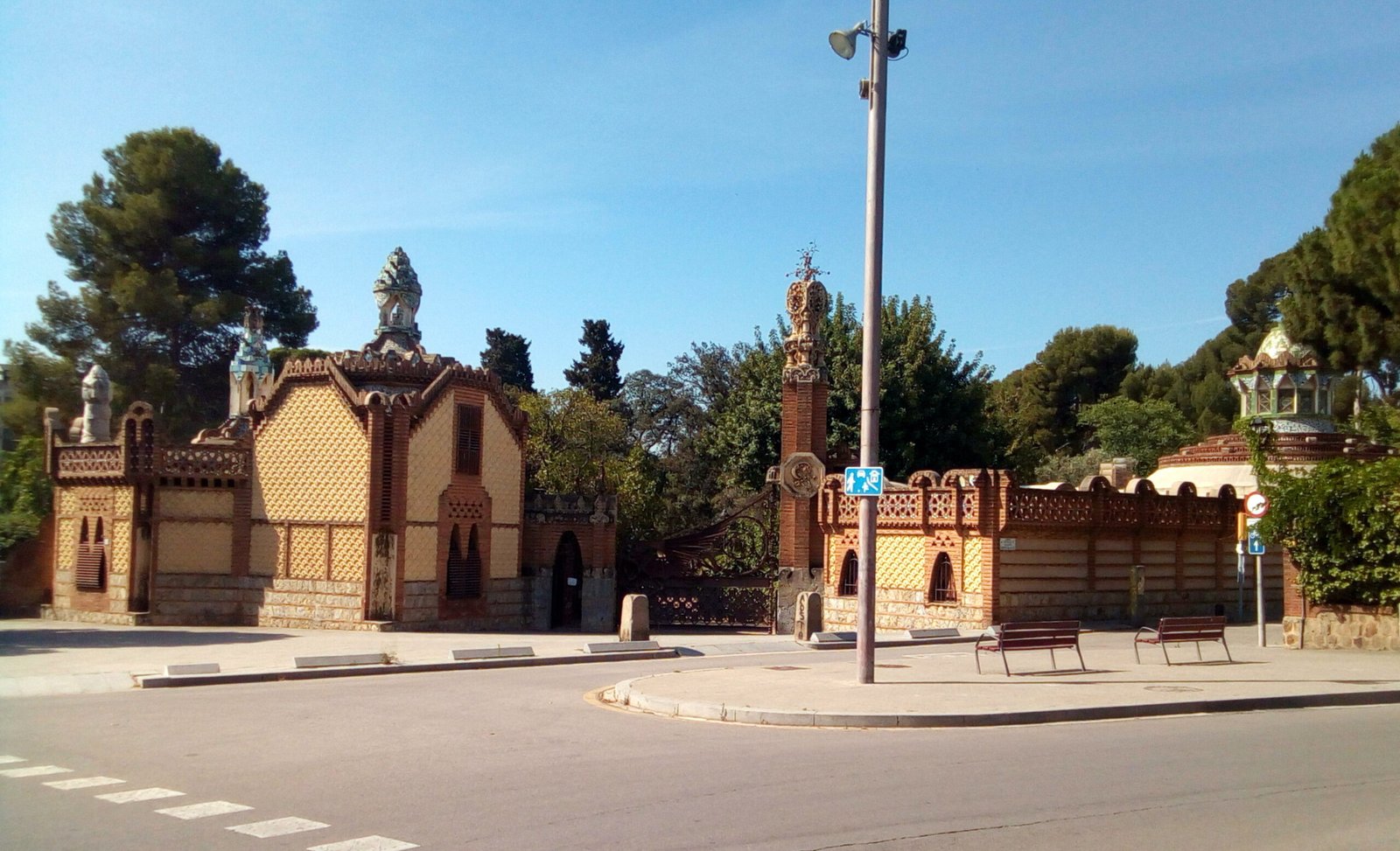
A masterwork of Catalan Modernism, Antoni Gaudí’s Güell Pavilions reveal the architect’s early experiments with ornament, structure, and material invention in this residential gatehouse complex.
At a glance
The Güell Pavilions stand in the Pedralbes neighborhood as a rare surviving ensemble of Gaudí’s early work. Built as service buildings for a private estate, the complex showcases the architect’s characteristic blend of Gothic revival, organic form, and decorative ironwork. The pavilions announce Gaudí’s mature style years before the Park Güell and Sagrada Família would cement his international fame.
History
Constructed between 1884 and 1887, the pavilions were commissioned as part of the Güell estate in Barcelona. Designed by Antoni Gaudí, the complex emerged during the architect’s early period, when he was still establishing the innovations that would define Catalan Modernism. The buildings survived urban development to remain accessible to the public.
What you see
Gaudí’s design fuses historical references with forward-thinking geometry. The pavilions feature elaborate wrought-iron gates and grilles—works of functional sculpture. Brick, stone, and decorative tiles compose facades of restless visual energy. Steep roofs and ornamental turrets recall medieval architecture while subtle curves and material contrasts signal the modernist sensibility that would dominate Barcelona’s fin-de-siècle building boom.
Cultural significance
The Güell Pavilions document a pivotal moment in European architecture. They reveal Gaudí’s early mastery of craft and ornament before his mature works became icons of artistic modernism. The complex remains essential to understanding how Catalan architects transformed medieval and Gothic traditions into a radically new visual language.
Key facts
- Architect: Antoni Gaudí
- Built: 1884–1887
- Location: Pedralbes, Les Corts, Barcelona, Spain
- Coordinates: 41.3894, 2.1192
- Style: Catalan Modernism
Practical information & getting there
The pavilions are located in the Pedralbes neighborhood of Barcelona, accessible by public transport. Visitors should verify current opening hours and access policies before traveling, as the site’s status as a heritage property may affect visiting arrangements.
Sources & resources
Find it on the map
See this place and what’s around it →📷 Become a Cultural Heritage Online photographer
Share your photos of places: they stay published under your name as the author. The more they're seen, the more you get noticed — and soon a contest will reward the most appreciated photos.
Log in or sign up free to add a photoIs this page about you?
This page is read by travellers and heritage enthusiasts who find it on Google. Tell us how you are connected to this place and we will take it from there.