
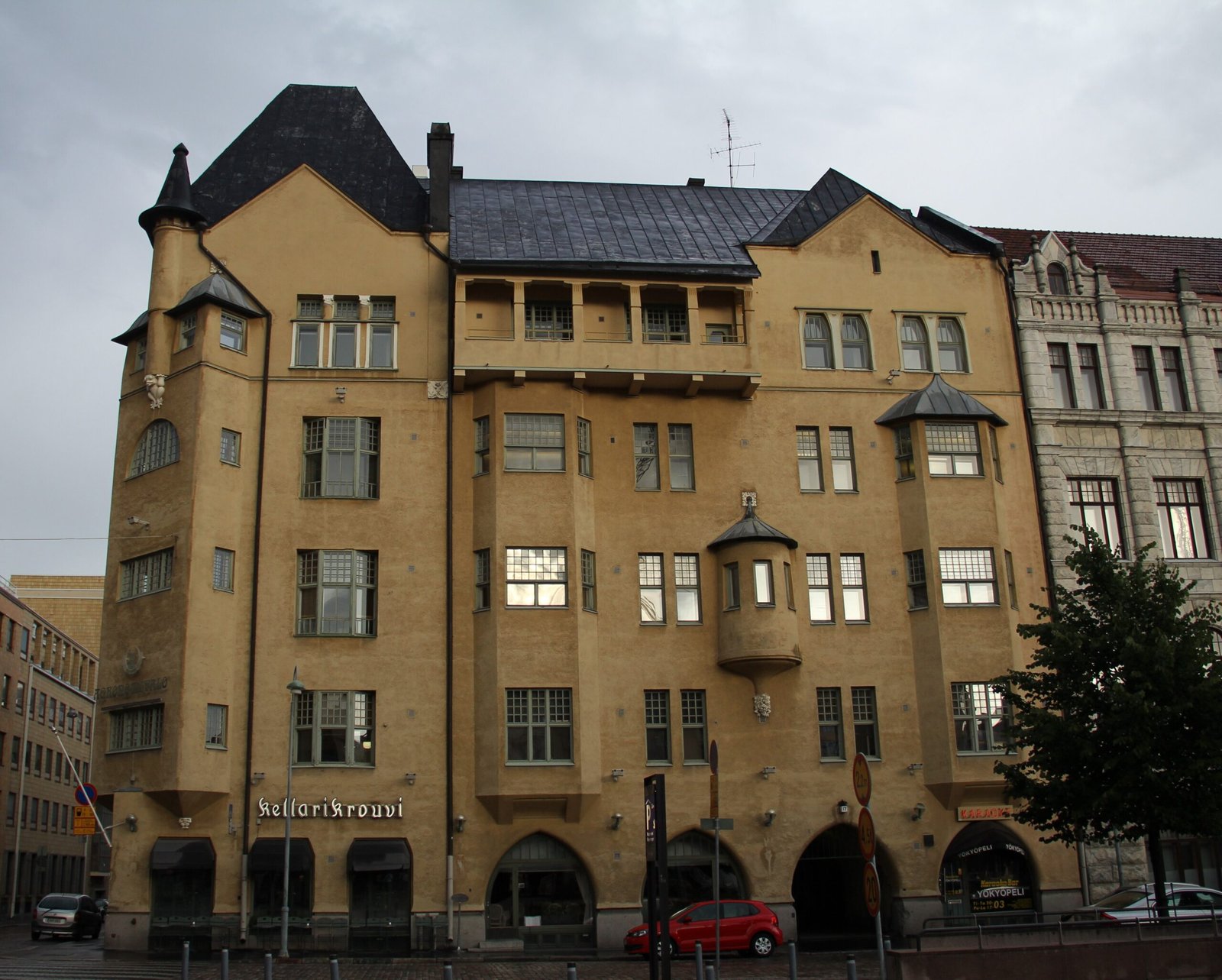
A landmark of National Romantic and Art Nouveau design in central Helsinki, this residential building became an office hub and cultural landmark over the course of the twentieth century.
At a glance
Built in 1900–1901, Fabianinkatu 17 exemplifies the National Romantic and Art Nouveau movements that defined early twentieth-century Finnish architecture. Originally conceived as a block of flats, the building gradually transformed into office space and acquired the nickname “Doctors’ House” (Lääkäreiden talo) for the medical professionals who worked within its walls. In 1953, the Finnish Association of Agronomists purchased the building, renaming it Agronomitalo.
History
Completed in 1901, the building was designed by the distinguished architectural firm Gesellius, Lindgren and Saarinen, whose innovative work shaped Helsinki’s early modern character. The structure began life as residential apartments but soon attracted tenants from the professional classes, particularly physicians, earning its long-standing popular name. Following decades of office use, the Finnish Association of Agronomists (Agronomiliitto) acquired ownership in 1953, establishing it as Agronomitalo—a designation it retains today.
What you see
The building exemplifies the transition between National Romanticism and Art Nouveau aesthetics, both prominent in Finnish design of the period. Details characteristic of this era, including decorative stonework and refined ornamentation, distinguish its façade in central Helsinki’s historic streetscape.
Cultural significance
Fabianinkatu 17 represents a pivotal moment in Helsinki’s architectural development, when the city was establishing its modern identity through distinctive Nordic design. The building’s evolution from residential to professional use mirrors broader urban transformations of early twentieth-century Finnish society. Its continuing function as an institutional headquarters maintains its role as a living part of the city’s cultural infrastructure.
Key facts
- Country: Finland
- City: Helsinki
- Designed by: Gesellius, Lindgren and Saarinen
- Completed: 1901
- Coordinates: 60.1655, 24.9501
Practical information & getting there
The building is located in central Helsinki. For current visiting information and hours, consult local tourism resources or contact Agronomiliitto directly.
Sources & resources
Find it on the map
See this place and what’s around it →📷 Become a Cultural Heritage Online photographer
Share your photos of places: they stay published under your name as the author. The more they're seen, the more you get noticed — and soon a contest will reward the most appreciated photos.
Log in or sign up free to add a photoIs this page about you?
This page is read by travellers and heritage enthusiasts who find it on Google. Tell us how you are connected to this place and we will take it from there.