
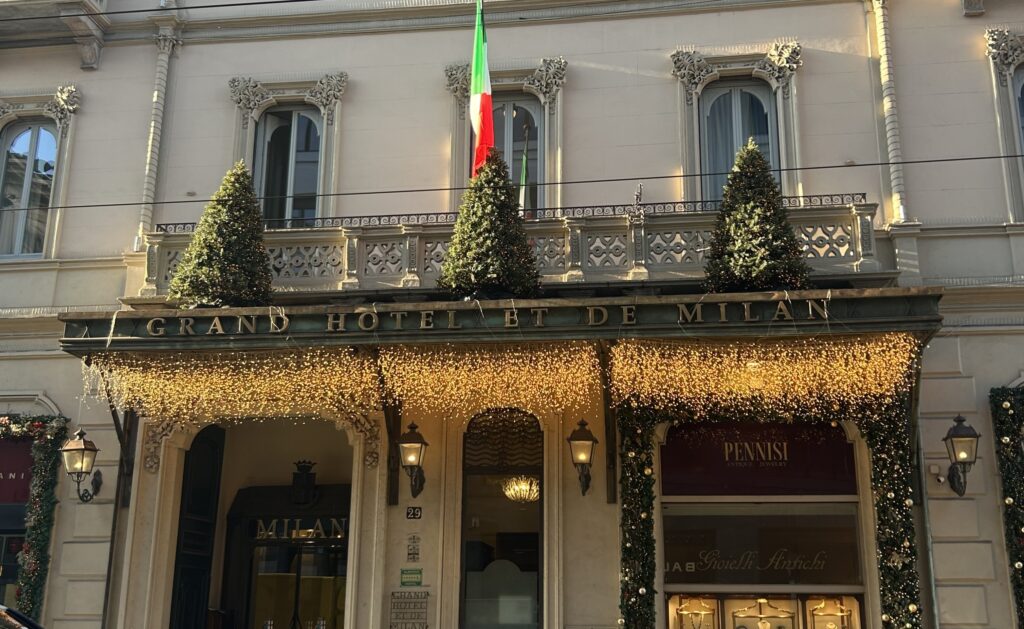

When Verdi lay dying here in 1901, the city spread straw across via Manzoni so the carriage wheels would not disturb him. He had been a resident for nearly thirty years.
At a glance
The Grand Hotel et de Milan opened on via Manzoni in 1863, two years after Italian unification, in a building drawn up by Andrea Pizzala with neo-Gothic leanings. It was equipped for a capital: postal and telegraph services, and a hydraulic lift. Giuseppe Verdi took a suite in 1872 and kept it until his death in 1901, which is why the hotel is as much a literary address as an architectural one. A bomb took off the fourth floor in 1943; Giovanni Muzio rebuilt it after the war. It has never stopped trading.
Key facts
- Opened: 1863
- Architect: Andrea Pizzala (1798–1862), neo-Gothic in inspiration
- Atrium: rebuilt in 1900 by Emilio Polli
- Giuseppe Verdi: resident from 1872 until his death on 27 January 1901
- War damage: bombed in 1943, fourth floor destroyed
- Post-war rebuilding: Giovanni Muzio, 1946
- Address: Via Alessandro Manzoni 29, Milan
- GPS: 45.469923, 9.192498 — View on Google Maps
History
Pizzala died in 1862, the year the work was commissioned, and the hotel opened the following spring. Milan was then the commercial engine of a new kingdom, and via Manzoni was becoming its most deliberate street. The services advertised at the opening — post, telegraph, a hydraulic lift — were the marks of a hotel written for people doing business across a country that had only just become one.
Verdi moved in in 1872 and stayed. His suite was arranged to resemble his study at Sant’Agata, near Piacenza, and it is preserved. The straw laid on via Manzoni during his final illness is the detail everybody repeats, and it is worth repeating: it records a moment when a city organised its traffic around one man’s hearing.
In 1931 the hotel was refitted with running water and telephones throughout. In 1943 bombing destroyed the fourth floor, and the rebuilding fell to Giovanni Muzio, the architect who had given interwar Milan much of its civic face. In the early 1990s work in the basement uncovered a defensive wall of the third century, now shown inside one of the restaurants.
What you see
The via Manzoni front is restrained rather than showy: a nineteenth-century block whose neo-Gothic inflection lives in the window heads and the proportions rather than in applied ornament. The entrance sits under a canopy, and a plaque on the facade marks Verdi’s residence — the quickest way to confirm you are at the right door on a street of similar frontages.
The interest inside is layered rather than unified: an atrium of 1900, a suite kept as it was in Verdi’s day, a fourth floor that is post-war Muzio, and a Roman wall in the basement. Reading the building means reading four campaigns at once, which is the ordinary condition of a central Milanese address that has stayed in the same use for a hundred and sixty years.
Practical information
- A working hotel — the interiors are for guests and restaurant customers, not a museum visit
- The facade and the Verdi plaque are freely visible from via Manzoni at any hour
- Ten minutes on foot from La Scala, whose archive holds the other half of the Verdi story
Getting there
Via Manzoni runs north-east from Piazza della Scala toward Porta Nuova. Montenapoleone on the yellow metro line is the nearest stop, a two-minute walk; the Duomo is about ten minutes on foot. Milano Centrale is fifteen minutes by metro.
Nearby
- Museo Bagatti Valsecchi — a nineteenth-century Milanese house museum, five minutes away
- Grand Hotel Tremezzo — the Liberty palace hotel on Lake Como, an hour north
Sources
- Grand Hotel et de Milan, own history pages — opening in 1863, the services offered, Verdi’s suite, the straw on via Manzoni
- Wikipedia, « Grand Hotel et de Milan » — Andrea Pizzala and his dates, the 1900 atrium by Emilio Polli, the 1931 refit, the 1943 bombing, Giovanni Muzio’s rebuilding of 1946, the third-century wall
- OpenStreetMap Nominatim — coordinates verified against via Manzoni 29
Find it on the map
See this place and what’s around it →📷 Become a Cultural Heritage Online photographer
Share your photos of places: they stay published under your name as the author. The more they're seen, the more you get noticed — and soon a contest will reward the most appreciated photos.
Log in or sign up free to add a photoIs this page about you?
This page is read by travellers and heritage enthusiasts who find it on Google. Tell us how you are connected to this place and we will take it from there.