
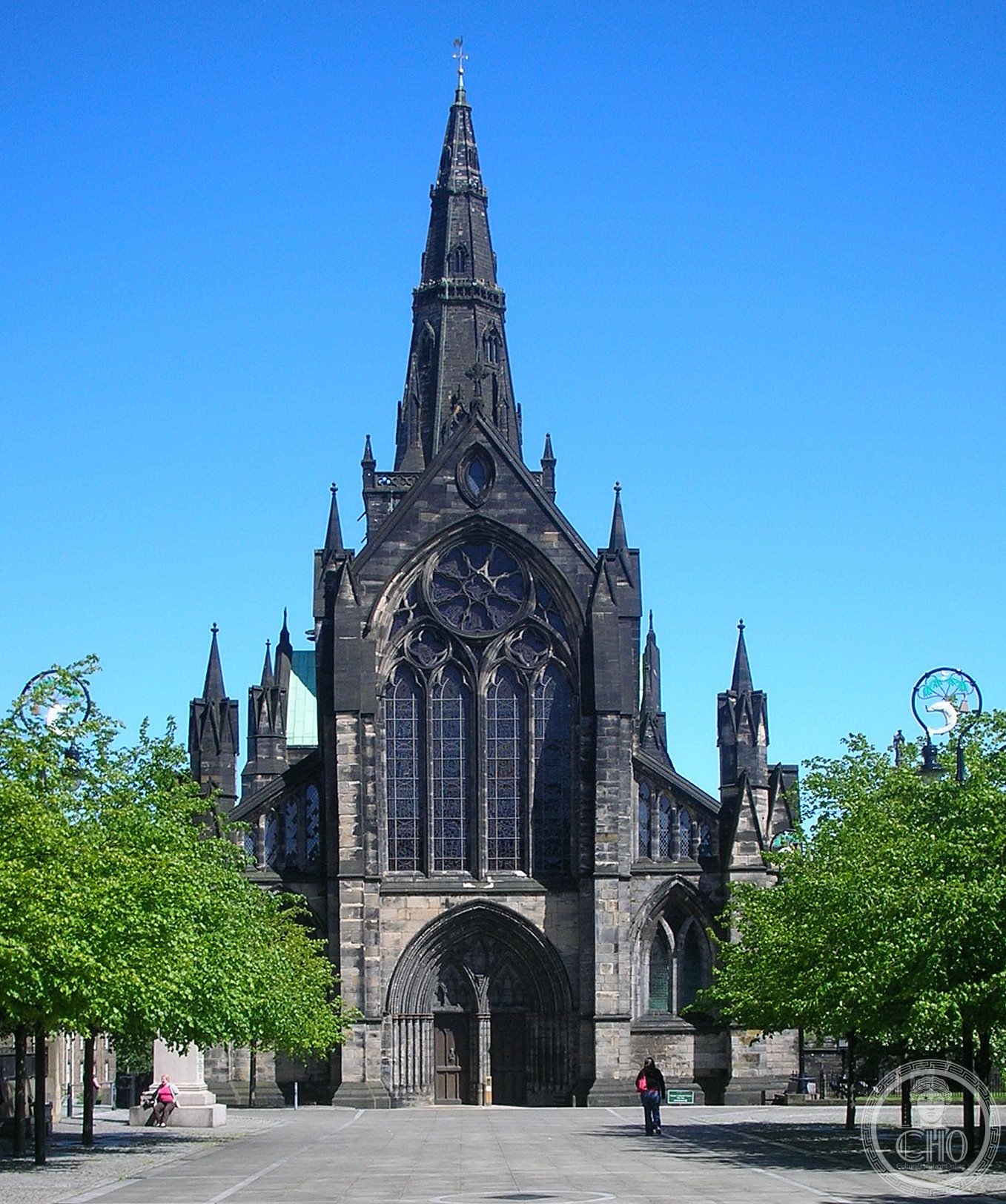
Scotland’s oldest cathedral and Glasgow’s oldest building, dedicated to Saint Mungo and shaped by medieval ambition, Reformation upheaval, and 19th-century restoration.
At a glance
Glasgow Cathedral stands as one of only two surviving medieval cathedrals in Scotland—the other being St Magnus Cathedral in Orkney. Though now a parish church of the Church of Scotland, it served as the seat of the Archbishop of Glasgow from the 12th century until the Scottish Reformation. The cathedral dominates its district, its grounds and the adjacent Necropolis forming a distinct quarter within the city.
History
The first stone cathedral was dedicated in 1136 in the presence of King David I. Fragments of that Romanesque structure survive beneath the present building, which was formally dedicated in 1197 but largely rebuilt during the 13th century. The cathedral served as the mother church of the Archdiocese and province of Glasgow for nearly four centuries.
The Scottish Reformation of the 16th century threatened destruction, yet Glasgow Cathedral escaped the iconoclasm that leveled most Scottish medieval churches. Instead, it was internally partitioned to accommodate three separate Church of Scotland congregations: the Inner High, Outer High, and Barony. This pragmatic solution preserved the building while fragmenting its liturgical purpose.
From 1451, the University of Glasgow—Scotland’s second university—held its earliest classes within the cathedral’s chapter house before relocating. By the early 19th century, antiquarian interest in medieval architecture sparked restoration efforts. The Outer High and Barony congregations departed by 1835, allowing the cathedral to be restored toward its pre-Reformation character. Glasgow Cathedral became Crown property in 1587 and passed fully into state care in 1857, now managed by Historic Environment Scotland.
What you see
The cathedral’s plan and elevation reflect 13th-century Scottish Gothic. Its Lower Church—an unusual vaulted crypt—preserves the medieval shrine of Saint Mungo at its centre, a focus of pilgrimage for centuries. The Upper Church displays characteristic pointed arches and ribbed vaults.
The building’s survival owes much to its practical subdivisions during the post-Reformation period, which ensured continuous maintenance and use. Medieval stonework and tracery survive in the choir, transepts, and nave, offering insight into late medieval Scottish ecclesiastical architecture.
Cultural significance
Glasgow Cathedral embodies Scotland’s complex religious history—a monument to Catholic piety that survived Protestant reform through adaptation rather than destruction. Its dedication to Saint Mungo (Kentigern), the city’s patron, anchors Glasgow’s spiritual identity. The cathedral’s evolution from archbishop’s seat to multi-congregation parish church to heritage monument reflects broader patterns of religious and social change in Scotland. Its integrity as a surviving medieval structure makes it invaluable for understanding Scottish ecclesiastical architecture and the Reformation’s uneven impact across the kingdom.
Key facts
- Location: Glasgow, United Kingdom (55.863°N, 4.2346°W)
- Dedicated to Saint Mungo (Kentigern), patron saint of Glasgow
- First cathedral dedicated 1136; present structure largely from 13th century
- One of only two surviving medieval cathedrals in Scotland
- Passed to state care in 1857; managed by Historic Environment Scotland
- Currently a parish church of the Church of Scotland
Practical information & getting there
Glasgow Cathedral is located in the Cathedral Square area of central Glasgow, near the Necropolis. The building remains an active place of worship and is open to visitors. As a historic monument under state guardianship, it is maintained to the highest conservation standards. Consult Historic Environment Scotland or the Church of Scotland for current visiting hours and services.
Sources & resources
Find it on the map
See this place and what’s around it →📷 Become a Cultural Heritage Online photographer
Share your photos of places: they stay published under your name as the author. The more they're seen, the more you get noticed — and soon a contest will reward the most appreciated photos.
Log in or sign up free to add a photoIs this page about you?
This page is read by travellers and heritage enthusiasts who find it on Google. Tell us how you are connected to this place and we will take it from there.