
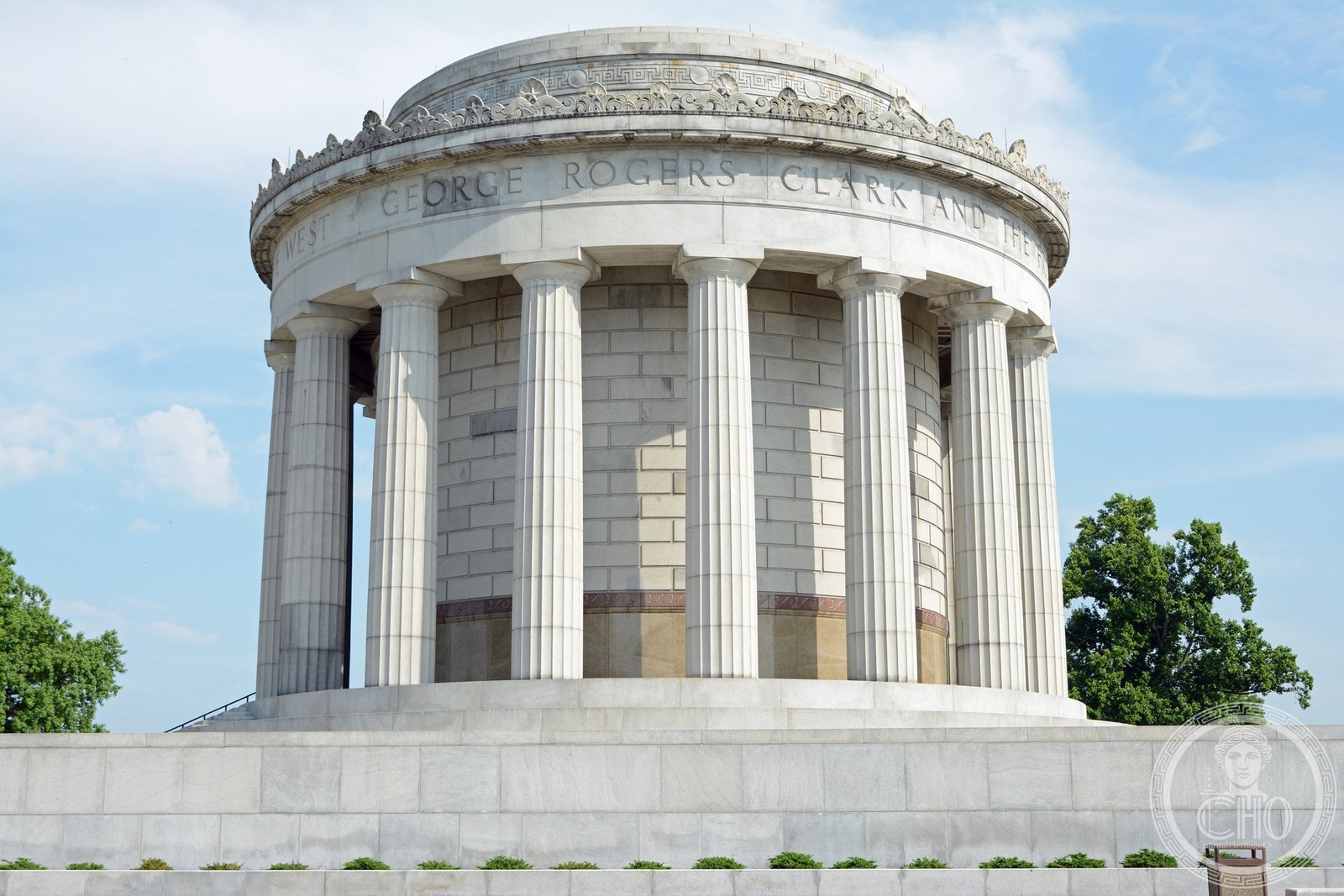
A circular granite rotunda in Art Deco Moderne, raised on the banks of the Wabash River to mark the site where Clark’s outnumbered militia turned the tide of the American Revolution in the Old Northwest.
At a glance
The George Rogers Clark Memorial stands at the site of Fort Sackville in Vincennes, Indiana — the British garrison that Clark and his a small force of Virginia militiamen captured in February 1779 after an improbable winter march through flooded Illinois country. Dedicated on July 4, 1936, the memorial is a columned rotunda of pink Tennessee marble clad in classical Art Deco detail, housing interior murals depicting Clark’s campaigns and a 14-foot bronze statue of Clark himself at the center. It is administered by the National Park Service as the centerpiece of George Rogers Clark National Historical Park.
Key facts
- Dedicated: July 4, 1936
- Architect: Frederick C. Hirons
- Style: Art Deco Moderne with classical references; pink Tennessee marble exterior
- Bronze statue: George Rogers Clark by Hermon A. MacNeil, 14 feet high
- Interior murals: Seven panels depicting Clark’s Illinois Campaign (1778–1779)
- Administered by: National Park Service, George Rogers Clark National Historical Park
- Location: Vincennes, Knox County, Indiana, on the banks of the Wabash River
History
George Rogers Clark’s Illinois Campaign of 1778–1779 was one of the most consequential operations of the American Revolutionary War. Commanding a small force of Virginia militiamen, Clark marched from Kentucky across hundreds of miles of hostile wilderness and flooded river bottomland in the depths of winter to surprise the British garrison at Fort Sackville in Vincennes. He demanded the fort’s surrender, was refused, then demonstrated through tactical deception that his force was larger than it was — the British surrendered on February 25, 1779. Clark’s seizure of the Illinois country — Kaskaskia, Cahokia, Vincennes — helped secure American claims to the Northwest Territory in the Treaty of Paris (1783) and opened the Ohio Valley to American settlement.
Congress authorized a memorial at Vincennes in 1929, and construction began under the design of architect Frederick C. Hirons. The building is a rotunda form — a circle of Ionic columns supporting a shallow dome — but the detail is unmistakably of the Art Deco Moderne period: the ornamental program is abstract and geometric, the surfaces polished and regular, the proportions more horizontal than the classical rotunda formula typically permits. It was dedicated by President Franklin D. Roosevelt on Independence Day, 1936, as part of a broader New Deal investment in commemorating the Revolutionary generation at symbolic sites across the country.
The bronze statue of Clark at the center was sculpted by Hermon A. MacNeil, who depicted Clark at the moment of the fort’s surrender — hand extended, gesturing the terms of the British capitulation. The seven interior mural panels, painted by artists working under the supervision of the National Park Service, document the campaign from departure to victory.
What you see
The memorial is a substantial rotunda of pink Tennessee marble, its exterior colonnade of Ionic columns rising from a stepped podium that gives the building a presence above the Wabash riverbank. The dome is shallow — more a lid than a hemisphere — and the overall impression is of width and solidity rather than soaring height, a proportioning system characteristic of the Art Deco Moderne approach to classical references. The cornice detailing and the relief ornament on the frieze are geometric and stylized, the ornamental language of the 1930s rather than the strict classical vocabulary it echoes.
Inside, the central figure of Clark occupies the domed rotunda, the 14-foot bronze figure dominating the circular space without overwhelming it. The mural panels encircling the interior walls give the room a quality of a sacred history painting — the events depicted in sequence, stylized in the flat graphic manner of New Deal public art, their colors warm against the marble. The floor is a polished stone compass rose centered on Clark’s statue, a deliberate orientating gesture: everything in the room turns around the man and the moment the building commemorates.
Practical information
- Hours: Daily 9 am–5 pm; closed Thanksgiving, Christmas, New Year’s Day (verify with NPS)
- Admission: Free (National Park Service site)
- Visitor center: On-site NPS visitor center with exhibits on the Revolutionary War in the Northwest Territory
- Location: 401 South Second Street, Vincennes, IN 47591
Getting there
Vincennes is in southwestern Indiana, approximately 115 miles southwest of Indianapolis via US Route 41 or US Route 50. The nearest major airport is Indianapolis International (IND); rental car is recommended. The town of Vincennes has limited public transportation — the memorial is walkable from the downtown commercial district, about a 10-minute walk from most hotels. Evansville, Indiana (120 miles southwest) is an alternative base with a regional airport (EVV).
Nearby
- Indiana Military Museum, Vincennes — Museum of Indiana military history with exhibits spanning the Revolutionary War through the twentieth century, approximately one mile from the memorial
- Grouseland (1804), Vincennes — Home of William Henry Harrison (governor of Indiana Territory, later US President), a Federal-style house open for tours adjacent to the Clark memorial complex
- Lincoln Memorial Bridge, Vincennes — Historic bridge crossing the Wabash River from Indiana into Illinois, named for Abraham Lincoln who crossed here in 1830 en route from Kentucky to Illinois
- Angel Mounds State Historic Site, Evansville — Large Mississippian-era Native American mound complex, approximately 115 miles south; one of the best-preserved pre-Columbian sites in the eastern United States
Sources
- National Park Service, George Rogers Clark National Historical Park, nps.gov/gero
- Wikipedia, “George Rogers Clark National Historical Park,” en.wikipedia.org/wiki/George_Rogers_Clark_National_Historical_Park
- Barnhart, John D. and Carmony, Donald F., Indiana: From Frontier to Industrial Commonwealth, Lewis Historical Publishing, 1954
- National Register of Historic Places, George Rogers Clark Memorial documentation
Find it on the map
See this place and what’s around it →Record researched and written by Luigi De Marchi for Cultural Heritage Online, 2026.
📷 Become a Cultural Heritage Online photographer
Share your photos of places: they stay published under your name as the author. The more they're seen, the more you get noticed — and soon a contest will reward the most appreciated photos.
Log in or sign up free to add a photoIs this page about you?
This page is read by travellers and heritage enthusiasts who find it on Google. Tell us how you are connected to this place and we will take it from there.