
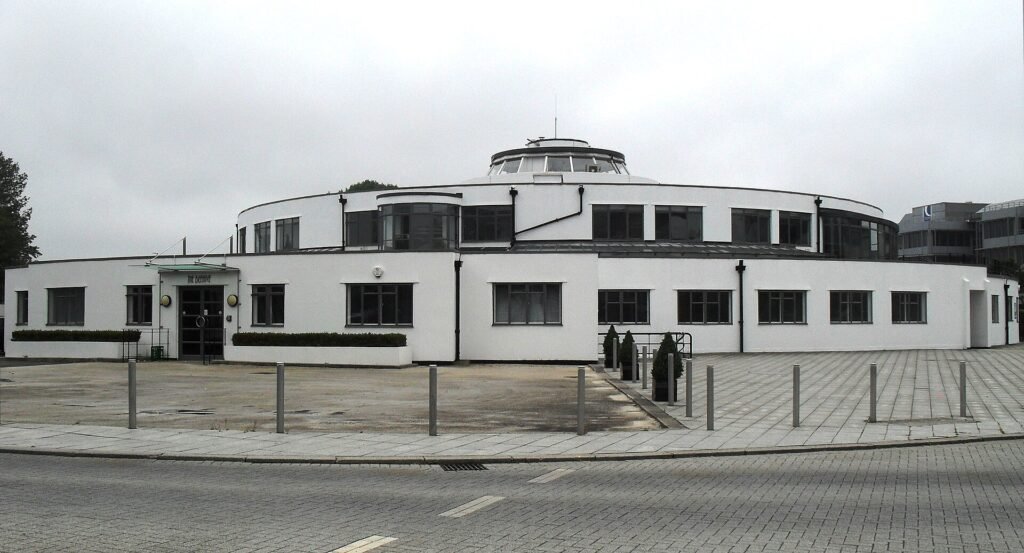
A round terminal with covered jetties to the planes: in 1936, the future of the airport, built in concrete.
At a glance
The Beehive is the original terminal of Gatwick Airport, opened in 1936 and named for its rounded, tiered shape. Designed by Hoar, Marlow and Lovett, it was the world’s first circular airport terminal, with covered piers reaching out to the aircraft so passengers stayed dry. It still stands beside the modern airport, now in office use.
Key facts
- Location: beside Gatwick Airport, near Horley
- Architects: Hoar, Marlow & Lovett
- Opened: 1936
- Style: Streamline Moderne / Art Deco
- Claim: the world’s first circular airport terminal
History
As air travel grew in the 1930s, Gatwick was developed as a new London airport, and needed a terminal to handle passengers smartly. The answer was a drum-shaped building with telescopic covered walkways out to the planes, an idea decades ahead of the jet-age air bridge.
A railway station connected it directly to London. When Gatwick was rebuilt on a larger site after the war, the Beehive was left behind; it survives, listed and restored, as offices.
What you see
The building steps up in rounded white tiers like its namesake hive, all curves and horizontal lines in the Streamline Moderne taste. Stubs of the covered piers that once ran to the aircraft can still be read on the ground. It is a complete little vision of how flying was meant to feel.
Practical information
- Open: an office building; exterior viewable
- Cost: free to view from outside
- Best for: the rounded Streamline Moderne form
- Time needed: 15–20 minutes
Getting there
The Beehive stands just south of the present Gatwick Airport, near Horley in Surrey, a short distance from the airport terminals and railway station.
Nearby
- Gatwick Airport — the modern airport beside it
- Horley — the Surrey town next to the airport
Sources
- Wikipedia — Beehive, Gatwick Airport
- Historic England — listed building record
- Wikimedia Commons — image source and licence
Find it on the map
See this place and what’s around it →Record researched and written by Luigi De Marchi for Cultural Heritage Online, 2026.
📷 Become a Cultural Heritage Online photographer
Share your photos of places: they stay published under your name as the author. The more they're seen, the more you get noticed — and soon a contest will reward the most appreciated photos.
Log in or sign up free to add a photoIs this page about you?
This page is read by travellers and heritage enthusiasts who find it on Google. Tell us how you are connected to this place and we will take it from there.