
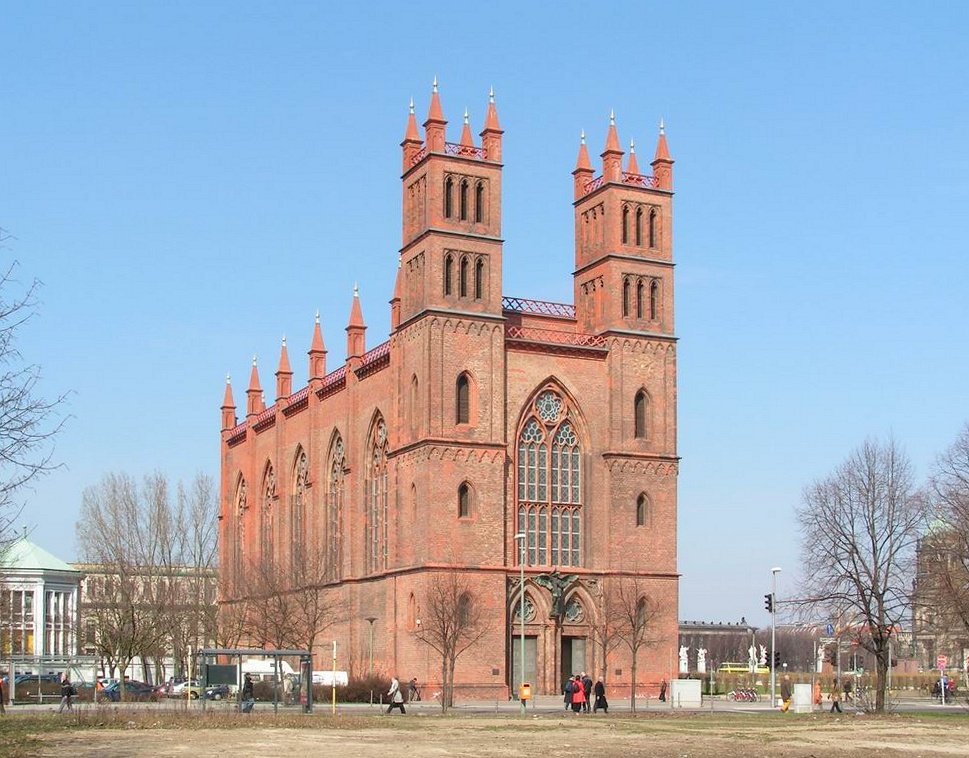
Karl Friedrich Schinkel’s audacious turn toward Neo-Gothic, this Berlin church introduced a new architectural language to Prussia’s capital and now houses treasures of nineteenth-century German sculpture.
At a glance
Berlin’s first Neo-Gothic church stands as a pivotal moment in German architectural history. Designed and built by Schinkel between 1824 and 1831, it reveals a master Neoclassicist embracing pointed arches and verticality—a departure that would influence Berlin’s skyline for generations.
History
Schinkel directed construction from 1824 to 1831, completing what became Berlin’s pioneering Neo-Gothic structure. The building remained in use until late 2012, when nearby construction caused structural damage severe enough to require closure. A comprehensive restoration campaign restored the church by October 2019, reopening it to house collections from the Prussian Cultural Heritage Foundation and Berlin State Museums.
What you see
The church embodies Schinkel’s distinctive interpretation of Gothic Revival—not an imitation of medieval forms, but a rational, controlled application of pointed arches and verticality characteristic of his Neoclassical discipline. The interior arranges sculpture galleries across two levels, with the upper floor dedicated to Schinkel’s own architectural work and legacy.
Cultural significance
Friedrichswerder Church marks a watershed in Prussian taste. Schinkel’s authority as Berlin’s leading architect gave Neo-Gothic legitimacy at a moment when Neoclassicism still dominated. The building now anchors the Prussian Cultural Heritage Foundation’s ensemble and presents nineteenth-century German sculpture in dialogue with Schinkel’s own architectural ideals.
Key facts
- Country: Germany
- City: Berlin, Bezirk Mitte
- Coordinates: 52.5159, 13.3975
- Architect: Karl Friedrich Schinkel
- Built: 1824–1831
- Maintained by the Prussian Cultural Heritage Foundation
Practical information & getting there
The church is part of the Berlin State Museums’ ensemble in Mitte. Check current hours and exhibition details before visiting, as displays may rotate. Visitors can explore sculptures by Schadow, Schinkel, and Rauch on the main floor, and Schinkel’s architectural retrospective upstairs.
Sources & resources
Find it on the map
See this place and what’s around it →📷 Become a Cultural Heritage Online photographer
Share your photos of places: they stay published under your name as the author. The more they're seen, the more you get noticed — and soon a contest will reward the most appreciated photos.
Log in or sign up free to add a photoIs this page about you?
This page is read by travellers and heritage enthusiasts who find it on Google. Tell us how you are connected to this place and we will take it from there.