
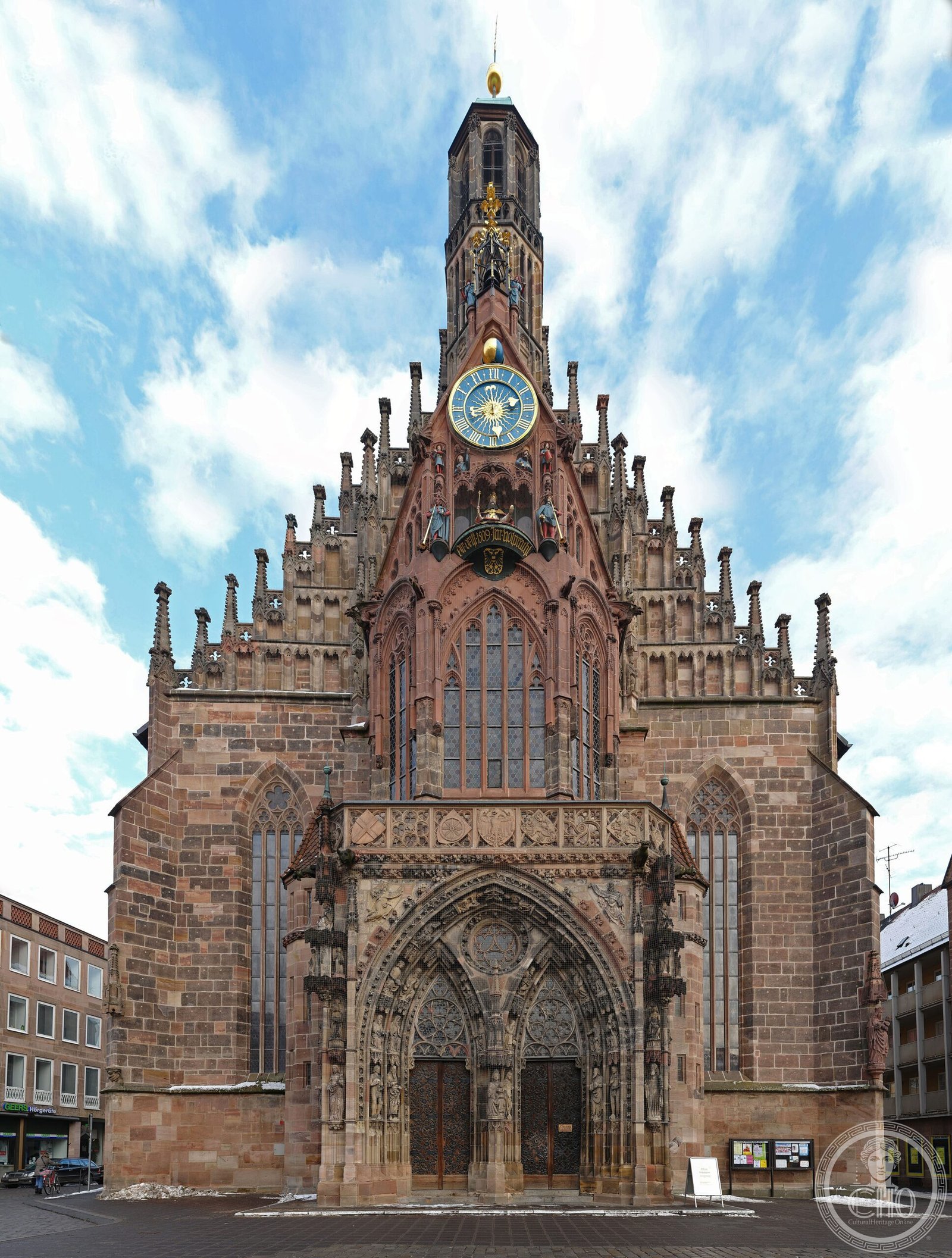
A brick Gothic masterpiece overlooking Nuremberg’s main market, this luminous church was commissioned by Holy Roman Emperor Charles IV and stands as one of Germany’s finest medieval urban monuments.
At a glance
The Frauenkirche (Church of Our Lady) occupies the eastern side of Nuremberg’s central marketplace. Built in brick Gothic style between 1352 and 1362, it exemplifies the architectural ambitions of the Holy Roman Empire at its height. The church remains in active Catholic use and houses major works of medieval art.
History
Construction began in 1352 under the patronage of Charles IV, the Holy Roman Emperor who elevated Prague and reformed imperial governance. The church was completed in 1362, emerging as a civic and spiritual landmark for Nuremberg’s merchant class. It became a Catholic parish church in 1810, a status it maintains today.
What you see
The Frauenkirche exemplifies brick Gothic, a distinct regional style that dominates Northern and Central European urban architecture. Its exterior showcases characteristic red-brick masonry with refined proportions characteristic of 14th-century German cathedral building. The interior contains multiple sculptures, some substantially restored over centuries of use and occasional damage.
Cultural significance
The church represents the intersection of imperial power, civic pride, and commercial prosperity in medieval Nuremberg. Its artworks—the Tucher Altar and Adam Kraft sculptures—document the evolution of German devotional and sculptural practice from the 15th century onward. The Tucher Altar, created around 1440, originally served the Augustinian church of St. Vitus before its relocation here, illustrating the fluid movement of sacred art across the city’s religious institutions.
Key facts
- Country: Germany
- City: Nuremberg
- Coordinates: 49.454°N, 11.078°E
- Built: 1352–1362
- Architectural style: Brick Gothic
- Patron: Charles IV, Holy Roman Emperor
Practical information & getting there
The Frauenkirche stands on Nuremberg’s historic Marktplatz (market square), easily reached on foot from the city’s central train station. The church remains active in Catholic worship. Specific visiting hours and Mass times are available through the parish office. As an active church, visitors should respect services and devotional practices.
Sources & resources
Find it on the map
See this place and what’s around it →📷 Become a Cultural Heritage Online photographer
Share your photos of places: they stay published under your name as the author. The more they're seen, the more you get noticed — and soon a contest will reward the most appreciated photos.
Log in or sign up free to add a photoIs this page about you?
This page is read by travellers and heritage enthusiasts who find it on Google. Tell us how you are connected to this place and we will take it from there.