
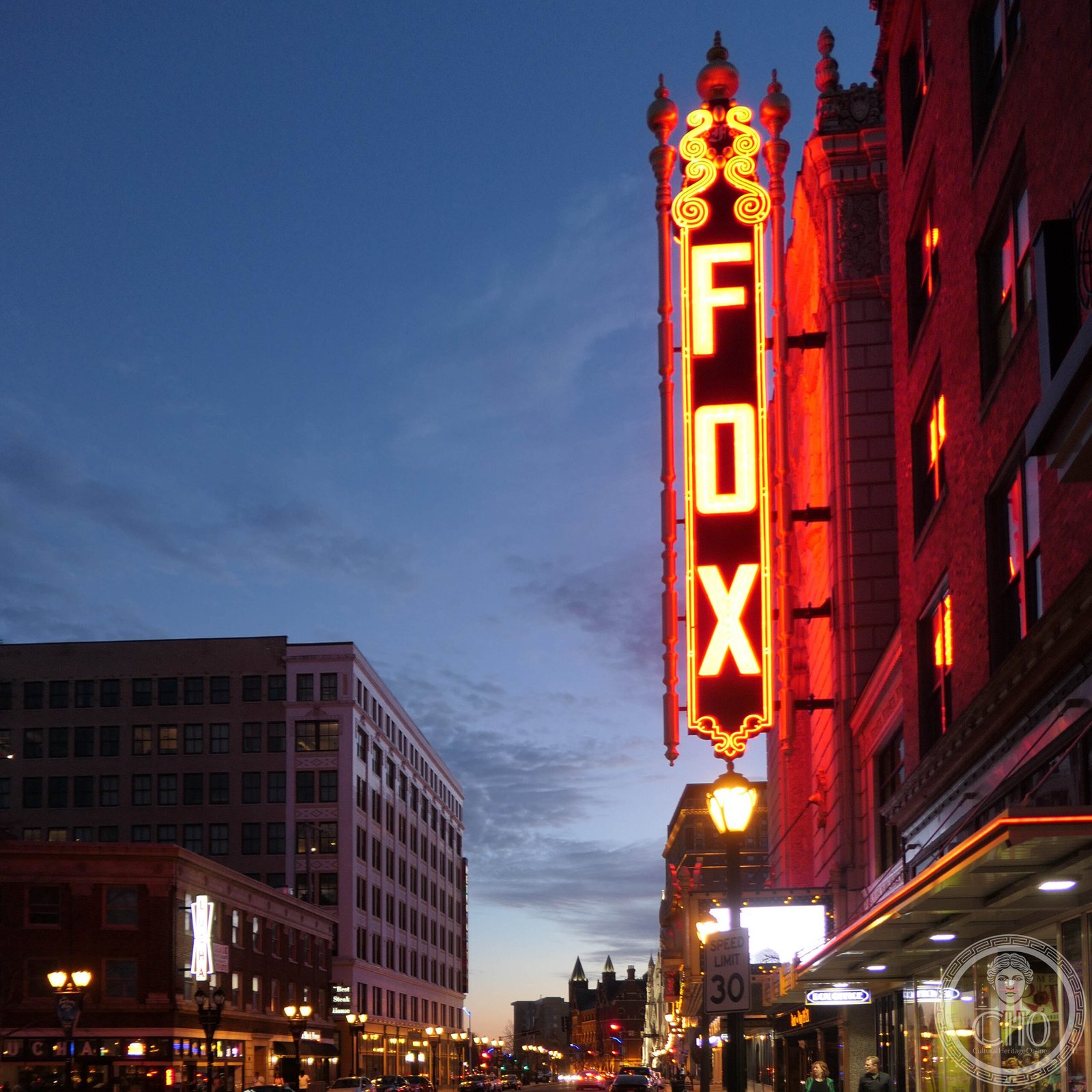
When the Fox opened on Grand Boulevard in September 1929, audiences entered a world assembled from Siamese, Byzantine, and Indian architectural precedents — elephant heads flanking the stage, a star-filled ceiling canopy overhead, and carved plasterwork that made Hollywood’s own sets look austere by comparison.
At a glance
The Fox Theatre at 527 North Grand Boulevard opened on September 21, 1929, at a cost of six million dollars, one of the most expensive purpose-built cinemas in the United States at the time. Designed by Detroit architect C. Howard Crane for William Fox’s Fox Film Corporation, the theatre seats approximately 4,500 people in its original configuration — one of the largest single-auditorium performance spaces in the American Midwest. The “Siamese Byzantine” interior draws on Thai temple architecture, Byzantine mosaics, and Indian sculptural traditions, weaving them into a coherent, if historically improbable, fantasy that was the deliberate aim of the great movie palace era. Designated a National Historic Landmark, the Fox today operates as a touring Broadway venue under the name “The Fabulous Fox.”
- Opened: September 21, 1929
- Architect: C. Howard Crane, Detroit
- Style: “Siamese Byzantine” — eclectic Asian and Byzantine motifs
- Original cost: $6 million (1929)
- Seating: Approximately 4,500 (originally); approximately 4,000 after restoration
- National Historic Landmark
Key facts
- Builder: William Fox, Fox Film Corporation
- Opening: Film premiere accompanied by a live vaudeville stage show
- Stage dimensions: Among the largest in St. Louis; used for full Broadway touring productions
- Organ: Wurlitzer theatre organ, still playable
- Restoration: 1981–1982 by Fox Associates (Leon and Mary Strauss); further restorations 1990s
- Operator: The Fabulous Fox Theatre, Inc., St. Louis
History
William Fox built his movie empire on the premise that the cinema experience should be as opulent as any opera house — that the working-class audiences who were his primary market deserved grandeur as much as the upper classes who attended Carnegie Hall. The St. Louis Fox was part of the late-1920s expansion of the Fox Film Corporation into flagship theatres in major American cities; the Los Angeles Fox, the San Francisco Fox, and the Detroit Fox were built at roughly the same time. Architect C. Howard Crane, who had already designed the Fox Theatre in Detroit and the Palace Theatre in Detroit among hundreds of other projects, produced the St. Louis design.
The timing proved catastrophic. The Fox opened ten weeks before the Wall Street Crash of October 1929. William Fox, already overextended by his purchase of Loew’s theatres and MGM stock, was financially ruined by 1932. The Fox Film Corporation entered receivership, and the St. Louis theatre passed through various owners during the Depression. It continued operating as a cinema, but by the 1970s the combination of suburban migration, urban decline, and multiplexes had severely reduced attendance. The theatre closed briefly and faced demolition.
In 1981, Leon Strauss and Mary Strauss purchased the building through their Fox Associates partnership and undertook a restoration that opened in 1982. The project brought the theatre back to something close to its original condition and repositioned it as a venue for Broadway touring productions and concerts. The restoration is credited with catalysing the broader revival of the Grand Center arts district on Grand Boulevard.
What you see
C. Howard Crane’s “Siamese Byzantine” vocabulary is immediately apparent in the lobby, where carved elephant heads project from the pilasters flanking the entrance to the auditorium. The ceiling of the main auditorium reproduces the effect of a fabric canopy stretched across a Thai or Cambodian palace hall — draped, fringed, and stitched with jewel-like detail — while the walls rise through tiers of carved stone and plaster ornament: Byzantine arcades, Indian lotus capitals, and peacock motifs drawn from Siamese decorative arts. The effect, under the original colour scheme restored in the 1982 renovation, is not of competing styles but of a single sustained fantasy that the audience is invited to inhabit for the duration of the performance.
The exterior on Grand Boulevard is in contrast relatively restrained: a terracotta façade of warm orange-brown set with decorative panels, its main gesture the vertical illuminated marquee that reads “FOX” in letters visible from several blocks. The contrast between the plain street presence and the extravagant interior was a deliberate feature of the movie palace design tradition — the drama is reserved for the moment of entry.
Practical information
- Access: Performances only; check the Fabulous Fox Theatre schedule at fabulousfox.com
- Backstage tours: Offered on select Saturday mornings; booking required
- Box office: On-site at 527 North Grand Boulevard; ticketing also via MetroTix
- Dress: No dress code; smart casual common for Broadway shows
- Parking: Paid lots adjacent to the theatre; Fox Associates operates several nearby garages
Getting there
The Fox Theatre is in the Grand Center arts district of St. Louis, approximately 1.5 miles north-northwest of downtown. By MetroLink light rail: the Grand station on the Red and Blue Lines is three blocks west of the theatre. By car from downtown, take Market Street west to Grand Boulevard and turn north; the theatre is at the corner of Grand and Washington Avenue. Lambert–St. Louis International Airport is 12 miles northwest, approximately 20 minutes by car or by MetroLink Red Line to the Grand station.
Nearby
- Powell Symphony Hall (1925) — Home of the St. Louis Symphony Orchestra, two blocks south on Grand Boulevard; another landmark of the Grand Center arts district.
- Pulitzer Arts Foundation — Contemporary art museum in a building by Tadao Ando, three blocks east; a striking contrast to the Fox’s historicist interior.
- Gateway Arch National Park — Eero Saarinen’s 1965 stainless steel arch on the Mississippi riverfront, 1.5 miles southeast; a counterpoint to the Deco-era historicism of Grand Boulevard.
Sources
- National Historic Landmark designation, Fox Theatre, St. Louis
- National Register of Historic Places Nomination, Fox Theatre, St. Louis
- The Fabulous Fox Theatre, Inc. — official history and restoration records
- Nasaw, David. Going Out: The Rise and Fall of Public Amusements. Harvard University Press, 1993
- Naylor, David. American Picture Palaces: The Architecture of Fantasy. Van Nostrand Reinhold, 1981
Find it on the map
See this place and what’s around it →📷 Become a Cultural Heritage Online photographer
Share your photos of places: they stay published under your name as the author. The more they're seen, the more you get noticed — and soon a contest will reward the most appreciated photos.
Log in or sign up free to add a photoIs this page about you?
This page is read by travellers and heritage enthusiasts who find it on Google. Tell us how you are connected to this place and we will take it from there.