
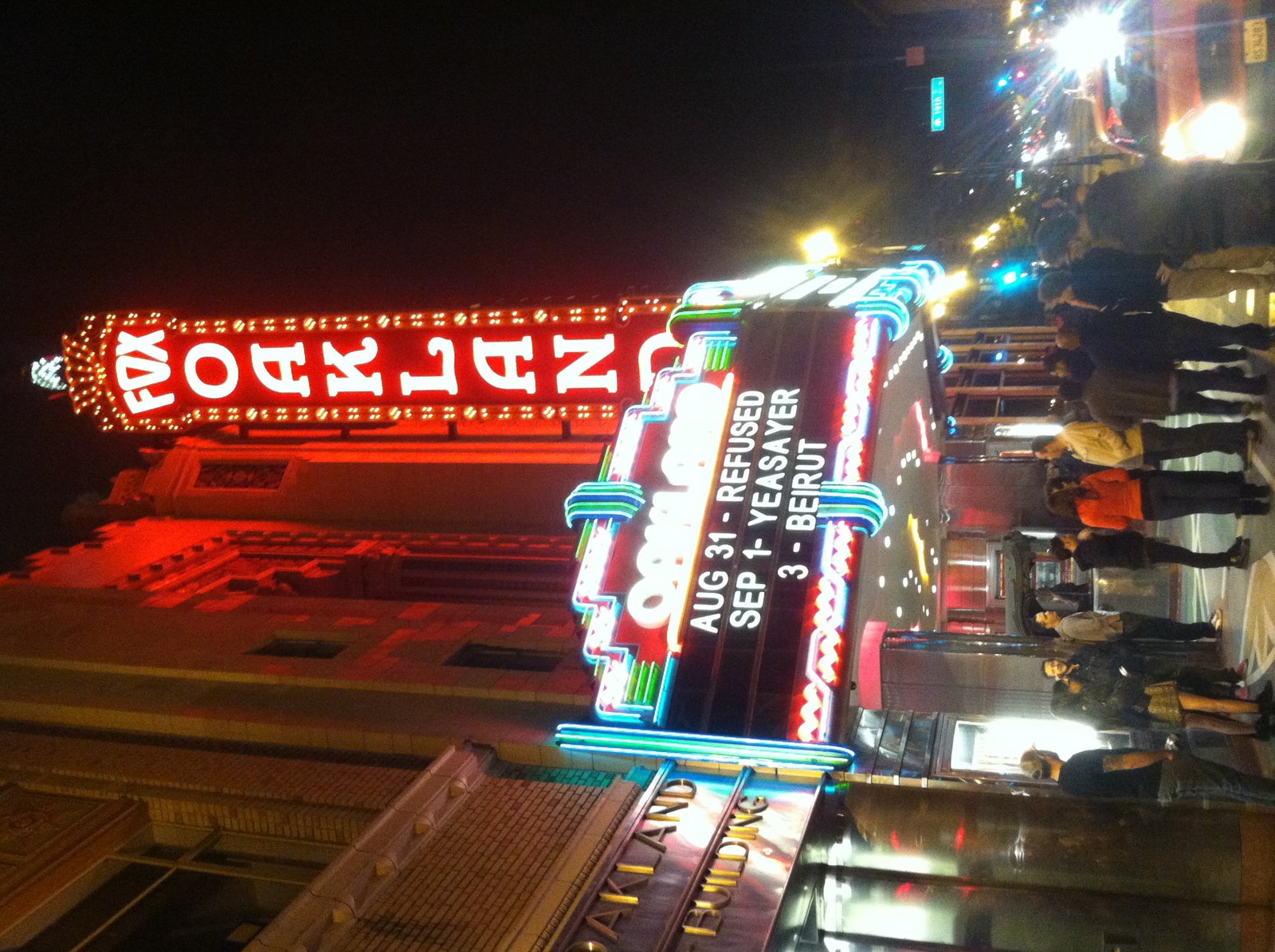
Opened on October 27, 1928 as the largest theater in Oakland, the Fox Oakland Theatre on Telegraph Avenue was designed by Weeks and Day in an Art Deco idiom with Moorish ornamental accents — closed in 1973, saved from demolition by community advocacy, and restored to life as a 2,800-seat concert venue after a $75 million renovation that reopened it in 2009.
At a glance
The Fox Oakland Theatre stands at 1807 Telegraph Avenue in downtown Oakland, California, one block from the 19th Street BART station. Designed by the San Francisco firm Weeks and Day and opened on October 27, 1928, it was the largest theater in Oakland at its opening — 3,200 seats in orchestra and balcony, a Wurlitzer pipe organ, and a live stage that brought vaudeville-style programming alongside the new sound films. Listed on the National Register of Historic Places in 1979 and designated an Oakland City Landmark in 1978, it was extensively restored and reopened as a concert venue in 2009 after a nearly four-decade closure, with a capacity of 2,800 seats.
Key facts
- Opened: October 27, 1928
- Style: Art Deco (with Moorish ornamental elements)
- Architect: Weeks and Day
- Builder: Maury L. Diggs
- Original name: The Oakland (renamed Fox Oakland, March 1929)
- Original capacity: 3,200 seats; current capacity: 2,800
- Pipe organ: Wurlitzer Opus 1960, 3 manuals, 15 ranks
- NRHP listed: February 2, 1979 (#79000468)
- Oakland Landmark: #23, 1978
- Reopened as concert venue: February 5, 2009
- Address: 1807 Telegraph Avenue, Oakland, California
- GPS: 37.80790, −122.27013
History
When the Fox Oakland opened in October 1928, it was designed to be the dominant movie palace on the East Bay. The firm of Weeks and Day — whose principal Walter W. Weeks had previously designed the Fox Theatre in San Francisco — gave the building a theatrical Art Deco treatment with a strong Moorish accent: the theater was originally intended to carry the name “The Bagdad” in recognition of its eastern-derived ornament. Instead it opened as “The Oakland,” the marquee name forming part of the vertical blade sign that still anchors the facade today. Five months after opening, in March 1929, William Fox bought the West Coast Theatres chain and folded the Oakland into his national Fox Theatres circuit, giving it the name it has carried since.
The Fox Oakland’s first screening was Fox’s The Air Circus, one of the early sound films, with live stage acts between reels and newsreels; the Hermie King band provided house music and an organist played the Wurlitzer Opus 1960. At 3,200 seats it was larger than the Orpheum in San Francisco (2,561). Attendance dropped through the 1960s as television and suburban multiplexes drew audiences away; the Fox closed on September 14, 1965, with a Marlon Brando film its final showing. Sporadic reopenings failed to find a viable audience, and in 1973 arson attacks badly damaged the building. By 1975, city officials were openly discussing demolition for a parking lot. Instead, the building was sold at auction in 1978, then designated a landmark and listed on the NRHP in 1978–1979.
The Oakland Redevelopment Agency bought the property in 1996 for $3 million; the Friends of The Oakland Fox organized in 1999 and led the restoration effort. A $75 million rehabilitation, completed in 2009, restored the stage house, installed new mechanical and electrical systems, and returned the theater to its original capacity of 2,800 seats. The Fox Oakland Theatre reopened as a concert venue on February 5, 2009 and is now operated by Another Planet Entertainment.
What you see
The Fox Oakland’s most iconic exterior element is the vertical blade sign — a tower of neon letters spelling “FOX” that rises above the marquee and is visible from blocks up Telegraph Avenue. The sign is a late-1920s movie palace standard taken to its logical maximum: a beacon for the building from every approach on the avenue. Below it, the facade is organized symmetrically around the marquee, with Art Deco panels, geometric moldings, and the Moorish ornamental accents that made the original “Bagdad” name plausible — pointed arch references in the decorative field, interlace patterns worked into the carved stone surrounds.
The interior, restored in 2009, preserves the scale and atmosphere of the original 1928 house: a broad orchestra floor raked below the balcony, side loges with their own ornamental treatment, and a proscenium arch that frames the stage with the layered complexity of late-1920s movie palace decoration. The Wurlitzer pipe organ — original to 1928 — was also restored and remains in place. As a concert venue the Fox Oakland is now one of the premier mid-size music rooms on the West Coast, a fact that brings the building’s acoustic virtues into contact with a new generation of audiences.
Practical information
- Active concert venue operated by Another Planet Entertainment; ticketing at thefoxoakland.com.
- The building exterior is best seen from Telegraph Avenue, where the neon blade sign is the main viewpoint. It is illuminated on event nights.
- BART access: 19th Street Oakland station is one block east on 20th Street.
- Shows span a wide range of genres; the space seats 2,800 in a general-admission or reserved format depending on the event.
Getting there
The Fox Oakland Theatre is at 1807 Telegraph Avenue in Oakland’s Uptown district, approximately 13 miles east of San Francisco via the Bay Bridge. Oakland International Airport (OAK) is approximately 9 miles south; San Francisco International Airport (SFO) is approximately 20 miles south. By BART: the 19th Street Oakland station is one block east on 20th Street, served by multiple lines from San Francisco and the East Bay. By car, I-580 and I-980 provide the main approaches to downtown Oakland, with Telegraph Avenue accessible from the Harrison Street exit.
Nearby
- Paramount Theatre Oakland (1931) — a National Historic Landmark Art Deco movie palace at 2025 Broadway, three blocks northeast, now the home of the Oakland Symphony and Oakland Ballet
- Oakland Museum of California — the city’s primary art, natural science, and history museum, approximately 8 blocks south on Oak Street
- Lake Merritt — a 155-acre tidal lagoon in the center of Oakland, the largest natural saltwater lake in an American city, a 15-minute walk southeast from the Fox
Sources
- Wikipedia: “Fox Oakland Theatre”
- National Register of Historic Places, listing #79000468, February 2, 1979
- Tillmany, Jack. Theatres of Oakland. Arcadia, 2006
- Wikimedia Commons: Oakland_Fox_Theatre,_2012-08-31.jpg, CC BY-SA 3.0, Mamaril
Find it on the map
See this place and what’s around it →Record researched and written by Luigi De Marchi for Cultural Heritage Online, 2026.
📷 Become a Cultural Heritage Online photographer
Share your photos of places: they stay published under your name as the author. The more they're seen, the more you get noticed — and soon a contest will reward the most appreciated photos.
Log in or sign up free to add a photoIs this page about you?
This page is read by travellers and heritage enthusiasts who find it on Google. Tell us how you are connected to this place and we will take it from there.