
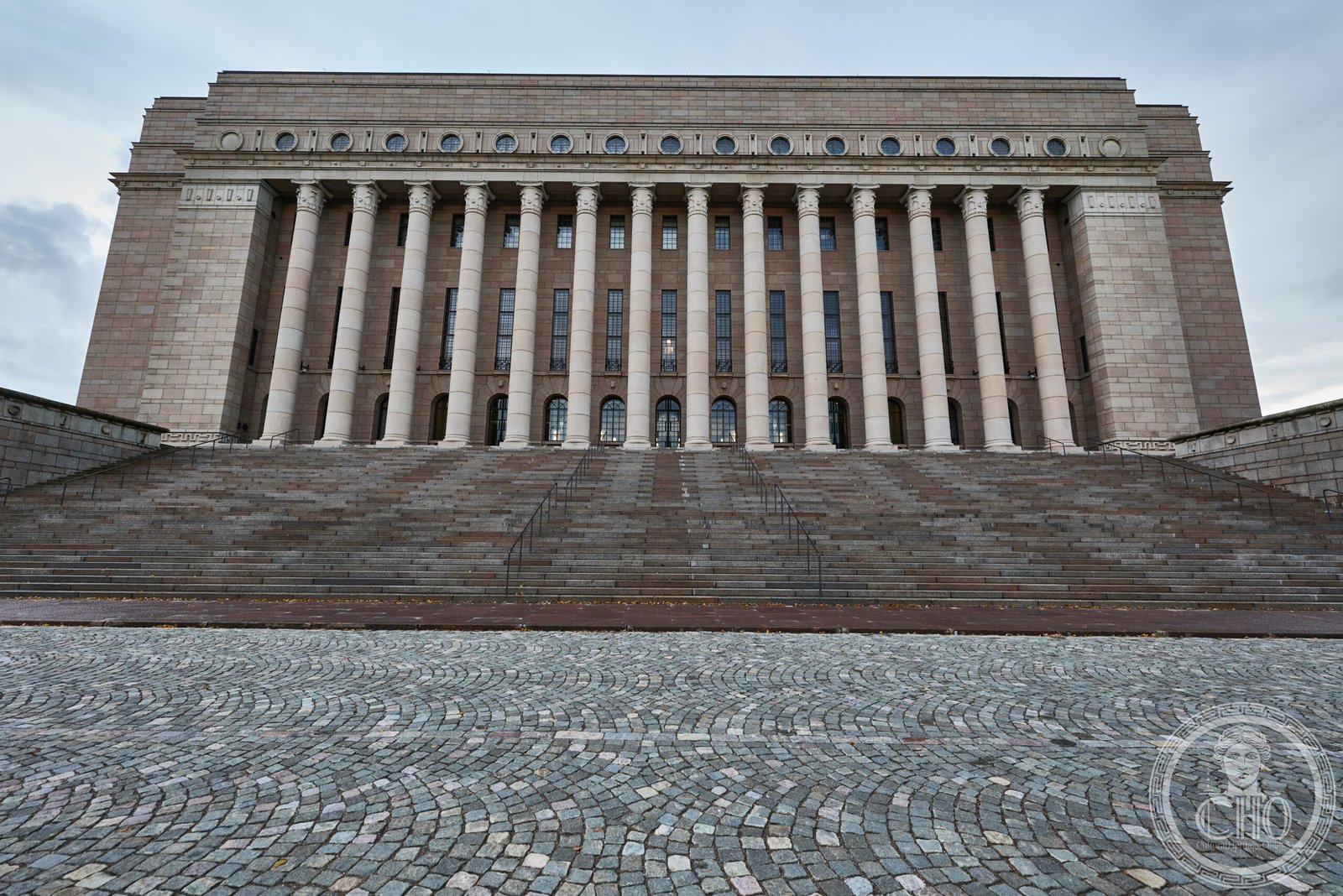
The Finnish Parliament Building on Mannerheimintie is one of the defining works of Nordic Classicism — a movement that sought to combine the formal grammar of antiquity with the materials, light, and temperament of Scandinavia. Designed by Johan Sigfrid Siren, who won the competition in 1924, the building was inaugurated in 1931 and immediately recognised as a masterpiece of its genre. Fourteen monolithic columns of Finnish red granite rise across the main facade in a colonnade of severe, almost Doric authority, stripped of the ornament that would accompany similar columns in Rome or Paris. The granite was quarried in Finland specifically for this project, making the building both literally and symbolically rooted in its landscape. Inside, a refined Art Deco staircase, hand-carved wooden panelling, and a hemicycle chamber for 200 Members of Parliament embody a parliament designed for a nation that had been independent only since 1917. The building was a deliberate assertion that Finland was ancient, permanent, and sovereign — not a province of somewhere else, but a country with a civilisation of its own.
At a glance
- Type
- National parliament
- Period
- Inaugurated 1931
- Style
- Nordic Classicism
- Location
- Helsinki, Finland
- Coordinates
- 60.1699 N, 24.9330 E
- Architect(s)
- Johan Sigfrid Siren
Overview
The Eduskuntatalo — parliament house — stands on a slight rise at the top of Mannerheimintie, Helsinki's main ceremonial boulevard, facing south toward the city centre. Its position is deliberate: the building is visible from the harbour and from the Central Railway Station esplanade, making it a constant visual presence in the daily life of the capital. The plan is a deep rectangular block behind the colonnade, with two symmetrical wings extending to the rear. The colonnade extends the full width of the main facade, fourteen columns in all, each monolithic and slightly tapered in the Greek manner. The entrance is set back behind the colonnade rather than centred under a pediment, creating a shadowed portico that belongs to the Nordic tradition of indirect, sheltered thresholds.
History
Finland declared independence from Russia on 6 December 1917. The new state needed a parliament building — the old Senate House in Senate Square was associated with imperial administration and was too small. A design competition was announced in 1923; Siren's proposal was selected in 1924. Construction began in 1926 and the building was completed in 1930, inaugurated on 1 March 1931. The timing matters: the building was designed, constructed, and opened entirely within Finland's first fourteen years of independence, during a period of intense national institution-building. During the Winter War of 1939 to 1940 and the Continuation War of 1941 to 1944, the parliament continued to function in the building. The exterior was damaged by Soviet bombing in 1939 and 1944; the granite proved resilient. A major renovation was completed in 2017.
Architecture and Design
Siren's design achieves its authority through reduction rather than addition. The colonnade is the building's entire rhetorical gesture: nothing above the entablature competes for attention. The attic story is plain ashlar; the skyline is flat. Finnish red and grey granite is used throughout the exterior, creating a tonal range from warm to cool that shifts through the day with the northern light. The entrance hall is the first surprise: a luminous double-height space with a monumental staircase rising to the upper galleries, its balusters and railings in wrought iron with a restrained Art Deco geometry. The chamber is a semicircular hemicycle in pale Finnish birch, designed so that every member of parliament can see and be seen from the speaker's chair. The acoustics were calculated for unamplified speech.
Cultural significance
The Finnish Parliament Building is recognised internationally as one of the finest examples of Nordic Classicism, a movement that emerged across Denmark, Sweden, Norway, and Finland in the 1920s as an alternative to both historicist eclecticism and the emerging International Style. Nordic Classicism drew on the clarity and proportion of antiquity while refusing its decorative program; it was warm where the International Style was cold, material where it was abstract. Siren's building is considered the most fully realised example of the genre in Finland and one of the best in Scandinavia. The choice of Finnish granite — rather than imported marble — was a political and cultural statement that has been recognised and quoted by Finnish architects ever since. The building has been designated a nationally significant cultural environment by the Finnish Heritage Agency.
Visiting today
The Parliament Building offers free guided tours when parliament is not in session, typically from late June to late August and during Christmas recess. Tours in Finnish, Swedish, and English depart from the main entrance and last approximately one hour, covering the chamber, the entrance hall, and selected committee rooms. Pre-booking is recommended and available on the parliament's website. The colonnade and exterior are freely accessible at all times. The building is particularly striking at dawn and dusk when the granite columns change colour in the raking light. Photography is permitted on the exterior; interior photography on guided tours follows tour rules. The nearby Kiasma Museum of Contemporary Art and the Helsinki Music Centre make the immediate area one of the richest concentrations of public architecture in the Nordic countries.
Getting there
The Parliament Building is at Mannerheimintie 30, a ten-minute walk from Helsinki Central Railway Station along Mannerheimintie. Trams 2, 4, 7, and 10 stop at the Eduskuntatalo stop directly in front of the building. From Helsinki-Vantaa Airport the journey by train (Ring Rail Line I) to Central Station takes approximately 30 minutes, followed by the short walk or tram. The Airport Bus also serves the city centre. Parking in the immediate vicinity is limited; the nearby Kamppi Centre has a multi-storey car park. Cycling from Central Station via Mannerheimintie takes under five minutes on the well-maintained city bike network.
Sources and resources
Find it on the map
See this place and what’s around it →Record researched and written by Luigi De Marchi for Cultural Heritage Online, 2026.
📷 Become a Cultural Heritage Online photographer
Share your photos of places: they stay published under your name as the author. The more they're seen, the more you get noticed — and soon a contest will reward the most appreciated photos.
Log in or sign up free to add a photoIs this page about you?
This page is read by travellers and heritage enthusiasts who find it on Google. Tell us how you are connected to this place and we will take it from there.