
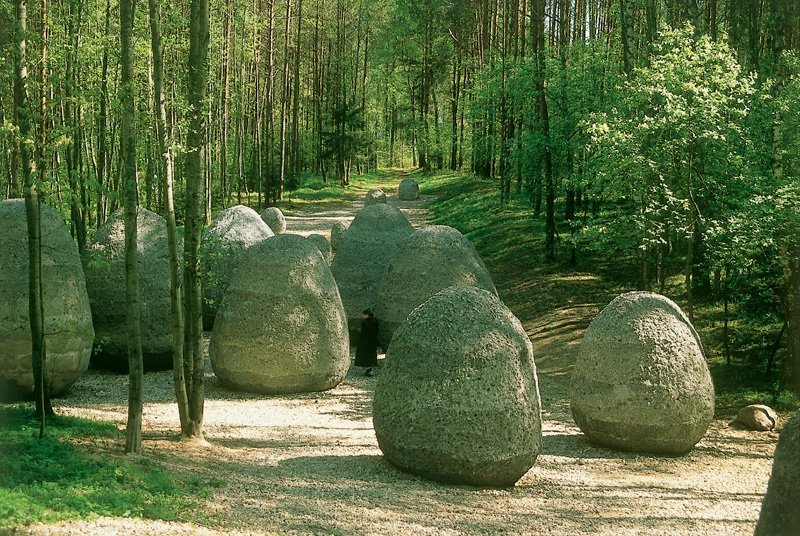
An open-air museum celebrating Europe’s geographic heart through contemporary art and landscape installation.
At a glance
Europos Parkas—meaning “Park of Europe”—is a 50-hectare open-air museum situated 17 km north of Vilnius. The site marks the geographic centre of the European continent, as officially determined by the French National Geographic Institute in 1989. The museum merges geographic significance with artistic vision, presenting works by Lithuanian and international contemporary artists within a landscape setting.
History
The park’s founding capitalized on a precise cartographic discovery. When the French National Geographic Institute identified the continent’s geographic centre in 1989, Lithuania recognized an opportunity to invest this mathematical landmark with cultural meaning. Europos Parkas was established to transform coordinates into an active artistic space, bridging science and contemporary creativity.
What you see
The museum’s fifty hectares are devoted to open-air installations and sculptures. Works span Lithuanian and international modern art practices, arranged across the landscape rather than within traditional buildings. The scale of the grounds allows visitors to experience art within a natural environment, where the park’s geography itself becomes part of the exhibition.
Cultural significance
Europos Parkas represents a contemporary approach to place-making: taking an abstract geographic fact and investing it with artistic and national meaning. The museum celebrates both European identity and Lithuania’s artistic contributions to the contemporary art world, drawing attention to the country’s creative practitioners and international collaborators.
Key facts
- Country: Lithuania
- Location: 17 km from Vilnius
- Size: 50 hectares
- Coordinates: 54.83083333, 25.35138889
- Historic designation: Geographic centre of Europe (French National Geographic Institute, 1989)
Practical information & getting there
Europos Parkas is accessible from Vilnius by car, located approximately 17 km north of the city centre. As an open-air museum, visiting hours and admission details should be confirmed directly with the venue. The landscape setting makes it suitable year-round, though weather conditions will affect the experience.
Sources & resources
Find it on the map
See this place and what’s around it →📷 Become a Cultural Heritage Online photographer
Share your photos of places: they stay published under your name as the author. The more they're seen, the more you get noticed — and soon a contest will reward the most appreciated photos.
Log in or sign up free to add a photoIs this page about you?
This page is read by travellers and heritage enthusiasts who find it on Google. Tell us how you are connected to this place and we will take it from there.