
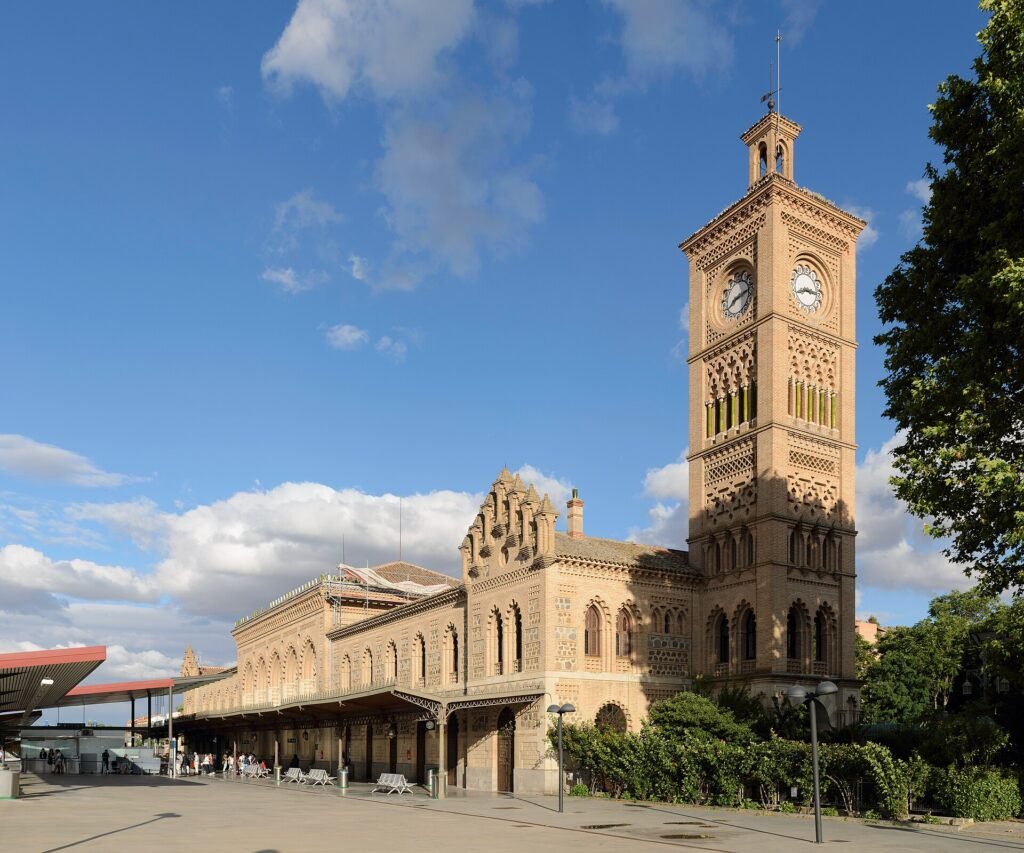
A railway station built to echo the city it serves: brick, tile and horseshoe arches, in the Mudéjar manner.
At a glance
The station of Toledo, finished in 1919, was designed by Narciso Clavería to match the Moorish and medieval character of the old city above it. It is a neo-Mudéjar building of brick and coloured tile, with horseshoe arches, fine ironwork and a tall tiled clock tower. Travellers arriving for the cathedral and the synagogues meet the style at the platform.
Key facts
- Location: Paseo de la Rosa, Toledo
- Architect: Narciso Clavería
- Built: 1919
- Style: neo-Mudéjar (Moorish revival)
- Function: railway station
History
Toledo’s old station had grown too small, and the railway wanted a building worthy of a city that is itself a museum of Christian, Jewish and Muslim Spain. Clavería answered in the neo-Mudéjar style then fashionable for Spanish stations.
He used brick, glazed tile and carved plaster to recall the city’s medieval craftsmen, and crowned it with a clock tower like a minaret. Restored, it now also serves high-speed trains from Madrid.
What you see
The building is a play of brick and tile: horseshoe and lobed arches, blue-and-white azulejos, wrought-iron lamps and screens, and a tower topped with coloured tilework. Inside, the booking hall keeps the same Moorish detail. It is a station dressed as the city it opens onto.
Practical information
- Open: daily, as a working station
- Cost: free to enter the hall
- Best for: the tiled tower and the Mudéjar booking hall
- Time needed: 15–25 minutes
Getting there
The station sits below the old town, across the Tagus, about half an hour from Madrid by high-speed train. The historic centre is a short bus ride or a steep walk up the hill.
Nearby
- Toledo old town — the UNESCO city of three cultures above the river
- Alcázar of Toledo — the fortress crowning the hill
Sources
- Wikipedia — Toledo railway station
- Adif / Castilla-La Mancha tourism — station heritage
- Wikimedia Commons — image source and licence
Find it on the map
See this place and what’s around it →📷 Become a Cultural Heritage Online photographer
Share your photos of places: they stay published under your name as the author. The more they're seen, the more you get noticed — and soon a contest will reward the most appreciated photos.
Log in or sign up free to add a photoIs this page about you?
This page is read by travellers and heritage enthusiasts who find it on Google. Tell us how you are connected to this place and we will take it from there.