

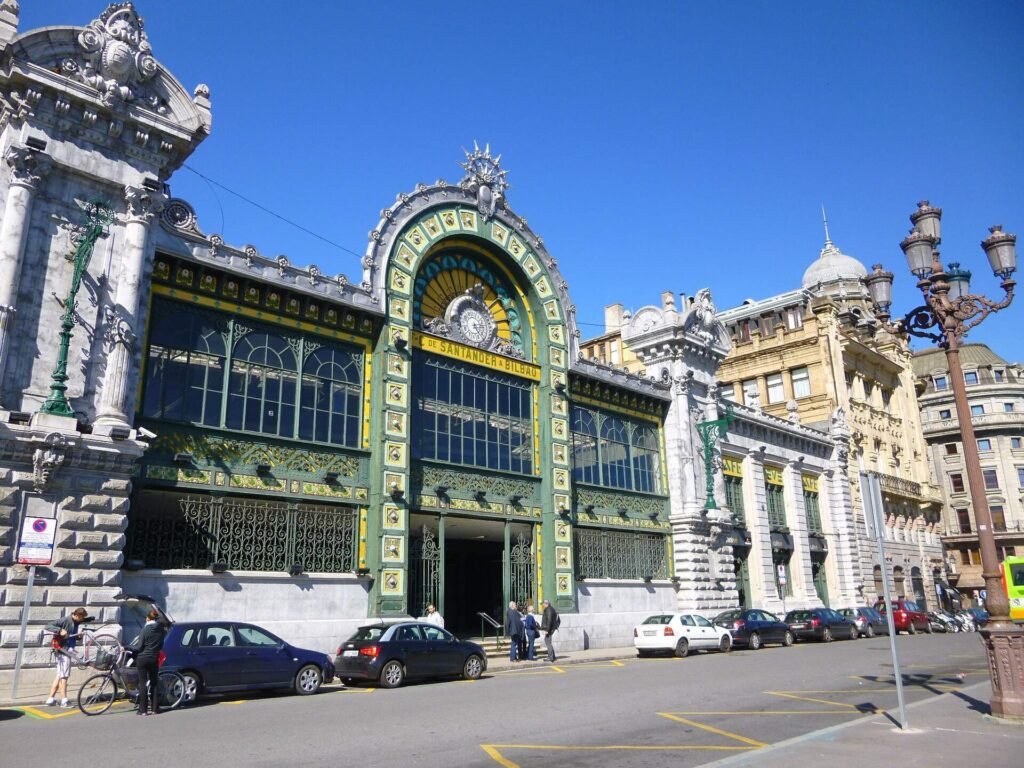
An iron-and-glass Art Nouveau front in green and cream, facing the river that made Bilbao rich.
At a glance
The Concordia station in Bilbao, also known by the Santander line it serves, is a jewel of Basque Art Nouveau. The engineer-architect Severino Achúcarro designed it, finished around 1902, with a façade of iron, glass and tile in green and cream curving along the river Nervión. It is small, ornate, and quite unlike the heavy stone stations of its day.
Key facts
- Location: Calle Bailén, on the Nervión, Bilbao
- Architect: Severino Achúcarro
- Built: 1898–1902
- Style: Art Nouveau (Modernismo)
- Function: railway station
History
Bilbao boomed on iron and shipping, and its railways needed a terminus on the river. Achúcarro, a leading Basque architect, gave the Santander line a station in the new Art Nouveau, using the very material the city traded in: iron.
Squeezed onto a narrow riverside plot, the building made a virtue of its ironwork and glass. Restored, it still serves regional trains, a delicate counterpoint to the modern Bilbao of the Guggenheim.
What you see
The façade is a screen of iron and glass, painted green and cream, with curving Art Nouveau detail and the line’s name worked into the metal. Inside, a light concourse leads to the platforms along the river. It is engineering turned ornamental, the iron city in miniature.
Practical information
- Open: daily, as a working station
- Cost: free to view the façade and hall
- Best for: the iron-and-glass Art Nouveau front
- Time needed: 10–20 minutes
Getting there
The station is on the river in central Bilbao, beside the Arenal, a short walk from the old town (Casco Viejo) and the metro.
Nearby
- Casco Viejo — the old town across the river
- Guggenheim Museum Bilbao — Gehry’s landmark upstream
Sources
- Wikipedia — Bilbao-Concordia railway station
- Ayuntamiento de Bilbao / Basque heritage register — building information
- Wikimedia Commons — image source and licence
Find it on the map
See this place and what’s around it →Record researched and written by Luigi De Marchi for Cultural Heritage Online, 2026.
📷 Become a Cultural Heritage Online photographer
Share your photos of places: they stay published under your name as the author. The more they're seen, the more you get noticed — and soon a contest will reward the most appreciated photos.
Log in or sign up free to add a photoIs this page about you?
This page is read by travellers and heritage enthusiasts who find it on Google. Tell us how you are connected to this place and we will take it from there.