
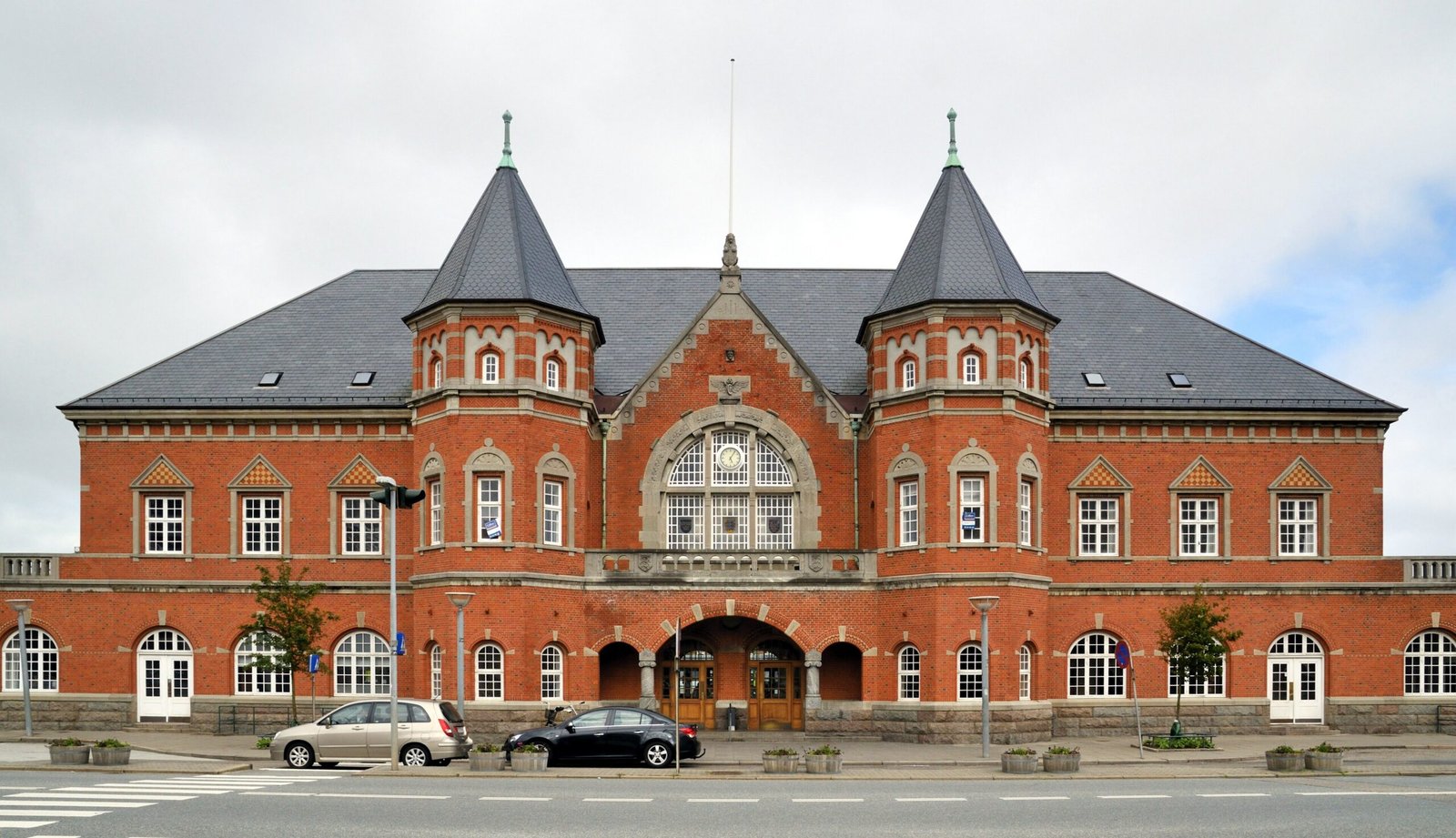
A turn-of-the-century railway terminus in southwest Jutland, crowned by twin towers and Historicist detail inspired by Dutch Renaissance design.
At a glance
Esbjerg station serves as the main railway hub for Denmark’s southwestern coast, anchoring central Esbjerg between the historic town centre and residential districts. The building is a landmark blend of architectural styles, distinguished by its three-storey towers and ornamental gable.
History
The station first opened in 1874 to connect the growing port city along Denmark’s North Sea coast. The present building was completed three decades later, in 1904, replacing or substantially renovating the original structure. Designed by Heinrich Wenck, it arrived at a moment when Esbjerg was establishing itself as a major commercial and industrial centre. The station remains a terminal point on two key regional lines: the Lunderskov–Esbjerg and Esbjerg–Struer routes.
What you see
The three-storey facade features symmetrical towers flanking a central gable, a composition that draws on Historicist principles and echoes of Dutch Renaissance styling. The building exemplifies early 20th-century railway architecture in Scandinavia, balancing functional design with civic grandeur.
Cultural significance
The station embodies Esbjerg’s transformation from a small fishing community into a substantial port and industrial city during the late 19th and early 20th centuries. Its architectural detail reflects the period’s aspirations for civic identity and modernity through railway infrastructure.
Key facts
- Location: Esbjerg, Denmark
- Completed: 1904
- Designer: Heinrich Wenck
- Original opening: 1874
- Coordinates: 55.467°N, 8.459°E
- Terminal station on the Lunderskov–Esbjerg and Esbjerg–Struer lines
- Adjacent to Esbjerg bus station
Practical information & getting there
Esbjerg station is centrally located in the city, immediately adjacent to the main bus station. Train services are operated by DSB and GoCollective, connecting to Copenhagen, Aarhus, Ribe and other regional destinations. The station lies on the eastern edge of the historic town centre, making it accessible to both transport links and surrounding districts.
Sources & resources
Find it on the map
See this place and what’s around it →📷 Become a Cultural Heritage Online photographer
Share your photos of places: they stay published under your name as the author. The more they're seen, the more you get noticed — and soon a contest will reward the most appreciated photos.
Log in or sign up free to add a photoIs this page about you?
This page is read by travellers and heritage enthusiasts who find it on Google. Tell us how you are connected to this place and we will take it from there.