
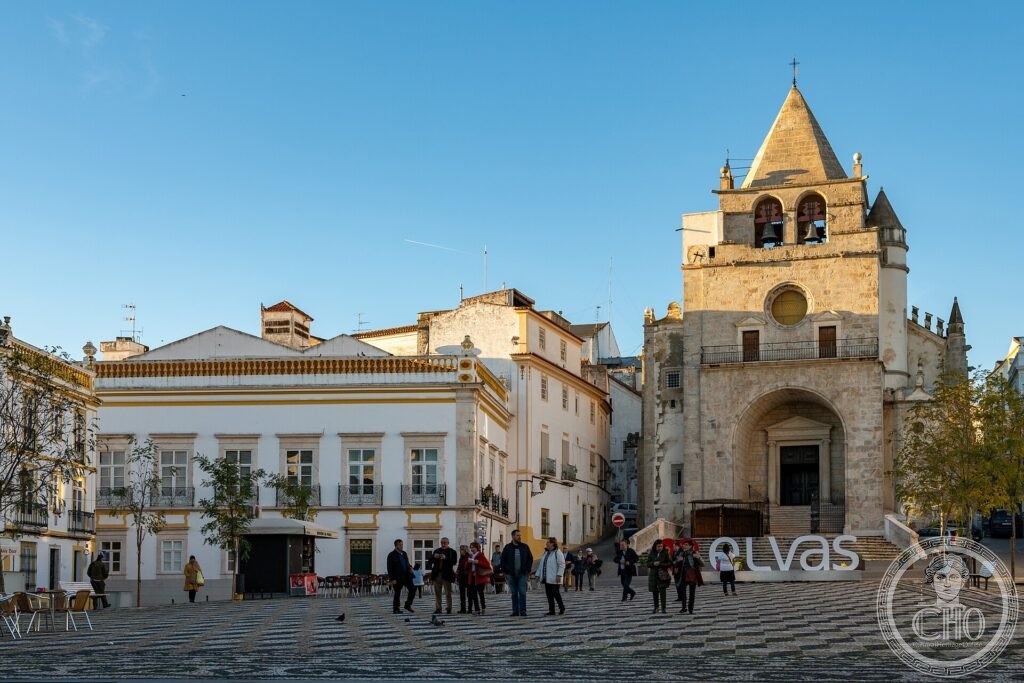
A few kilometres from Spain, Elvas is a city enclosed within the world’s most extensive dry-moat bastioned fortifications. Star-shaped ramparts, redoubts and a monumental aqueduct once defended Portugal’s frontier: a masterpiece of military engineering still intact.
At a glance
Elvas guards the dry plains of the Alentejo a few kilometres from the Spanish border. From the 17th century it was rebuilt as a frontier stronghold, surrounded by the largest bulwarked dry-ditch fortifications in the world: a star of ramparts, bastions and outlying forts designed to the latest Dutch and French military science. Fresh water reached the besieged town through the great Amoreira Aqueduct. The garrison town and its defences were inscribed by UNESCO in 2012.
Key facts
- UNESCO: World Heritage since 2012 (Garrison Border Town of Elvas and its Fortifications)
- Largest of their kind: the most extensive bulwarked dry-ditch fortifications in the world
- Frontier: a few kilometres from the Spanish border with Badajoz
- Amoreira Aqueduct: a monumental 16th–17th-century aqueduct supplying the town
- Outlying forts: the hilltop forts of Graça and Santa Luzia
- Restoration era: rebuilt after Portugal regained independence in 1640
History
A frontier town since the Middle Ages, Elvas gained strategic weight after Portugal broke from Spanish rule in 1640. In the wars that followed, military engineers ringed the town with state-of-the-art bastioned fortifications, designed to resist artillery with low, angled ramparts and deep dry ditches. The defences were tested and held in the great siege of 1658 and again in later conflicts.
To withstand siege the town needed water, brought from afar by the Amoreira Aqueduct, begun in the 16th century and finished in the 17th. Detached hilltop forts — Nossa Senhora da Graça and Santa Luzia — extended the defensive system, making Elvas one of the most strongly fortified towns in Europe.
What you see
The walls enclose a living town of white houses, churches and the arcaded main square. The ramparts can be walked, their star points and bastions clear from above. Striding across the plain on tall arches, the Amoreira Aqueduct carried water into the heart of the fortress.
On the hills beyond stand the detached forts of Graça and Santa Luzia, with commanding views toward the Spanish frontier.
Practical information
- Old town: freely walkable within the walls
- Forts: Graça and Santa Luzia can be visited for the views and museums
- Time needed: half a day for the town, walls and aqueduct
- Note: the Alentejo is hot in summer; bring water and shade
Getting there
Elvas is in the Alentejo region of eastern Portugal, on the border with Spain near Badajoz. It is reached by road from Lisbon (about 2.5 hours) or from Spain; bus services also serve the town. GPS: 38.881° N, 7.163° W.
Nearby
- Badajoz — the Spanish border city, a few kilometres east
- Évora — a UNESCO old town to the west
- Estremoz and Vila Viçosa — marble towns of the Alentejo
Sources
- UNESCO World Heritage Centre — “Garrison Border Town of Elvas and its Fortifications” (ref. 1367)
- Câmara Municipal de Elvas — official city authority
- Encyclopaedia Britannica — Elvas
Find it on the map
See this place and what’s around it →📷 Become a Cultural Heritage Online photographer
Share your photos of places: they stay published under your name as the author. The more they're seen, the more you get noticed — and soon a contest will reward the most appreciated photos.
Log in or sign up free to add a photo