

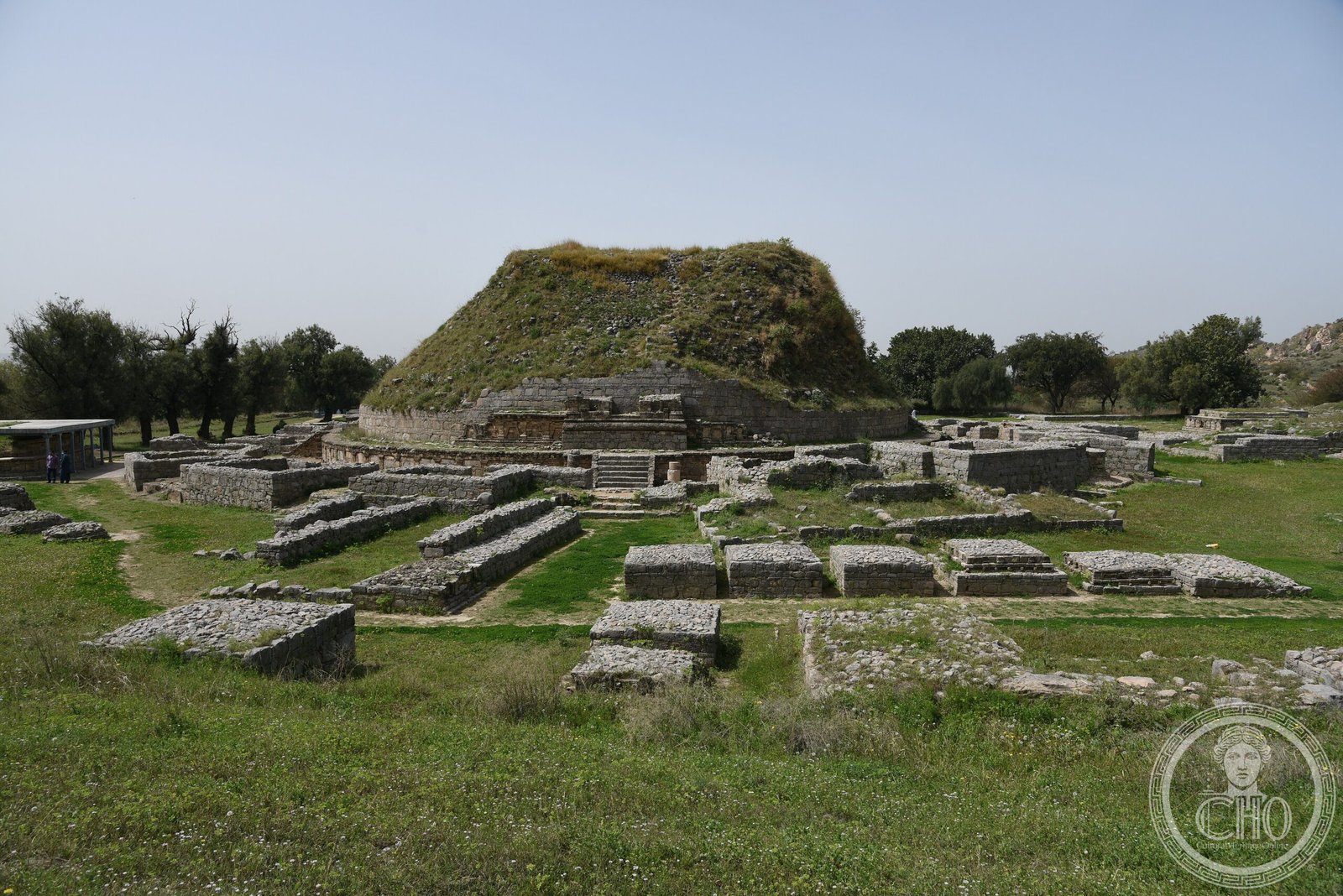
Emperor Ashoka commissioned this monumental Buddhist stupa to enshrine relics of the Buddha, establishing a sacred site that would anchor one of South Asia’s greatest monastic centers.
At a glance
The Dharmarajika Stupa stands as one of the finest examples of Mauryan religious architecture. Built by imperial decree in the 3rd century BCE, it became the spiritual heart of an extensive monastic complex that developed over centuries. Today it anchors the Ruins of Taxila, a sprawling archaeological landscape revealing multiple layers of Buddhist civilization.
History
Emperor Ashoka of Magadha ordered the construction of this stupa to house relics of the Buddha—an act reflecting both his authority and his deep commitment to Buddhism. The structure’s prominence attracted monks and pilgrims, spurring the growth of monasteries, temples, and supporting structures around it. Taxila evolved into a major center of Buddhist learning and devotion, drawing scholars and practitioners across Asia for centuries.
What you see
The stupa exemplifies Mauryan architectural principles, though centuries of use, rebuilding, and erosion have altered its original form. A large monastic complex developed around the central shrine, with multiple periods of construction visible in the archaeological record. Excavations have revealed the stratified remains of stupas, monasteries, and votive structures accumulated through successive eras of habitation and worship.
Cultural significance
As an imperial foundation by one of history’s most important Buddhist rulers, the Dharmarajika Stupa embodied Ashoka’s role in spreading Buddhism across his empire. The site’s longevity—inhabited and rebuilt over many centuries—demonstrates Buddhism’s sustained influence in the region. Its inclusion in the UNESCO-designated Ruins of Taxila recognizes it as essential to understanding Buddhist monastic life and Hellenistic-Indian cultural exchange.
Key facts
- Location: Taxila, Pakistan
- Coordinates: 33.73°N, 72.78°E
- Founded: 3rd century BCE by Emperor Ashoka
- UNESCO World Heritage Site: Part of Ruins of Taxila (inscribed 1980)
Practical information & getting there
The Dharmarajika Stupa is located within the archaeological zone of Taxila, approximately 30 kilometers north of Islamabad. The site is open to visitors and features a museum displaying finds from excavations. Local guides can provide context for the complex stratigraphy visible in the ruins.
Sources & resources
Find it on the map
See this place and what’s around it →📷 Become a Cultural Heritage Online photographer
Share your photos of places: they stay published under your name as the author. The more they're seen, the more you get noticed — and soon a contest will reward the most appreciated photos.
Log in or sign up free to add a photoIs this page about you?
This page is read by travellers and heritage enthusiasts who find it on Google. Tell us how you are connected to this place and we will take it from there.