

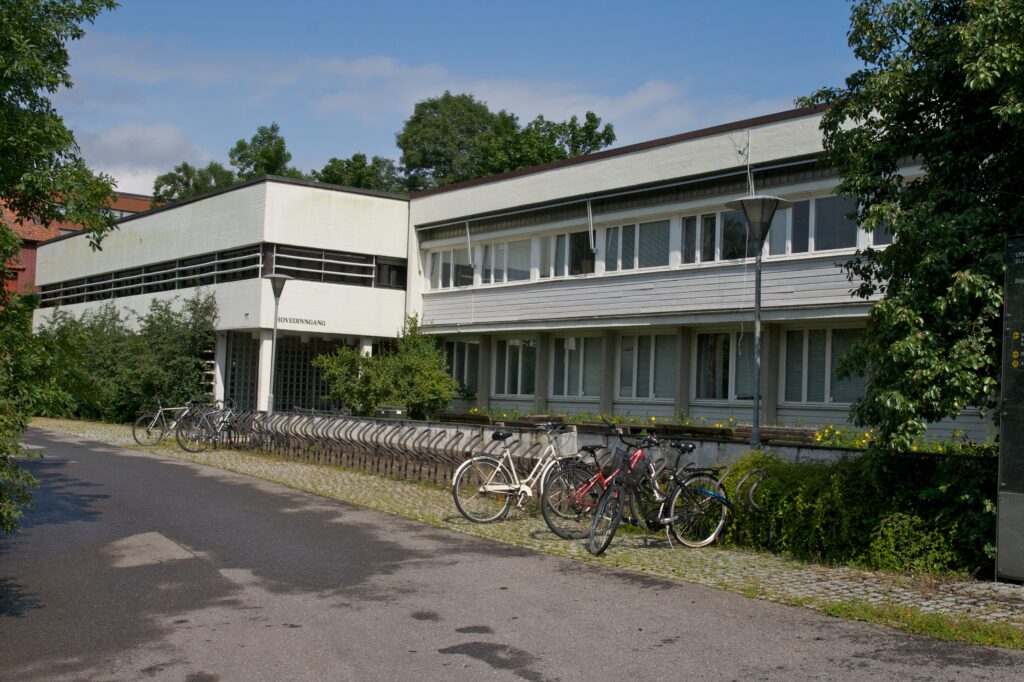
The Department of Archaeology, Conservation and History is part of the University of Oslo. It teaches three fields that study the past in different ways, and it runs Norway's only training for object and painting conservators.
At a glance
The department works from Blindernveien 11, a two-storey building on the Blindern campus in Oslo. Its history section sits on the fourth floor of Niels Treschows hus. There are three bachelor's programmes, five master's programmes and a one-year programme. About 795 students are enrolled. Teaching runs from the Stone Age to the present day.
Key facts
- Part of the Faculty of Humanities, University of Oslo
- Three fields: archaeology, conservation, history
- Norway's only education in conservation
- 795 students and close to 100 employees
- Three bachelor's programmes, five master's, one one-year programme
- Address: Blindernveien 11, 0371 Oslo
- History section on the fourth floor of Niels Treschows hus
History
The department holds three disciplines that read the past by different means. Archaeologists work from the Stone Age to the Middle Ages, on excavated material. Conservators handle objects and paintings. They ask how those objects change over time, and how the change can be managed. Historians cover antiquity to the present, and they form the largest history group in the Nordic countries. The three sit in one department. Administration and degrees are shared.
Research rests on historical sources, on archaeological evidence and on the conservation of objects and paintings. In 2025 four projects were financed by the European Research Council and six by the Research Council of Norway. One of them is EcoArch. It studies how people and climate have shaped landscapes and biodiversity across Africa and Arabia.
Doctoral training runs through Dialogues with the Past, a Nordic graduate school in archaeology that takes PhD students from the Nordic countries, Kiel, St Petersburg and the Baltic states. A second strand is HEI: Heritage Experience Initiative. It develops critical heritage research with the heritage sector, and it tests new ways of teaching.
The figures are for 2025. The department reports 54 academic man-years, 43 research fellows, postdoctoral researchers and doctoral candidates, and 22 administrative man-years. Its staff produced 136 scientific publications that year, and total income was 121 million NOK.
What you see
Blindernveien 11 is a low building of two floors, with a gross area of 1.679 square metres. It stands on the upper part of the Blindern campus. Archaeology and conservation are taught here, in lecture rooms and in the practical rooms the conservation course needs. The entrance is step-free. A platform lift joins the first and second floor, but it requires assistance. Accessible toilets sit on both floors. Some doors are narrow or heavy.
The history section works separately, on the fourth floor of Niels Treschows hus at Niels Henrik Abels vei 36. Students and staff use the university library, which the university describes as Norway's largest research library. The department keeps its own reading rooms. This is a working department, not a museum. Visitors with a reason to be there are received through the department office, not at a ticket desk.
Practical information
- Address: Blindernveien 11, 0371 Oslo, Norway (archaeology and conservation)
- History section: Niels Treschows hus, 4th floor, Niels Henrik Abels vei 36
- Telephone 22 85 49 00; public enquiries [email protected]
- Postal address: IAKH, P.b. 1008 Blindern, 0315 Oslo
- A working department: entry is through the department office, not a public ticket desk
Getting there
Blindern is served by bus, tram and metro, and the campus has its own stops. Blindernveien 11 stands on the upper campus, within walking distance of the other Blindern buildings.
Nearby
- Niels Treschows hus, where the history section works
- Kristine Bonnevies hus
- Villa Eika
- Frederikkeplassen, the open square at the centre of the campus
Sources
- https://www.hf.uio.no/iakh/english/about/index.html
- https://www.hf.uio.no/iakh/english/about/facts/index.html
- https://www.hf.uio.no/iakh/english/about/contact/index.html
- https://www.uio.no/english/about/getting-around/areas/blindern/bl30/
- https://www.hf.uio.no/iakh/english/studies/programmes/index.html
- https://www.uio.no/studier/program/konservering/
- https://www.hf.uio.no/iakh/english/research/index.html
- https://www.hf.uio.no/iakh/english/services/index.html
Find it on the map
See this place and what’s around it →📷 Become a Cultural Heritage Online photographer
Share your photos of places: they stay published under your name as the author. The more they're seen, the more you get noticed — and soon a contest will reward the most appreciated photos.
Log in or sign up free to add a photoIs this page about you?
This page is read by travellers and heritage enthusiasts who find it on Google. Tell us how you are connected to this place and we will take it from there.
This entry stays online and free either way — and a free account lets you add to it yourself.