
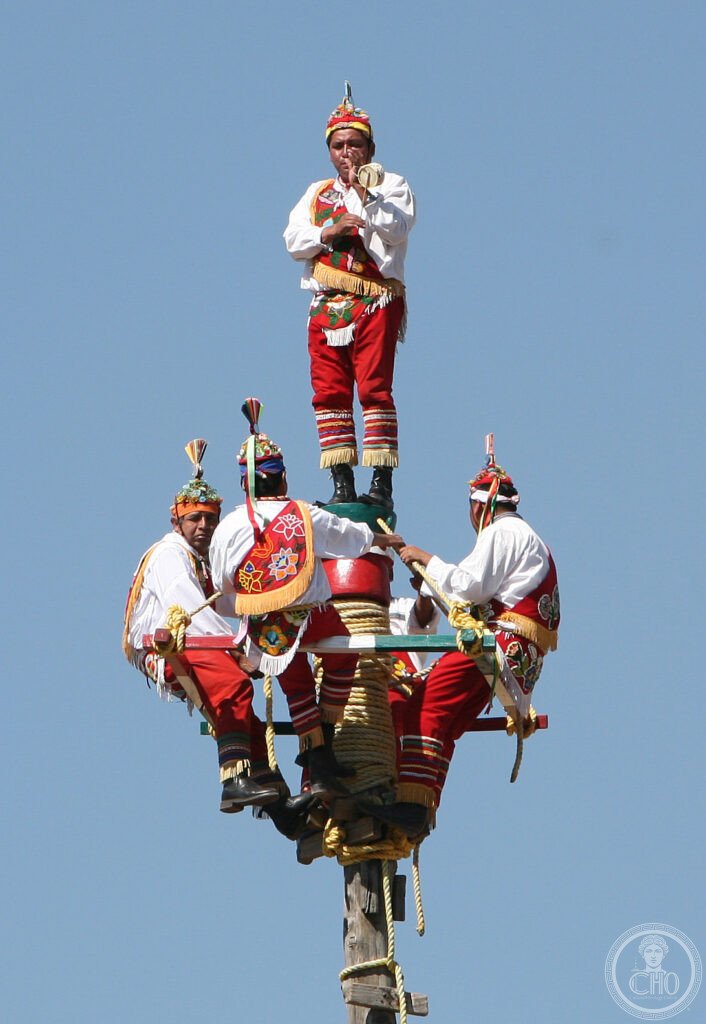
Four men spiral down from a 30-metre pole, tethered by rope, while a fifth dances above playing flute and drum. This ancient Mesoamerican ceremony—thought to originate as a plea to end drought—survives today chiefly among the Totonac people of Veracruz.
In UNESCO’s words
The ritual ceremony of the Voladores (‘flying men’) is a fertility dance performed by several ethnic groups in Mexico and Central America, especially the Totonac people in the eastern state of Veracruz, to express respect for and harmony with the natural and spiritual worlds. During the ceremony, four young men climb a wooden pole eighteen to forty metres high, freshly cut from the forest with the forgiveness of the mountain god. A fifth man, the Caporal, stands on a platform atop the pole, takes up his flute and small drum and plays songs dedicated to the sun, the four winds and each of the cardinal directions. After this invocation, the others fling themselves off the platform ‘into the void’. Tied to the platform with long ropes, they hang from it as it spins, twirling to mimic the motions of flight and gradually lowering themselves to the ground. Every variant of the dance brings to life the myth of the birth of the universe, so that the ritual ceremony of the Voladores expresses the worldview and values of the community, facilitates communication with the gods and invites prosperity. For the dancers themselves and the many others who participate in the spirituality of the ritual as observers, it encourages pride in and respect for one’s cultural heritage and identity.
Official description, UNESCO Intangible Cultural Heritage List — Ritual ceremony of the Voladores
At a glance
The Voladores is a fertility dance performed by several ethnic groups in Mexico and Central America, most notably the Totonac people of Veracruz. Five participants engage in a ceremony combining music and movement: four young men fling themselves from a high wooden pole while tied by long ropes, twirling as they descend to mimic flight, while a fifth man—the Caporal—remains at the platform playing flute and drum. The ritual brings to life the myth of the universe's birth and expresses the community's worldview and values.
Origins & history
The Voladores ritual ceremony is performed by several ethnic groups in Mexico and Central America, with the Totonac people of Veracruz being especially associated with its practice. The ceremony has survived as a living tradition within these communities, each variant bringing to life the same foundational myth of universal creation.
The practice
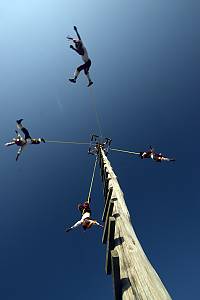
The ceremony centres on a wooden pole eighteen to forty metres high, freshly cut from the forest. Four young men climb to a platform at the top, where they are tied with long ropes. The Caporal stands on the platform and plays a flute and small drum, invoking the sun, the four winds and each cardinal direction. After this invocation, the four men fling themselves from the platform and, suspended by their ropes, twirl as the platform spins, gradually lowering themselves to the ground in a descent that mimics the motions of flight.
Cultural significance
The Voladores expresses respect for and harmony with the natural and spiritual worlds. For dancers and observers alike, the ritual facilitates communication with the gods and invites prosperity. The ceremony encourages pride in and respect for cultural heritage and identity, reinforcing the community's worldview and values across generations.
Key facts
- Country: Mexico
- Inscribed: 2009
- UNESCO list: Representative List of the Intangible Cultural Heritage of Humanity
- UNESCO reference: 00175
- UNESCO vocabulary: Acrobatics; Fertility ritual; Ritual dance; Rituals
- Map: Veracruz — the locality named in UNESCO’s official description of this element
Where to experience it
The Totonac people of Veracruz continue to perform the Danza de los Voladores in their communities, where the ritual remains central to spiritual and cultural life. Visitors can witness this ceremony during festivals and ceremonial gatherings throughout the region, where the dancers' acrobatic invocation of cosmic forces unfolds before observers who participate in the spirituality of the ritual. The practice thrives among several ethnic groups across Mexico and Central America, each maintaining their own variants of this fertility dance that expresses worldview, facilitates communication with the gods, and invites prosperity to the community.
Sources & resources
- UNESCO — official element page: Ritual ceremony of the Voladores
- UNESCO — open data record: Intangible Heritage List, reference 00175
- UNESCO — official video: UNESCO film on this element — embedded on this page
- UNESCO — official photograph: Photograph of this element — Alejandra Cerdeno — 2008, by Cumbre Tajin
- Reference — Wikipedia (secondary): Danza de los Voladores — consulted as a secondary reference, not as confirmation
- Cultural Heritage Online: Our archive and city guides
Find it on the map
See this place and what’s around it →📷 Become a Cultural Heritage Online photographer
Share your photos of places: they stay published under your name as the author. The more they're seen, the more you get noticed — and soon a contest will reward the most appreciated photos.
Log in or sign up free to add a photo