
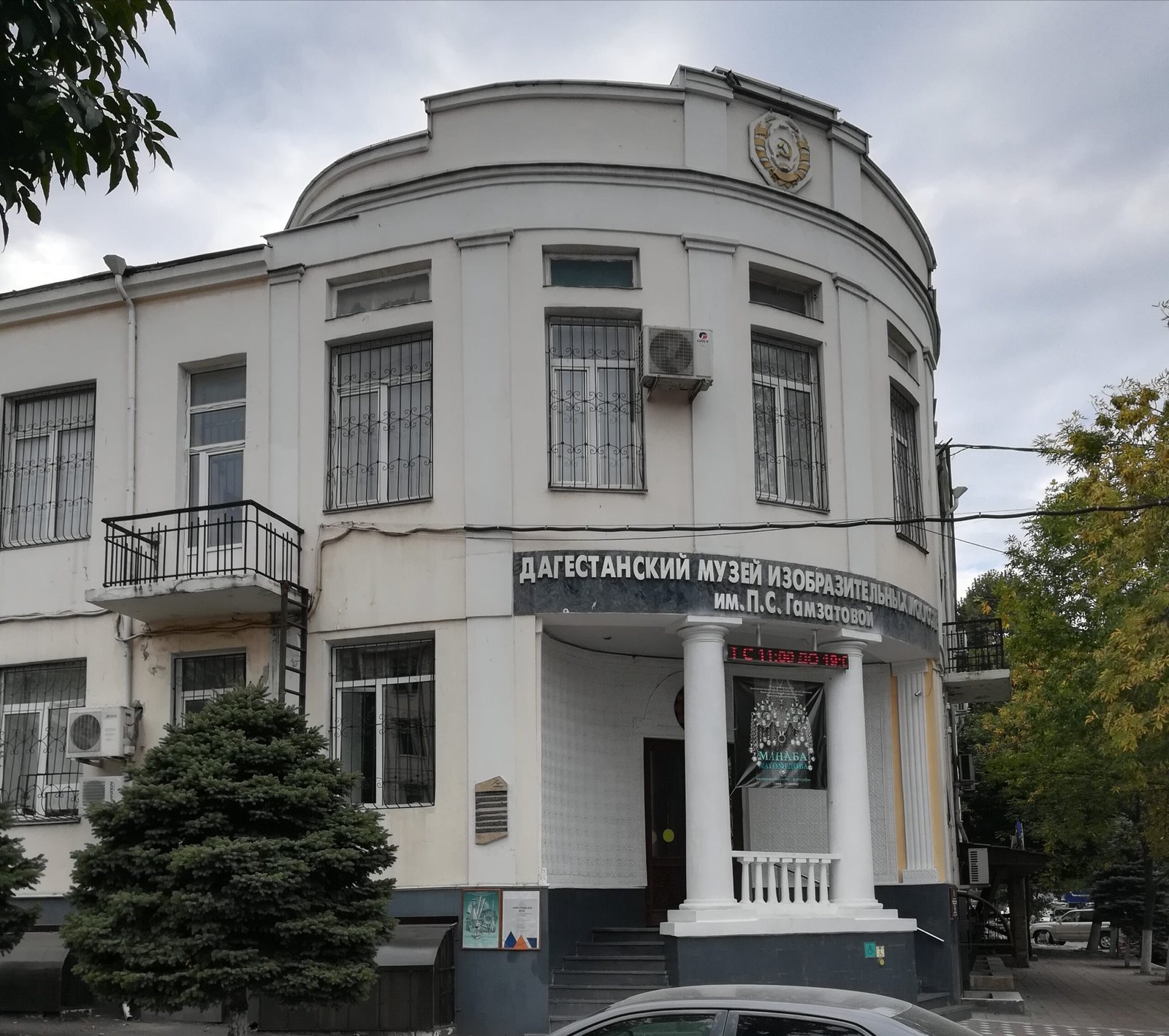
A ten-hall museum on Gorky Street holding one of the North Caucasus’s deepest art collections, from Aivazovsky seascapes to Dagestani carpets and carved wood.
At a glance
Founded in 1958, the museum grew from an art gallery assembled decades earlier inside Dagestan’s national museum. It now occupies a former administrative building on what was once Lenin Street. Ten permanent halls trace craft and fine art across four millennia, mixing Western European painting, Russian academic masters and Dagestani applied arts under one roof.
History
The core collection dates to the 1920s. A. Takho-Godi, a leading Dagestani official and public figure, personally selected works from museum storerooms in Moscow and Petrograd. Western European painting from the 16th to 19th centuries entered the holdings this way, alongside nineteenth- and early twentieth-century Russian art. Almost the entire collection of Prince A. I. Baryatinsky came into the museum’s keeping, along with several original works by T. Horschelt.
More material arrived from Tbilisi’s Caucasian Military History Museum, the “Temple of Glory,” including Franz Roubaud’s battle scenes “Siege of Akhoulgo” and “Storming the village of Gimry,” plus paintings tied to the Caucasian Wars and the figure of Shamil. Dmitry I. Pavlov, director of the national museum, later donated an album of drawings by G. G. Gagarin and eighteen lithographs depicting Shamil’s family life. The Ministry of Culture of the RSFSR formally established the fine arts museum in 1958, splitting the art gallery off as its own institution. In 1964 Patimat Saidovna Gamzatova took over as director. She led it without interruption until 2000, shaping much of its present character. That same year the republic’s government renamed the museum in her honor.
What you see
Visitors move through ten halls arranged by period and medium. Painting, graphics, sculpture, ceramics and wood carving share space with copper work, carpets, furniture, glass, porcelain and faience. Russian nineteenth-century painting anchors several rooms: Ivan Aivazovsky’s stormy seas, Ivan Kramskoi’s portrait of his sister, a study by Vasily Surikov for “Boyaryna Morozova.” A dedicated section, “Dagestan in the Works of Russian Artists,” gathers romantic mountain landscapes by Nikanor Chernetsov and Ivan Zankovsky beside Roubaud’s canvases and Gagarin’s lithographs. Later rooms turn to Soviet-era and Dagestani artists, including sculptor Khalil-Bek Askar-Sarydzha and Baku Muradova, the first Dagestani woman to work as a sculptor.
Cultural significance
Few regional museums in the North Caucasus combine imperial-era Russian painting with local applied arts on this scale. The Baryatinsky holdings and Roubaud’s battle paintings connect the collection directly to nineteenth-century Caucasian history. Under Gamzatova’s four decades of leadership, the institution became a fixture of Dagestani cultural life, hosting lectures and exhibitions alongside its permanent display.
Key facts
- Location: Gorky Street, Building 8, Makhachkala, Republic of Dagestan
- Founded: 1958, by order of the Ministry of Culture of the RSFSR
- Collection origins: 1920s, assembled by A. Takho-Godi
- Ten permanent exhibition halls
- Named after director Patimat Saidovna Gamzatova in 2000
Practical information & getting there
The museum sits centrally in Makhachkala, on Gorky Street. You can check current hours and exhibition schedules on the museum’s official website before visiting, since the article does not specify opening times or admission fees.
Sources & resources
Find it on the map
See this place and what’s around it →📷 Become a Cultural Heritage Online photographer
Share your photos of places: they stay published under your name as the author. The more they're seen, the more you get noticed — and soon a contest will reward the most appreciated photos.
Log in or sign up free to add a photoDo you manage this place?
This page is read by travellers and heritage enthusiasts who find it on Google. Keep it accurate — and make it work for you. Free for non-profit heritage institutions.