
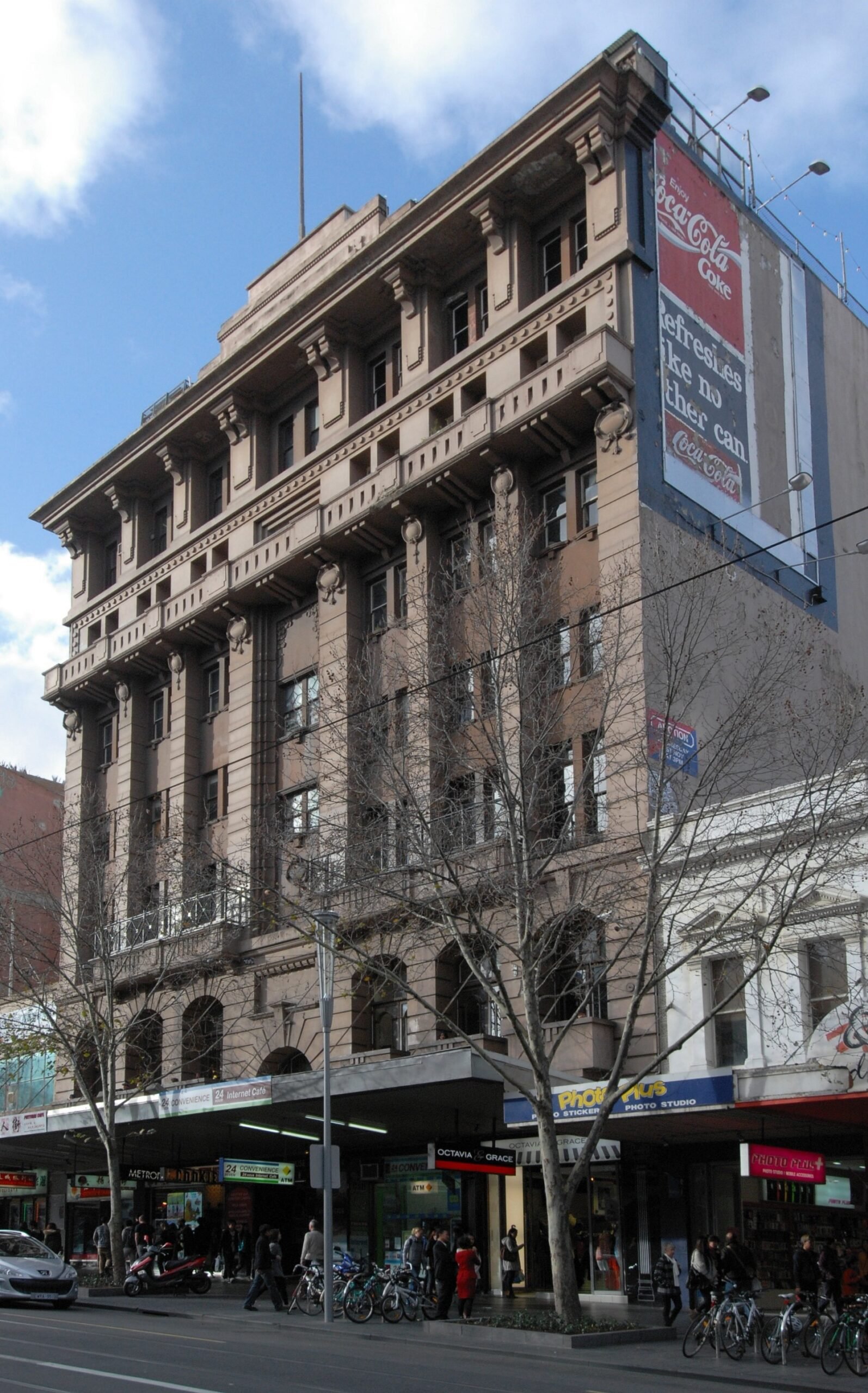
A six-storey Commercial Palazzo landmark on Swanston Street, transformed from office building into a vibrant vertical marketplace of independent shops, restaurants, and creative spaces.
At a glance
Curtin House exemplifies early twentieth-century Melbourne commercial architecture. Built in 1922 for the Tattersalls Club, it combines classical palazzo design with urban revitalisation, now functioning as a lively cultural and retail destination across all six floors and rooftop.
History
The building was constructed in 1922 as headquarters for the Tattersalls Club, with additional rental office space. For decades it served the city’s business community. In the early 2000s, it underwent radical transformation, reimagined as a vertical laneway—a new typology of mixed-use urban space that brought independent retailers, restaurants, and entertainment venues into every level of the structure.
What you see
The facade expresses Commercial Palazzo style, a blend of classical proportions and commercial pragmatism typical of early-twentieth-century Australian banking and business districts. The building’s six storeys were originally unified by consistent fenestration and material expression. The adaptive reuse preserved the structural integrity while opening interior spaces to create interconnected retail environments, culminating in roof-level venues.
Cultural significance
Curtin House represents both preservation and reinvention. Its conversion into a vertical laneway pioneered a model for revitalising heritage commercial buildings in Australian city centres, proving that historic architecture could accommodate contemporary retail culture and creative enterprise without demolition.
Key facts
- Country: Australia
- City: Melbourne central business district
- Built: 1922
- Architectural style: Commercial Palazzo
- Location: Swanston Street
- Coordinates: -37.812, 144.96519444
Practical information & getting there
Curtin House occupies a central position on Swanston Street in Melbourne’s CBD. The building is publicly accessible, with independent retailers, cafés, and dining venues throughout its floors open to the public during business hours. It serves as both a working commercial space and a destination for shoppers and diners exploring Melbourne’s laneway culture.
Sources & resources
Find it on the map
See this place and what’s around it →📷 Become a Cultural Heritage Online photographer
Share your photos of places: they stay published under your name as the author. The more they're seen, the more you get noticed — and soon a contest will reward the most appreciated photos.
Log in or sign up free to add a photoIs this page about you?
This page is read by travellers and heritage enthusiasts who find it on Google. Tell us how you are connected to this place and we will take it from there.