

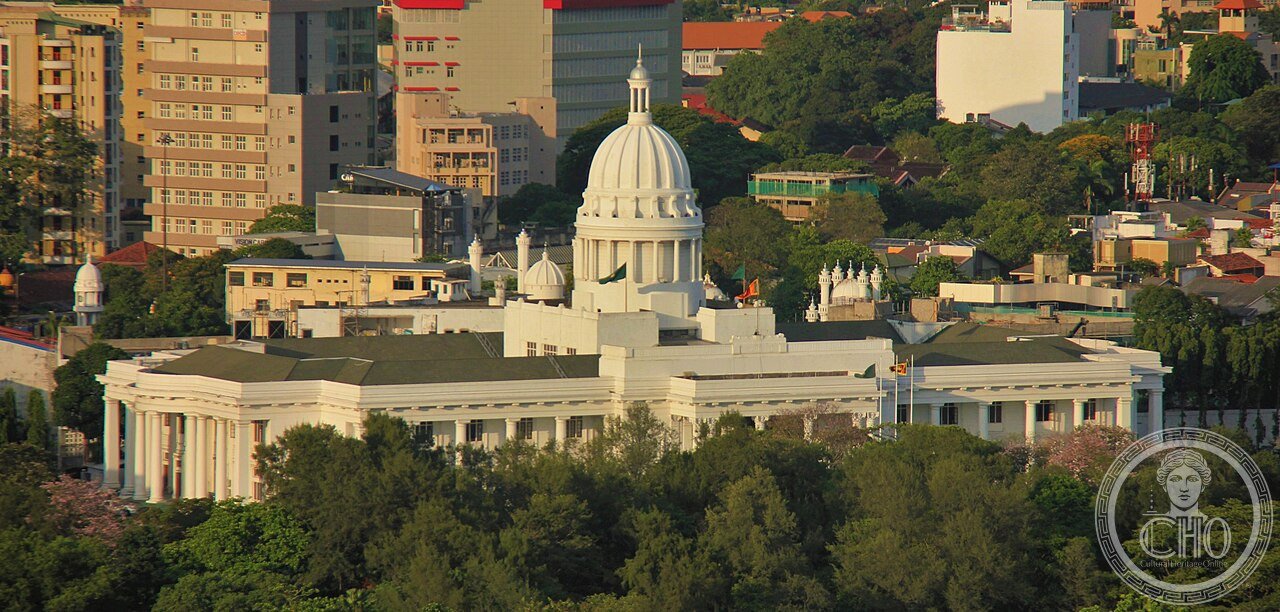
Known to Colombo residents as the “White House,” the Colombo Town Hall is the defining civic monument of colonial Sri Lanka — a Palladian-inspired building in brilliant white rendered concrete, fronted by a grand portico of Ionic columns and approached by a broad ceremonial staircase. The foundation stone was laid by Prince Edward, the future King Edward VIII, during his royal tour of 1921; the building opened to public use in 1927 and immediately became the symbolic center of municipal life in what was then the capital of British Ceylon. The small dome that crowns the structure was never completed as originally designed — budget constraints during construction resulted in a truncated silhouette — yet the building reads as entirely authoritative, its scale and whiteness dominating the surrounding street grid. Today it functions exactly as it was built to function: as the working headquarters of the Colombo Municipal Council, the city’s elected local government. It is a Heritage Monument of Sri Lanka and one of the best-preserved examples of late British colonial civic architecture in South Asia.
At a glance
- Type
- Municipal government building
- Period
- Construction completed 1927; opened 1928
- Style
- Neoclassical / British Colonial Palladian
- Location
- Colombo 7, Sri Lanka
- Coordinates
- 6.9315° N, 79.8515° E
- Architect(s)
- A.G. Fraser (Government Architect)
Overview
The Colombo Town Hall stands at the heart of the Colombo 7 administrative district, surrounded by the city’s principal government buildings. Its white rendered facade and colonnaded portico have made it the most photographed building in Colombo after Independence Square. The building houses the Mayor’s office, the full council chamber, and the administrative departments of the Colombo Municipal Council. It remains fully operational as a seat of local government, and on council sitting days the forecourt fills with officials, petitioners, and press. The interior retains much of its original detailing: marble floors, decorative plasterwork, and the formal mayoral chamber with its carved wooden furniture.
History
Colombo’s municipal government had operated from a series of inadequate premises since the establishment of the Colombo Municipal Council in 1865. By the early twentieth century the colonial administration recognized that a permanent, purpose-built town hall was required to reflect Colombo’s status as the principal city of British Ceylon. The foundation stone was laid on 26 March 1921 by Prince Edward during his celebrated empire tour, an occasion extensively documented in the colonial press. Construction proceeded under Government Architect A.G. Fraser through the early 1920s. The dome was truncated during construction due to budget overruns, a modification that was never reversed. The building was inaugurated in 1927 and entered full use in 1928. It has operated continuously as the municipal headquarters through Ceylon’s independence in 1948, the declaration of the Republic in 1972, and the renaming of the country as Sri Lanka.
Architecture & Design
The design follows the Palladian civic tradition that British colonial architects applied across India, Malaysia, and East Africa in the early twentieth century — a central projecting portico of full-height Ionic columns over a grand staircase, flanking wings with rhythmic window bays, and a dome or tower as vertical accent. At Colombo, the dome was truncated, producing a low octagonal tambour that sits apologetically above the roofline; the rest of the composition is self-assured. The exterior is rendered in white — a practical choice in a tropical climate, where the reflectivity reduces solar gain — and the columns and entablature are carefully detailed. The interior plan is formal: a central axis leads from the entrance through a marble-floored vestibule to the staircase hall, with council chambers and administrative offices on both floors.
Cultural significance
The Colombo Town Hall occupies a complicated place in Sri Lankan historical memory. As a building explicitly designed to represent British colonial municipal authority, it is simultaneously a symbol of the imperial period and, after independence, an instrument of Sri Lankan self-governance — the same chambers, different occupants. It appears on tourist literature, civic publications, and municipal correspondence as the logo of Colombo itself. Its designation as a Heritage Monument of Sri Lanka acknowledges both its architectural quality and its irreplaceable role in the documentary record of the city’s modern history.
Visiting today
The exterior of the Colombo Town Hall can be viewed and photographed freely from the surrounding streets and forecourt. Interior access is generally not available to independent visitors, as the building is a functioning government office; however, the main hall and ground-floor corridors can sometimes be entered during council open days or by arrangement. The forecourt and ceremonial staircase are accessible. The building is best photographed in early morning light, when the white facade is fully lit and foot traffic is low. No admission charge for the exterior.
Getting there
The Colombo Town Hall is located in the Colombo 7 (Cinnamon Gardens) district. By bus: CTB and private buses on Ananda Coomaraswamy Mawatha and Independence Avenue serve the area. By three-wheeler (tuk-tuk): a 10–15 minute ride from Fort Station or the Pettah bus terminal. By train: Narahenpita Station is approximately 1.5 km away. Street parking is limited; the building is best reached by public transport or taxi.
Sources & resources
Find it on the map
See this place and what’s around it →Record researched and written by Luigi De Marchi for Cultural Heritage Online, 2026.
📷 Become a Cultural Heritage Online photographer
Share your photos of places: they stay published under your name as the author. The more they're seen, the more you get noticed — and soon a contest will reward the most appreciated photos.
Log in or sign up free to add a photoIs this page about you?
This page is read by travellers and heritage enthusiasts who find it on Google. Tell us how you are connected to this place and we will take it from there.