
.jpg)
A congregation that arrived on the eve of the feast of the Assumption in 1786 and named its church after the day; the building it worships in now went up in 1860, was a cathedral for forty-eight years, and still runs an organ shipped from Rutland in the middle of the First World War.
At a glance
The Church of the Assumption stands at the corner of Lebuh Farquhar and Love Lane, inside the core zone of the George Town World Heritage Site. It is the oldest Catholic parish in Penang and the first Catholic church in the northern part of the peninsula, founded in 1786; the present building dates from 1860. From 1955 to 2003 it was the cathedral of the Diocese of Penang. The Penang state government lists it among the Category One heritage buildings of the World Heritage Site, the top grade; it is not, however, separately gazetted under Malaysia’s National Heritage Act. Today it is one of the four churches of the City Parish, and it shares its grounds with the Penang Diocesan Museum.
Key facts
- Where: Lebuh Farquhar, at the corner of Love Lane, George Town, 10200 Penang
- Parish founded: 1786, under Monsignor Arnaud-Antoine (Arnold) Garnault, who served here until 1792; named for the feast of the Assumption, on whose eve the community arrived
- Present building: begun 1860 under Father Claude Manissol, first Mass October 1861, seating for about 1,200; two wings added in 1928
- Architect: not recorded. Manissol was the priest who had it built, not its designer, and no source names an architect.
- Earlier buildings: a wooden church on Church Street from 1786; a brick church with a tower from 1802, in use until 1857
- Cathedral: 1955 to 2003, when the seat moved to the Cathedral of the Holy Spirit in Green Lane
- Organ: built by Morton & Moody of Oakham, England in 1914, held up by wartime shipping and installed in 1916; 640 pipes of lead and zinc in a case of oak, pine and mahogany; restored in England in 2013 and still played on Sundays
- Protection: Category One heritage building in the George Town World Heritage Site, inscribed 2008; not individually listed on Malaysia’s National Heritage Register
- Restoration: closed 15 August 2016 for fourteen months, at a cost of RM2.5 million, architect Edmond Khoo; rededicated and reopened with the Penang Diocesan Museum on 1–2 January 2018
- Coordinates: 5.420516, 100.337648 · open in Google Maps
History
The British had been on the island for barely a year when the parish began. The accounts of who exactly founded it differ in emphasis: the Penang Heritage Trust ties the founding to Francis Light’s landing; the state’s own bulletin credits the French missionary Arnaud-Antoine Garnault and the island’s pioneer Eurasian community; a detailed local account has the first Catholic community of northern Malaya, until then at Kuala Kedah, arriving in Penang on the eve of the feast of the Assumption. All of them agree on the year, 1786, on Garnault, and on the feast that gave the church its name. The first church was a wooden building on Church Street; the priest’s house stood on the next street, which is why it is called Bishop Street.
In 1802 the wood was replaced by brick, with a tower, and that church served until 1857 under Father Denis Jourdain. Meanwhile the parish had become the hinge of Catholic education in the north: in 1825 Bishop Jean Baptiste Boucho, then parish priest here, founded a Catholic free school, and his invitations brought the La Salle Brothers and the Sisters of the Holy Infant Jesus to Penang, which produced St Xavier’s Institution and the Convent Light Street in 1852.
The congregation outgrew the brick church, and in 1860 the parish moved a few streets to Farquhar Street and built the cruciform church that stands there now, under Father Claude Manissol. The first Mass was said in October 1861. Manissol is buried in his own church, under an inscribed marble slab in the floor. Two wings were added in 1928. The building was largely shut through the Japanese occupation, apart from a few services.
In 1955 the Diocese of Penang was erected by papal decree and the Church of the Assumption became its cathedral, the sanctuary altered to take the throne of the first bishop, Monsignor Francis Chan. That lasted forty-eight years. In 2003 the seat moved to the Cathedral of the Holy Spirit in Green Lane, and the Assumption returned to being a parish church — one of the four that make up the City Parish, as the diocese itself lists it.
The church closed on 15 August 2016, the feast day, for a restoration that ran fourteen months and cost RM2.5 million, with Edmond Khoo as architect. It was rededicated on 1 January 2018, and the day after, the Penang Diocesan Museum opened in the grounds — the first museum of its kind in Penang, holding artefacts of Catholic practice in Malaysia. In August 2026 the parish marked its 240th anniversary with a Mass presided over by Cardinal Sebastian Francis and the blessing of a plaque to the Eurasian community that helped found it.
What you see
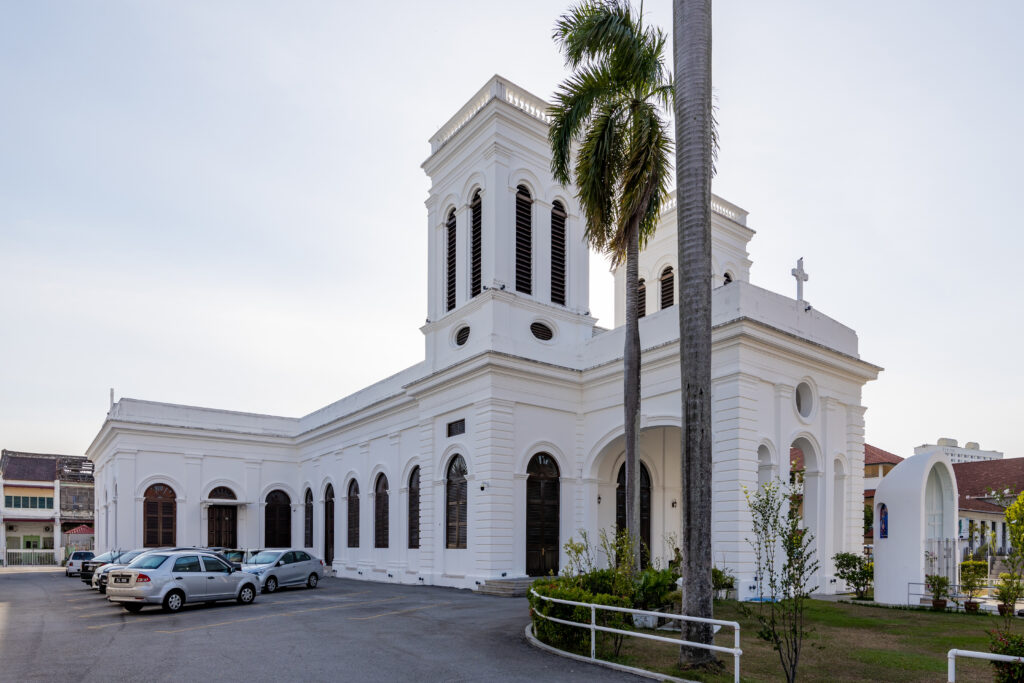
The church is rendered and painted white in recent photographs, though a long-standing local description calls it a grey building, so the colour has changed at least once. Two low square bell towers rise over the front, each with tall louvred round-arched openings on every face and a balustraded parapet, and each with a small round oculus in the stage below. Between and behind them the gable end carries another oculus and round-arched openings, framed by broad flat pilaster strips and a heavy moulded cornice that runs the length of the building.
Along the flank, a row of tall round-arched windows with louvred shutters and fan-shaped heads sits between the pilaster strips, above a plain plinth. The plan is cruciform. A portico shelters the entrance, and directly in front of it stands a dome-shaped grotto with a statue of Our Lady flanked by two stained-glass panels; the grotto is the white curved structure at the right of the photograph. At the door, two life-size white marble angels hold shells of holy water. Inside the entrance are two rows of chairs, each armrest ending in the carved head of a bald man. The nave is high and vaulted, with stained glass, life-size statues of saints and the Stations of the Cross on the walls, and the organ on the floor above the entrance. No source we have read classifies the building’s style, so we do not give it one.
Practical information
- The church is in use, with Masses on Saturdays and Sundays; visitors are asked to dress appropriately, and those who are not Catholic are asked not to approach the altar.
- The Penang Diocesan Museum is in the church grounds, together with an art gallery of paintings by Father Joseph Reutens.
- The church is a short walk from the Street of Harmony, the run of Lebuh Pitt where a mosque, a Chinese temple, a Hindu temple and an Anglican church stand within a few hundred metres of one another.
- The organ is used at Sunday services rather than shown as an exhibit.
Getting there
Lebuh Farquhar runs through the northern edge of the old town, a few minutes on foot from the Esplanade and Fort Cornwallis and from the ferry terminal at Weld Quay. Rapid Penang buses serve Lebuh Light and Jalan Penang. From the mainland, the ferry from Butterworth and the two road bridges both land within a short drive.
Nearby
- St George’s Church on Lebuh Farquhar, the Anglican church of 1818 and the only building on Penang island declared a National Heritage site in 2007.
- The Penang State Museum, in the former Penang Free School building next door, one of the three Penang entries on the national register.
- The Sun Yat-sen Museum on Lebuh Armenian, in the shophouse where the 1910 Penang Conference was held.
- The Kapitan Keling Mosque and the Street of Harmony, five minutes south.
Sources
- Diocese of Penang — City Parish: the church’s own diocese lists it as one of the four churches of the City Parish, on Lebuh Farquhar, with Our Lady of Sorrows, St John Britto and St Francis Xavier.
- Penang Heritage Trust, site visit notice: the founding of 1786 and the feast of 15 August, the first Roman Catholic church in the northern region, the cruciform church built in 1860 and opened in 1861, the fourteen-month closure from 15 August 2016, the RM2.5 million restoration, the opening of the church and the new Penang Diocesan Museum on 2 January 2018, and the architect Edmond Khoo.
- Adrian Cheah, “Church of the Assumption, among Penang’s historical landmarks”: the list of priests beginning with Garnault 1786–1792, the community from Kuala Kedah, Bishop Street, the brick church of 1802 and Father Denis Jourdain, Manissol and his grave slab, the seating for 1,200, the wings of 1928, the cathedral years 1955–2003 and Bishop Francis Chan, the rededication of 1 January 2018, the marble angels, the grotto, the carved chairs, and the Morton & Moody organ of 1914 commissioned by Father Louis Duvelle, delayed by the war, with its 640 pipes.
- Buletin Mutiara (Penang state government), “240 years of faith, heritage and community”: the 2026 anniversary, the Eurasian community and the commemorative plaque, Bishop Boucho’s free school of 1825 and the schools that followed, the Japanese occupation, the move of the cathedra to Green Lane in 2003, and the organ as the second-oldest playable pipe organ in Malaysia, restored in England in 2013.
- Buletin Mutiara, “Heritage buildings receive incentives for repair works”, April 2024: forty-seven Category One heritage buildings of the George Town World Heritage Site selected from seventy-six applications, naming Assumption Church among them.
- Jabatan Warisan Negara — national heritage site register: consulted for Pulau Pinang, which returns only the Penang Museum Board building, the Municipal building and the Clock Tower (all P.U.(A) 221 of 29 July 1982). The Church of the Assumption is not on it.
- OpenStreetMap / Nominatim — position, returned as Proto-Cathedral of the Assumption, Lebuh Farquhar, Little India, Central George Town, George Town, Pulau Pinang.
- Note on titles: the church is sometimes called a co-cathedral or a basilica online. The diocese lists it simply as a City Parish church; the minor basilica of the diocese is St Anne’s at Bukit Mertajam. We have followed the diocese.
Find it on the map
See this place and what’s around it →📷 Become a Cultural Heritage Online photographer
Share your photos of places: they stay published under your name as the author. The more they're seen, the more you get noticed — and soon a contest will reward the most appreciated photos.
Log in or sign up free to add a photoIs this page about you?
This page is read by travellers and heritage enthusiasts who find it on Google. Tell us how you are connected to this place and we will take it from there.