

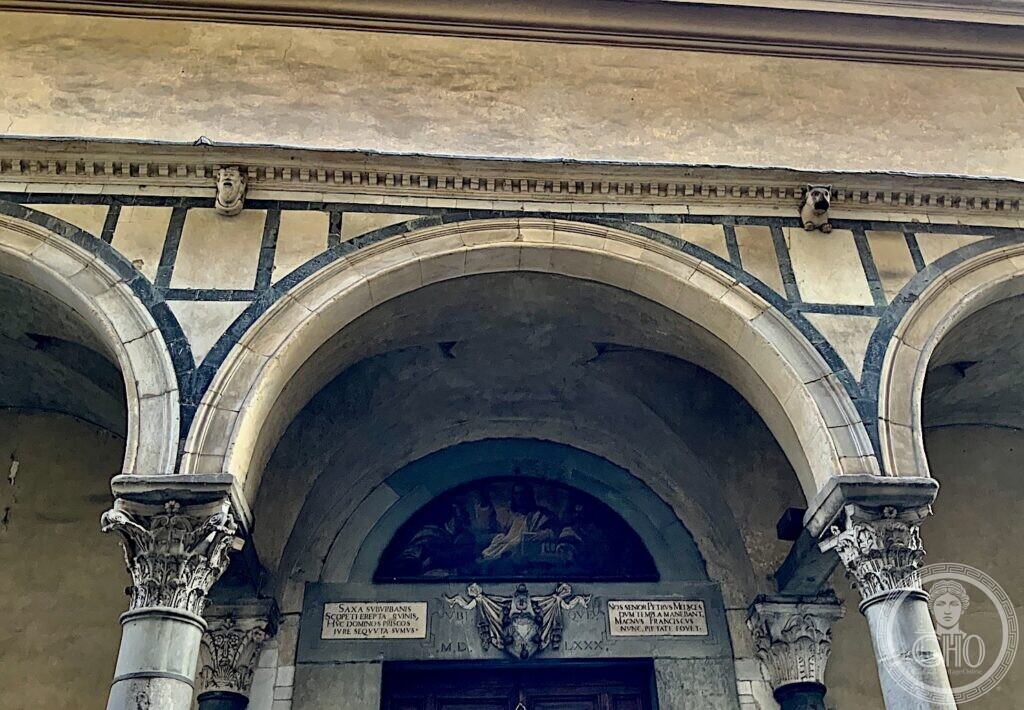
A small Romanesque church on Borgo San Jacopo in the Oltrarno, known for its layered architectural history and its position with the apse projecting over the River Arno.
At a glance
The church stands in the Oltrarno district of Florence, close to the Arno and a short walk from Ponte Santa Trinita. The building shows the marks of many centuries of change, from medieval origins to later renovations and redecoration.
Key facts
- Where: Borgo San Iacopo, 34, 50125 Firenze FI, Italy
- What: Church
- When: 10th–11th century (origins); later alterations
- GPS: 43.7681, 11.2507 · Open in Google Maps
History
The church was founded in the 10th century and had given its name to the surrounding Borgo San Jacopo by the late medieval period. Giovanni Villani mentions it as existing in 1078. In 1418, according to Vasari, the Ridolfi family commissioned Brunelleschi to build a chapel with a reduced-scale cupola as a trial for the dome of Florence Cathedral. The chapel and its cupola no longer survive.
The building has been much altered over time. The façade portico was added in 1580, using materials from the church of San Donato in Scopeto, which was demolished during fortification works before the siege of 1529. The bell tower was built in 1660 to a design by Gherardo Silvani. The interior was heavily modified in the 18th century. After the Arno flood of 1966, restorations brought original Romanesque structural details back to light.
The church now belongs to the Greek Orthodox community in Florence.
What you see
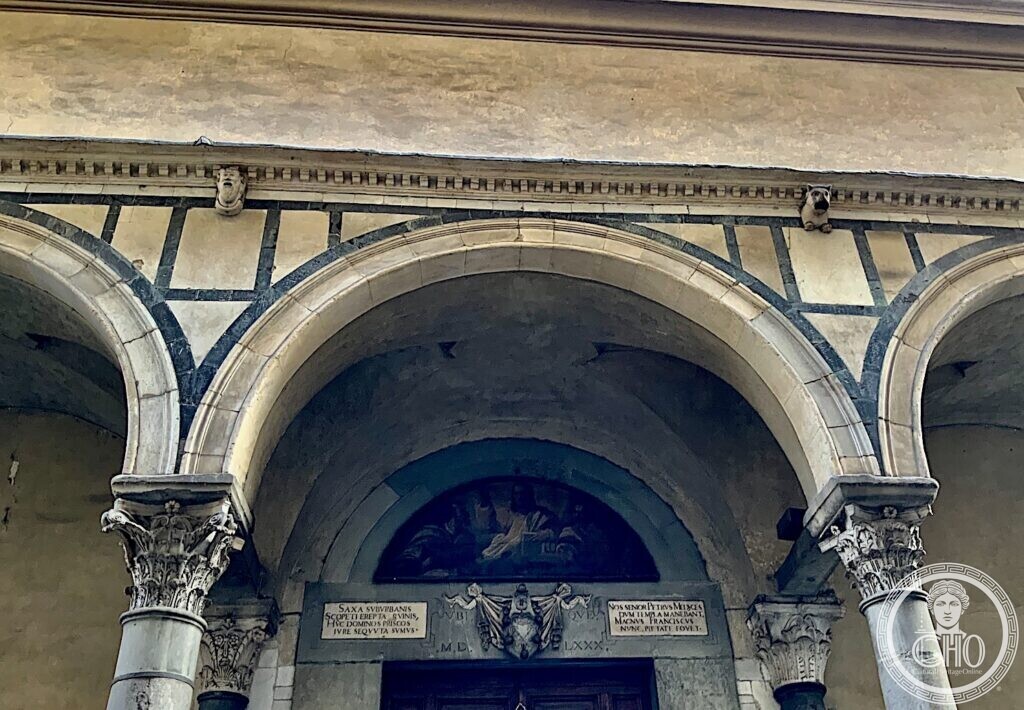
The photograph shows part of the façade portico, with columns and stone capitals. The capitals are decorated with carved heads, which are medieval in character. Above the arches, the wall surface includes geometric dark stone inlays and a stone plaque bearing a Latin inscription.
The church has a three-nave interior with eleven lateral chapels and gilded stucco decoration. The apse extends over the river, supported on projecting brackets, which is why Florentines once called the church “la chiesa col culo in Arno.”
Alba Santo’s photograph also records the Latin inscription on the façade plaque, partially legible as ‘SAXA SVIS VIRIBVS / SCIPIO… / AEDIFICATA… / IVRE SEQVATA SVVM / VIR / M.D. / LXXX.’ The Roman numerals M.D. LXXX correspond to 1580, the year the portico was added from San Donato in Scopeto. Santo’s notes to the editorial staff identify the subject of the photograph and the inscription. The church’s association with the Knights Templar, mentioned in visitor accounts collected by Wanderlog, is not confirmed by the historical sources cited on this page.
Do you know more about this place?
If you know a date, a name, a document, a plaque or a photograph that tells its story, write to Sofia through the contact page. What arrives with a source goes into this page, with your name as the contributor.
Nearby
- Ponte Vecchio, Florence — the medieval bridge at the end of Borgo San Jacopo
- Antichità Messeri Firenze — antique shop a short walk away in the Oltrarno
- Museo Salvatore Ferragamo — museum in the nearby Spini Feroni Palace
- Salvatore Ferragamo Museum – Spini Feroni Palace — historic palace and museum close to the church
Gallery
Sources
- Chiesa Greco-Ortodossa, San Jacopo Apostolo, Firenze, Storia: portico from San Donato in Scopeto, bell tower by Gherardo Silvani, interior changes
- Leonardo da Vinci Art School, La chiesa col culo in Arno: existence in 1078, Brunelleschi chapel, portico added in 1580, bell tower 1660, nickname
- Wanderlog, Chiesa di San Jacopo Soprarno, Florence, Italy: address, Romanesque origins, Greek Orthodox use
- Chiese Italiane, Chiesa di San Jacopo sopr’Arno, Firenze: property and restoration dates, 18th-century alterations
- Firenze-Oltrarno.net, Chiesa di San Jacopo in Soprarno: three-nave interior, eleven lateral chapels, frescoes by Meucci and Bonechi, medieval carved capitals
- OpenStreetMap, Chiesa di San Jacopo Soprarno: address and coordinates
- Alba Santo, photographs and notes to the editorial staff (2026): identification of the subject and the inscription. Not a published source
Find it on the map
See this place and what’s around it →📷 Become a Cultural Heritage Online photographer
Share your photos of places: they stay published under your name as the author. The more they're seen, the more you get noticed — and soon a contest will reward the most appreciated photos.
Log in or sign up free to add a photo