
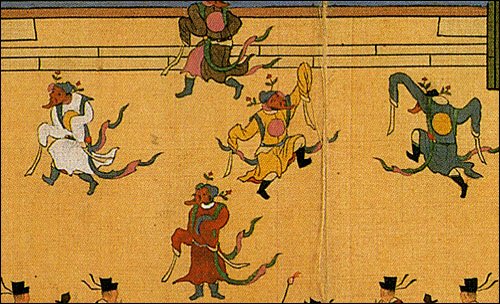
A masked court dance performed by five dancers to expel evil spirits, rooted in the legend of Cheoyong, son of the Dragon King of the Eastern Sea, and the oldest surviving Korean court dance.
At a glance
Cheoyongmu is a ritualistic masked dance in which five performers move with majesty and vigour to drive away malevolent forces, traditionally at year’s end. The dancers wear elaborate costumes and distinctive masks while moving to music punctuated by lyrical recitations. Both its form and its purpose—exorcism through movement—mark it as a living link to Korea’s shamanistic and courtly traditions.
Origins & history
The dance emerged during the Unified Silla period, making it the oldest surviving Korean court dance. It draws from the mythology of Cheoyong, a supernatural figure born to the Dragon King of the Eastern Sea, who became a protector against evil. The practice bridges two worlds: the royal court where it was formally performed, and the shamanistic tradition of spirit expulsion that gave it spiritual power. It was designated a South Korean Intangible Cultural Property in 1971 and inscribed on UNESCO’s Intangible Cultural Heritage List in 2009.
The practice
Five masked dancers command the performance space with deliberate, powerful movements. Each wears a mask and costume integral to the character and spiritual function of the dance. The accompaniment combines instrumental music with sung narratives—lyrical recitations that support the dancers’ gestures and set the pace. The music punctuates key moments, building and releasing tension to heighten the ritual’s efficacy. Performed traditionally at year’s end, Cheoyongmu transforms a public space into a site of collective protection through synchronized movement and sound.
Cultural significance
Cheoyongmu embodies Korea’s integration of mythology, courtly refinement, and spiritual practice. Its continuance demonstrates how a single dance can hold multiple meanings—as entertainment, ritual cleansing, and historical record. The practice transmits knowledge of movement vocabularies, costuming, mask-making, and music that would otherwise be lost. By keeping Cheoyongmu alive, Korean communities preserve a window into pre-modern court culture and the shamanistic worldview that shaped Korean identity.
Key facts
- Five dancers always perform Cheoyongmu
- Oldest surviving Korean court dance, created during the Unified Silla period
- Designated South Korean Intangible Cultural Property in 1971
- UNESCO Intangible Cultural Heritage inscription: 2009 (reference 00189)
- Anchor community: Seoul, South Korea (37.55546, 126.98828)
Where to experience it
Seoul is the heartland of Cheoyongmu practice and preservation. You may encounter performances at cultural centers, museums, and official celebrations throughout the city. Contact local cultural heritage organizations or the National Intangible Heritage Center for current performance schedules and venues.
Sources & resources
- Cheoyongmu — Wikipedia
- Cheoyongmu — UNESCO Intangible Cultural Heritage
- Cultural Heritage Online
Find it on the map
See this place and what’s around it →📷 Become a Cultural Heritage Online photographer
Share your photos of places: they stay published under your name as the author. The more they're seen, the more you get noticed — and soon a contest will reward the most appreciated photos.
Log in or sign up free to add a photo