
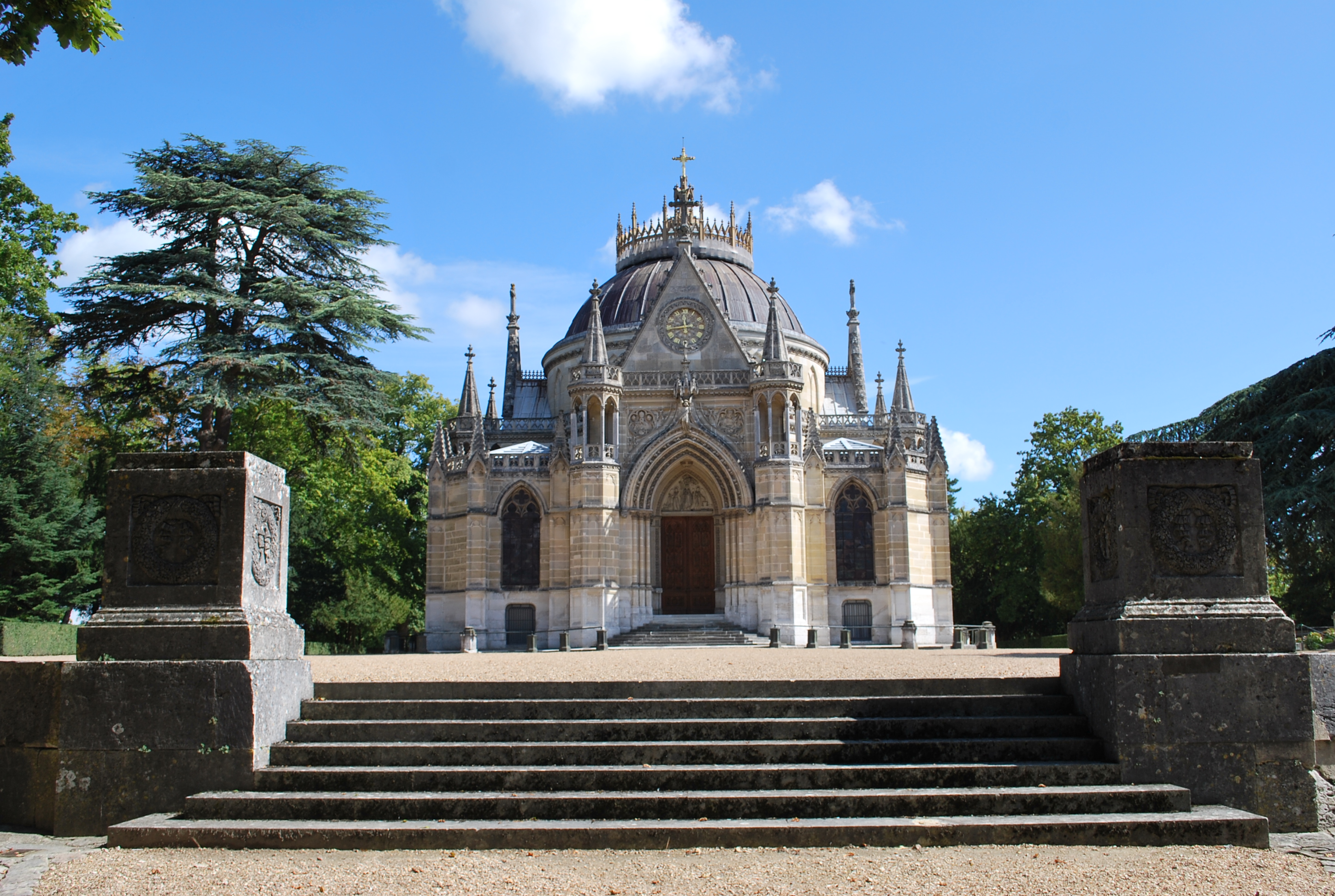
An early monument to French Gothic Revival architecture and the dynastic mausoleum of the House of Orléans, distinguished by its innovative enamel-on-glass windows.
At a glance
The Royal Chapel of Dreux serves as the burial place of members of the House of Orléans. Despite its domed crown, it marks an important moment in France’s embrace of Gothic Revival aesthetics during the nineteenth century.
History
Commissioned by King Louis Philippe I, the chapel’s decoration began in 1828. Alexandre Brogniart, director of the renowned Sèvres porcelain manufactory, undertook the ambitious task of producing fired-enamel paintings on large panes of plate glass—an innovative technique that established one of the first significant French Gothic Revival commissions. This work preceded most other Gothic Revival expressions in France, save for scattered Gothic elements in a few landscape gardens.
What you see
The chapel combines Gothic Revival elements with a distinctive domed roof, a hybrid approach that reflects early nineteenth-century experimentation with historical styles. The enamel-on-glass windows created by Brogniart represent a technical achievement of the period, merging decorative arts with architectural aspiration.
Cultural significance
The chapel holds importance both as a dynastic monument to the House of Orléans and as a landmark in French architectural taste. Its construction and decoration represent an early and authoritative engagement with Gothic Revival principles, introducing porcelain manufactory techniques to monumental religious and commemorative architecture.
Key facts
- Country: France
- City: Dreux
- Coordinates: 48.7383, 1.3633
- Decoration commenced: 1828
- Director of works: Alexandre Brogniart
Practical information & getting there
The chapel is located in Dreux, in north-central France. For current opening hours, visiting conditions, and further details, consult local tourism resources or the chapel directly.
Sources & resources
- Chapelle royale de Dreux – Wikipedia
- Cultural Heritage Online
Find it on the map
See this place and what’s around it →📷 Become a Cultural Heritage Online photographer
Share your photos of places: they stay published under your name as the author. The more they're seen, the more you get noticed — and soon a contest will reward the most appreciated photos.
Log in or sign up free to add a photoIs this page about you?
This page is read by travellers and heritage enthusiasts who find it on Google. Tell us how you are connected to this place and we will take it from there.