
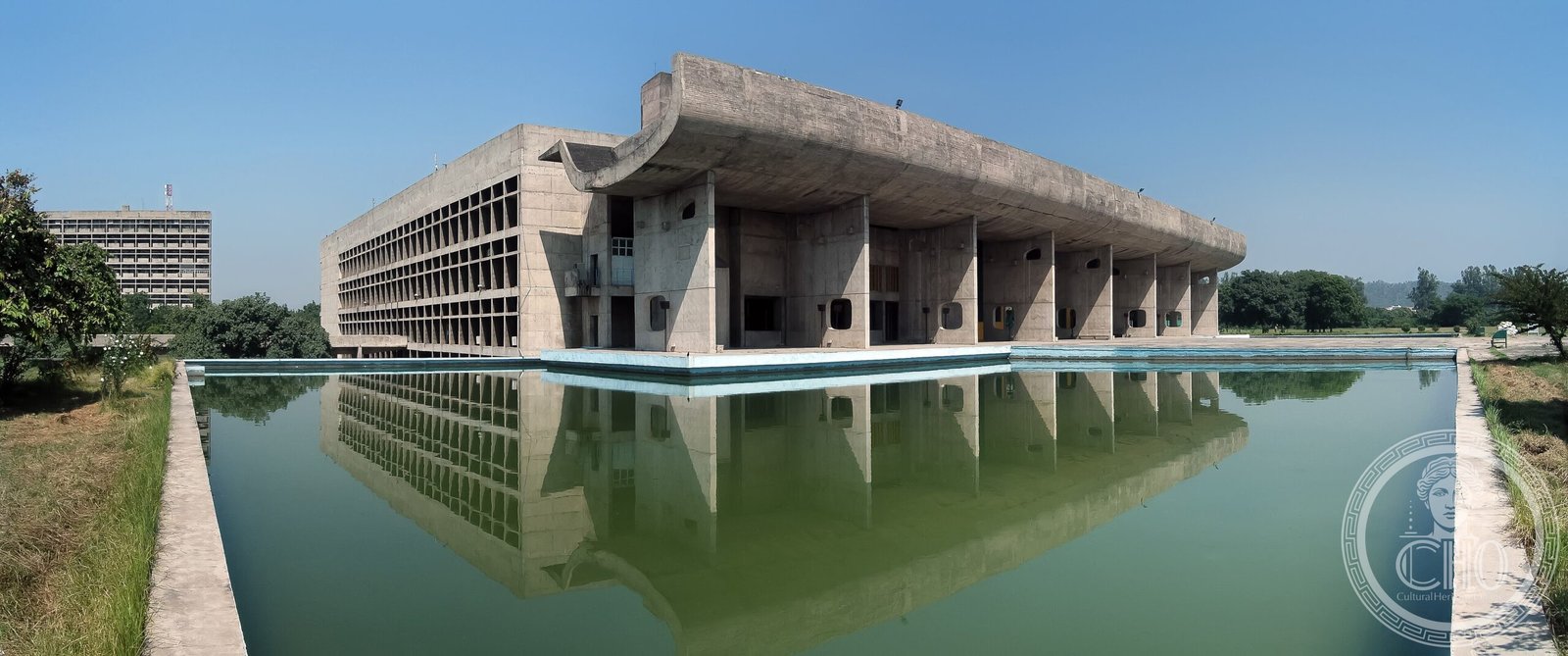
Le Corbusier’s visionary government compound in Chandigarh demonstrates modernist principles through three institutional buildings, monuments and careful manipulation of light and shadow across 100 hectares.
At a glance
The Capitol Complex comprises three primary buildings: the Palace of Assembly, Secretariat Building and High Court, supplemented by four monuments—the Open Hand Monument, Geometric Hill, Tower of Shadows and Martyrs Monument—plus an artificial lake. The ensemble sprawls across approximately 100 hectares of carefully planned landscape.
History
Swiss-French architect Le Corbusier designed this government compound as the institutional heart of Chandigarh, India’s newly planned capital city. His approach synthesized functional modernism with experimental environmental control, particularly in managing India’s intense solar radiation. The complex represents a pivotal moment in twentieth-century architectural ambition.
What you see
The Tower of Shadows exemplifies Le Corbusier’s innovative thinking: no direct sunlight penetrates its interior from any angle throughout the day. Its north-facing wall remains completely open, recognizing that the sun never reaches this direction. Le Corbusier applied these same light-management principles across the Capitol Complex buildings, creating spaces that respond precisely to climate and geometry rather than convention.
Cultural significance
The Capitol Complex stands as one of Le Corbusier’s most ambitious realized works and a landmark achievement in modernist architecture. UNESCO recognized its significance by inscribing it alongside sixteen other Le Corbusier projects as testimony to his transformative influence on twentieth-century design and urban planning.
Key facts
- Location: Chandigarh, India (30.7592°N, 76.8047°E)
- Architect: Le Corbusier and co-workers
- Area: Approximately 100 hectares
- UNESCO World Heritage Site (inscribed with other Le Corbusier works)
Practical information & getting there
The Capitol Complex is located in central Chandigarh. Specific opening hours, admission fees and visitor guidelines should be confirmed before your visit. For current details on access and tours, consult local tourism information or the official Chandigarh tourism authority.
Sources & resources
Find it on the map
See this place and what’s around it →📷 Become a Cultural Heritage Online photographer
Share your photos of places: they stay published under your name as the author. The more they're seen, the more you get noticed — and soon a contest will reward the most appreciated photos.
Log in or sign up free to add a photoIs this page about you?
This page is read by travellers and heritage enthusiasts who find it on Google. Tell us how you are connected to this place and we will take it from there.