

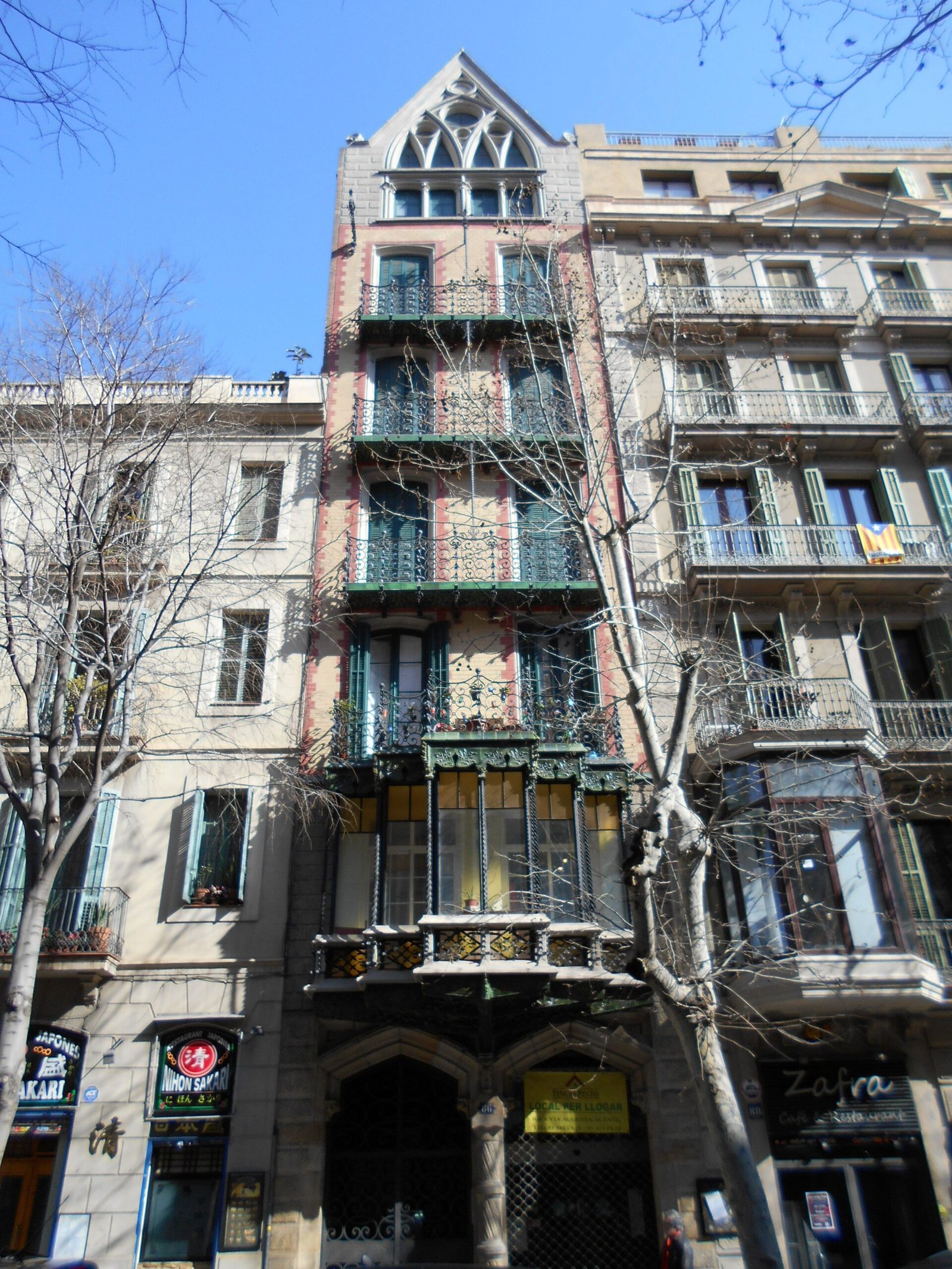
A modernist apartment building designed by Joan Rubió y Bellver, a protégé of Antoni Gaudí, showcasing refined early Catalan modernism through its distinctive bow window and neo-Gothic detailing.
At a glance
Casa Pomar occupies a corner site on Carrer de Girona in Barcelona’s Eixample district. The modest five-story building exemplifies the restraint and elegance that characterize second-generation Catalan modernism.
History
The building was designed by Joan Rubió y Bellver (1871–1952), a Catalan architect trained under Antoni Gaudí. Construction began in 1904 and was completed two years later. Rubió y Bellver’s career bridged the transition from modernisme to more austere contemporary movements.
What you see
The narrow facade makes efficient use of its constrained urban plot. A prominent bow window marks the first floor, its base clad in green ceramic tiles and wrought iron ornament. Above this focal point, a series of balconies step upward across the remaining floors. The neo-Gothic references in the metalwork and tilework suggest Rubió y Bellver’s interest in medieval Catalan precedents, a common preoccupation among modernist architects of the era.
Cultural significance
Casa Pomar represents a more sober expression of modernism than the exuberant work of Gaudí or Lluís Domènech i Montaner. Rubió y Bellver’s design demonstrates how the movement’s vocabulary could be adapted to modest residential commissions without sacrificing architectural sophistication.
Key facts
- Country: Spain
- City: Barcelona (Dreta de l’Eixample)
- Architect: Joan Rubió y Bellver
- Completed: 1906
- Coordinates: 41.3956, 2.1703
Practical information & getting there
Casa Pomar stands at number 86 Carrer de Girona, in the Eixample district. It remains a private residence and is best appreciated from the street. The building is accessible by public transport; several metro lines serve nearby stations.
Sources & resources
Find it on the map
See this place and what’s around it →📷 Become a Cultural Heritage Online photographer
Share your photos of places: they stay published under your name as the author. The more they're seen, the more you get noticed — and soon a contest will reward the most appreciated photos.
Log in or sign up free to add a photoIs this page about you?
This page is read by travellers and heritage enthusiasts who find it on Google. Tell us how you are connected to this place and we will take it from there.