

A confectioner’s shop opened by a Swiss family under the last Medici grand duke, which followed the city’s own rebuilding across two streets and settled, early in the twentieth century, on the corner where the old Ghetto had stood.
At a glance
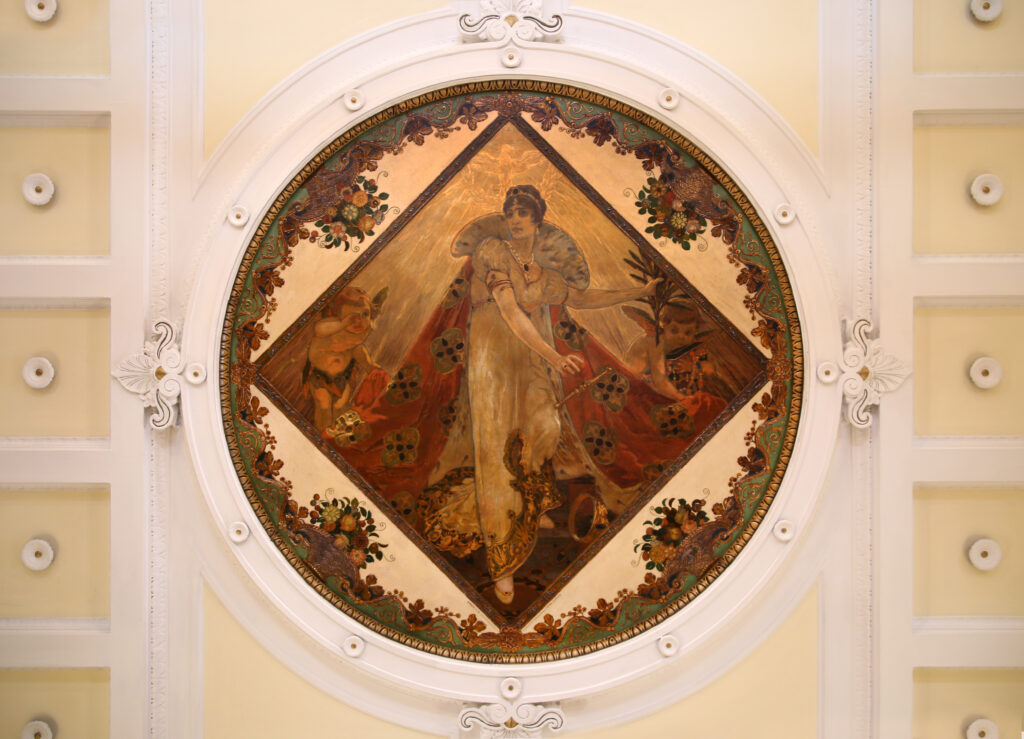
Gilli occupies the ground floor at the corner of Piazza della Repubblica and Via Roma, inside the block-sized palace built in 1890–1893 for the Levi brothers and long the headquarters of the Fondiaria insurance company. The business is older than the building by a century and a half: it began in 1733 as a sweet-bread shop in Via dei Calzaiuoli. Inside, the rooms keep furnishings described as original and four painted ceiling medallions of society women by Ezio Giovannozzi. The café is listed among Florence’s historic businesses and belongs to the Locali Storici d’Italia association.
Key facts
- Where: Piazza della Repubblica 39r, corner of Via Roma, Florence
- Founded: 1733, as the Bottega dei Pani Dolci, by the Swiss Gilli family, in Via dei Calzaiuoli
- Present site: from the early twentieth century (sources vary between the 1910s and around 1920)
- Building: Palazzo Levi, also called Palazzo della Fondiaria Assicurazioni, built 1890–1893 to a design by Giuseppe Boccini
- Interior: four ceiling medallions with portraits of women by Ezio Giovannozzi, first decade of the 1900s
- Status: recorded as a historic business of Florence (1988); member of Locali Storici d’Italia
- Coordinates: 43.771945, 11.254283 · open in Google Maps
History
The Gilli family came from Switzerland, and in 1733, in the Florence of Gian Gastone de’ Medici, they opened a confectioner’s shop in Via dei Calzaiuoli, near the Loggia degli Adimari. It was called the Bottega dei Pani Dolci, the sweet-bread shop, and its customers came from the Florentine nobility.
The move to its present corner was a consequence of the largest demolition in the city’s history. In the 1880s the Mercato Vecchio and the Jewish Ghetto were cleared to make a new square, then called Piazza Vittorio Emanuele II, and new palaces were raised around it. Gilli first moved to Via degli Speziali, and then, in the early twentieth century, to the corner of the new square and Via Roma, a spot old Florentines still call the canto de’ Dadaioli, after the dice players of the Ghetto’s gaming houses. The municipal register of historic businesses places the arrival around the 1920s, after the business had passed to another Swiss family, the Frizzoni; other accounts place it in the 1910s.
The building it moved into had been designed by Giuseppe Boccini and raised in 1890–1893 for the brothers Ottavio and Enrico Levi, who owned part of the Ghetto houses on the site; from 1893 it housed the Fondiaria insurance company. The square became the city’s literary café district. Gilli and its neighbour Paszkowski, in the same palace, were frequented by the writers of La Voce, among them Giuseppe Prezzolini, and in the Futurist years by Filippo Tommaso Marinetti and Ardengo Soffici. Ruth Orkin’s 1951 photograph American Girl in Italy was taken on the pavement outside. The palace was restored between 2005 and 2008 and its interiors reorganised to a design by Massimo Pierattelli in 2011.
What you see
The palace front on the square is long and even: four storeys in pale ochre render, eleven bays, rusticated corners, alternating triangular and curved pediments over the first-floor windows and a long stone balcony across the central bays. The ground floor is an arcade of round-headed openings, now shaded by the awnings of the two cafés that share it, Paszkowski to the left and Gilli at the right-hand end, where the building turns into Via Roma.
Inside, the photograph above shows one of the ceiling medallions: a woman in a long pale gown, a fur-trimmed cloak spread behind her, set in a lozenge flanked by two putti, with a painted border of flowers and scrolls inside a white stucco frame. The source that records these paintings attributes them to Ezio Giovannozzi and dates them to the first decade of the twentieth century. On the Via Roma side, a small bronze plaque records Gilli as the official seat of the Donatello prize.
Practical information
- Gilli is a working café, pastry shop and restaurant; the rooms can be seen by anyone who sits down or stands at the counter.
- The ceiling medallions are in the interior rooms; look up.
- The palace facade is best seen from the middle of the square, where the whole eleven-bay front fits in one view.
- Owned by the Valenza family since 1990, according to the Locali Storici d’Italia association.
Getting there
Piazza della Repubblica is at the centre of the historic core, about five minutes on foot from the Duomo along Via Roma and ten to twelve minutes from Santa Maria Novella station. The historic centre is a limited-traffic zone; arrive on foot.
Nearby
- Palazzo Strozzi, two blocks west.
- Palazzo Davanzati, the Museum of the Ancient Florentine House, a short walk south.
- Florence Cathedral, at the end of Via Roma.
- The Arcone, the triumphal arch on the west side of the same square, carrying the inscription on the 1890s clearance of the old centre.
Sources
- Repertorio delle Architetture Civili di Firenze (Palazzo Spinelli), Palazzo della Fondiaria Assicurazioni: dates, architect, patrons, restorations, the Giovannozzi medallions and the literary clientele.
- Destination Florence, historic businesses: Gilli: 1733 founding, the Frizzoni ownership and the move around the 1920s, the 1988 listing, the Donatello prize.
- Locali Storici d’Italia, Il fascino del Caffè Gilli: the Via dei Calzaiuoli origins, the two moves, the Valenza family.
- Wikipedia (it), Caffè Gilli and Palazzo Levi (Firenze), with their bibliographies (Draghi 2007; Spignoli 2009).
- OpenStreetMap / Nominatim: position returned as Caffè Gilli, 1r, Via Roma, Firenze.
Find it on the map
See this place and what’s around it →📷 Become a Cultural Heritage Online photographer
Share your photos of places: they stay published under your name as the author. The more they're seen, the more you get noticed — and soon a contest will reward the most appreciated photos.
Log in or sign up free to add a photoIs this page about you?
This page is read by travellers and heritage enthusiasts who find it on Google. Tell us how you are connected to this place and we will take it from there.