

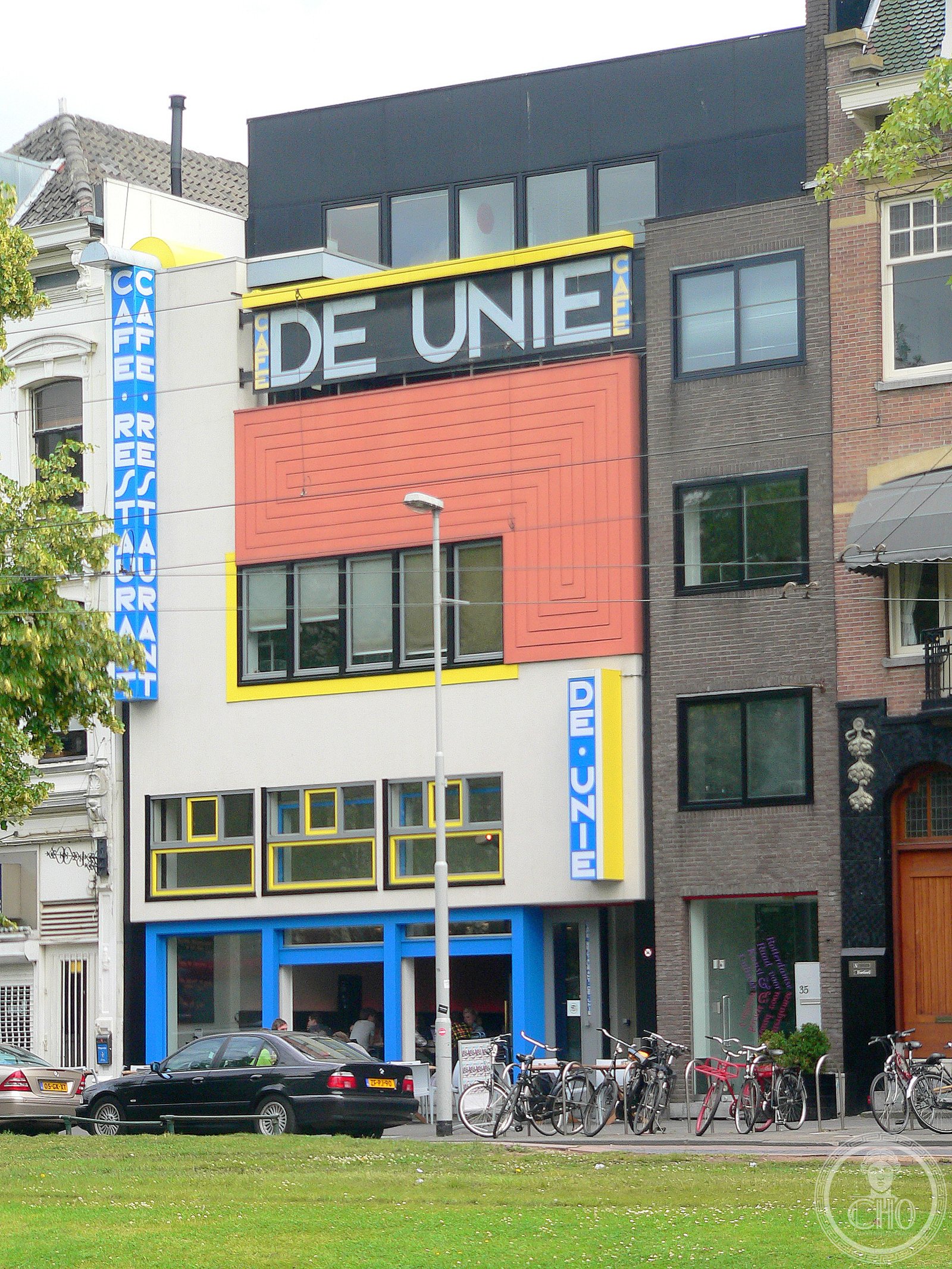
One of the founding monuments of 20th-century architecture, Café de Unie brought the radical geometry of the De Stijl movement directly to a Rotterdam street corner in 1925. Architect J.J.P. Oud stripped away every ornamental tradition and replaced them with a flat façade of horizontal and vertical planes, primary color blocks — red, yellow, blue, and white — and asymmetric window arrangements that read as a manifesto in built form. The letters of the café name were not signage added after the fact but integral elements of the overall composition, their sizing and placement calculated as carefully as any beam or column. This commercial building of modest scale had an impact far exceeding its footprint: it was a direct influence on Gerrit Rietveld, later on the Bauhaus, and ultimately on all Modernist commercial design. The original was destroyed by German bombing in May 1940, which leveled ninety percent of Rotterdam historic center. It was faithfully reconstructed in 1986 from original drawings on a nearby site, ensuring this seminal work endures for new generations of architects and visitors.
At a glance
- Type
- Commercial / Café
- Period
- 1925 (original); reconstructed 1986
- Style
- De Stijl / Dutch Functionalism
- Location
- Mauritsweg, Rotterdam, Netherlands
- Coordinates
- 51.9194° N, 4.4834° E
- Architect(s)
- J.J.P. Oud
Overview
Café de Unie stands as one of the purest applications of De Stijl principles to a real-world commercial building. J.J.P. Oud, who had worked closely with Theo van Doesburg and Piet Mondrian in the De Stijl group, used this modest two-storey structure — ground-floor cafés, upper-floor restaurant — to demonstrate that the movement abstract painting principles could govern architecture at human scale. The result was simultaneously avant-garde and functional: a working café that happened to be a living artwork. Heritage Rotterdam today considers it among the most important reconstructed structures in the city.
History
Oud designed the café in 1924 for a corner site on Mauritsweg and it opened in 1925. From the outset it was intended as a temporary structure — a statement building without pretense of permanence. Its fame spread immediately through the European architectural press, reaching Mies van der Rohe, Le Corbusier, and Walter Gropius. The German Luftwaffe bombing of Rotterdam on 14 May 1940 — one of the war most devastating urban air raids — destroyed the original along with most of the historic city center. For over four decades it existed only in drawings and photographs. In 1986 the city of Rotterdam commissioned a faithful reconstruction on a nearby Mauritsweg site using Oud original plans. The reconstruction itself became a landmark act of cultural memory, acknowledging what had been lost while restoring the building pedagogical role in the living city.
Architecture & Design
Oud rejected every historical ornament. The façade is organized as a grid of rectangular planes differentiated by color: white stucco fields punctuated by red and yellow panels, with blue lettering forming the café name. Window openings are asymmetrically placed to create visual tension rather than classical balance. The composition echoes Mondrian grid paintings but extends into three dimensions, where depth, shadow, and material texture add complexity absent in flat canvas. The integration of typography as structural design element — unprecedented at the time — anticipated by decades the graphic-architectural fusion that would characterize 20th-century commercial design. The ground floor housed two separate café spaces; the upper floor contained a restaurant. The palette and geometry were intended to be legible from a moving tram, making the building function simultaneously as architecture and urban advertisement.
Cultural significance
Café de Unie occupies an outsized position in the history of Modern architecture relative to its physical size. It demonstrated that De Stijl could operate at street level, not just in galleries or private villas, and that commercial constraints need not compromise artistic integrity. Its influence on Rietveld, the Bauhaus curriculum, and subsequent generations of European and American architects is well documented. The 1986 reconstruction itself carries significance: it affirmed Rotterdam commitment to cultural memory after wartime destruction and set a precedent for architecturally faithful reconstruction of lost Modernist landmarks.
Visiting today
The reconstructed Café de Unie is located on Mauritsweg in central Rotterdam, easily accessible on foot from Rotterdam Centraal station (approximately 15 minutes). The façade is fully visible from the street at all hours. Interior access depends on current commercial occupancy — the building has housed various businesses since reconstruction. Rotterdam architectural heritage trail connects Café de Unie with other key Modernist sites including the Kiefhoek housing estate (also Oud) and the Van Nelle Factory.
Getting there
Rotterdam Centraal station (trains from Amsterdam 40 min, The Hague 25 min) is the main arrival hub. Tram lines 4 and 7 serve Mauritsweg directly. By car, Rotterdam is on the A13/A20 motorway network; parking is available in the city center garages on Kruiskade. Rotterdam The Hague Airport (RTM) serves European routes; Amsterdam Schiphol (AMS) is 65 km north with direct train links.
Sources & resources
Find it on the map
See this place and what’s around it →Record researched and written by Luigi De Marchi for Cultural Heritage Online, 2026.
📷 Become a Cultural Heritage Online photographer
Share your photos of places: they stay published under your name as the author. The more they're seen, the more you get noticed — and soon a contest will reward the most appreciated photos.
Log in or sign up free to add a photoIs this page about you?
This page is read by travellers and heritage enthusiasts who find it on Google. Tell us how you are connected to this place and we will take it from there.