
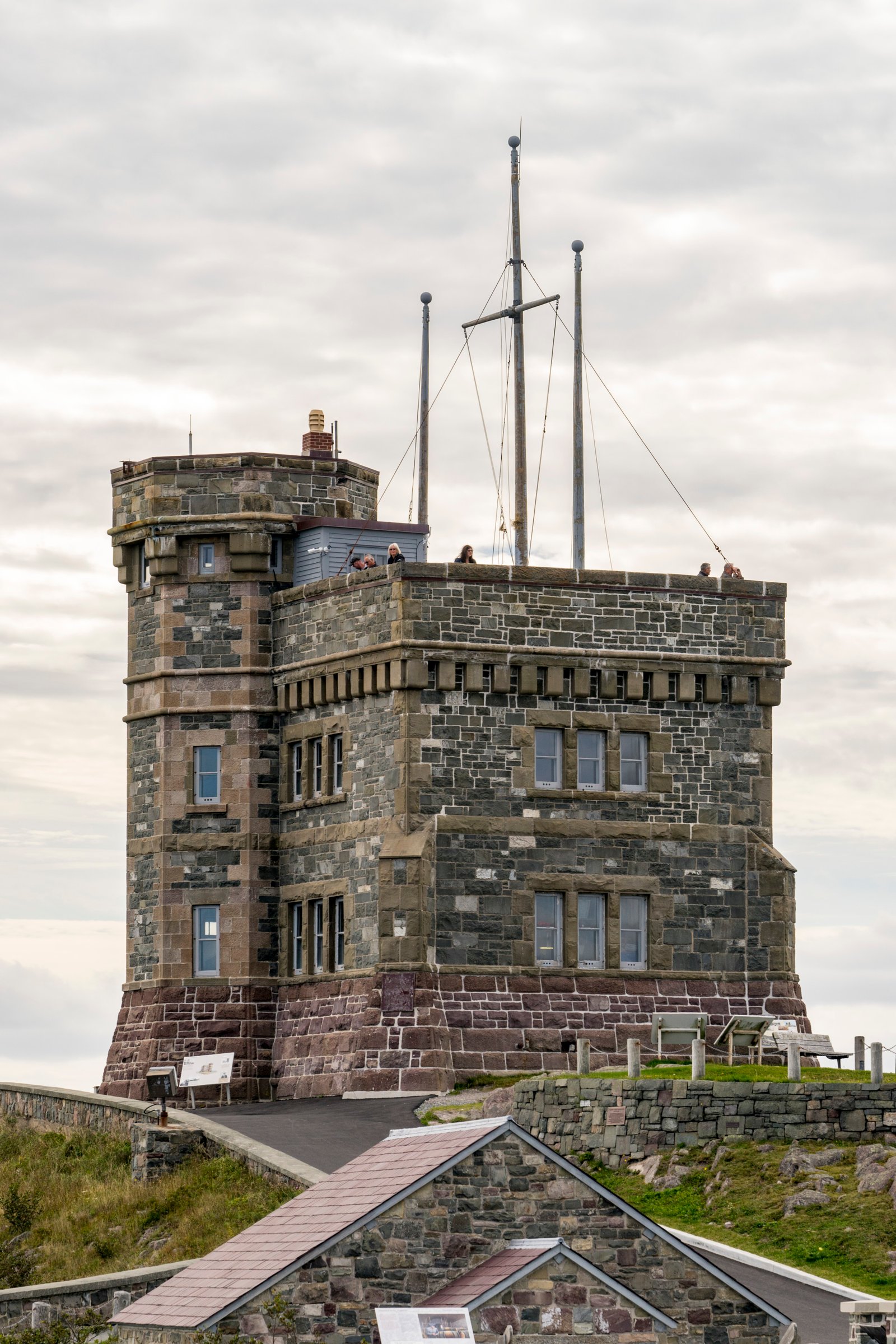
A cylindrical monument on Signal Hill commemorating John Cabot’s voyage to Newfoundland and Queen Victoria’s Diamond Jubilee, later the site of a historic wireless milestone.
At a glance
Cabot Tower stands on Signal Hill overlooking St. John’s harbour. Built between 1898 and 1901, the tower marks twin historical moments: the 400th anniversary of Cabot’s 1497 landing and the reigning monarch’s 60-year jubilee. Today it anchors the Signal Hill National Historic Site, drawing visitors to its interpretation centre and surrounding trails.
History
Construction began in 1898 to honour John Cabot’s voyage four centuries earlier. The project coincided with Queen Victoria’s Diamond Jubilee, making the tower a dual celebration of exploration and empire. In 1901, before the tower’s completion, Guglielmo Marconi received the first trans-Atlantic wireless message near the site—the letter “S” in Morse Code, transmitted from Poldhu, Cornwall. This achievement established Newfoundland as a crucial waypoint in the history of wireless communication.
What you see
The tower’s cylindrical form is characteristic of late-19th-century commemorative architecture. Its elevated position on Signal Hill commands views across St. John’s harbour and the Atlantic approaches, emphasizing Newfoundland’s maritime heritage.
Cultural significance
Cabot Tower bridges three historical narratives: European exploration of North America, Victorian imperial commemoration, and the advent of modern wireless technology. The Marconi reception elevated the site’s importance beyond local monument to international significance in the story of telecommunications. As the centrepiece of Signal Hill National Historic Site, it remains central to understanding Newfoundland’s role in transatlantic history.
Key facts
- Location: Signal Hill, St. John’s, Newfoundland and Labrador, Canada
- Coordinates: 47.57°N, 52.68°W
- Construction: 1898–1901
- Commemorates: John Cabot’s landing (1497) and Queen Victoria’s Diamond Jubilee
- Historic event: First trans-Atlantic wireless message received nearby, 1901
- Status: Centre of Signal Hill National Historic Site of Canada
Practical information & getting there
Cabot Tower is accessible to the public year-round as part of Signal Hill National Historic Site. The site offers walking trails and an interpretation centre providing context on the tower’s history and significance. For current visiting hours and detailed directions, consult the Parks Canada website.
Sources & resources
Find it on the map
See this place and what’s around it →📷 Become a Cultural Heritage Online photographer
Share your photos of places: they stay published under your name as the author. The more they're seen, the more you get noticed — and soon a contest will reward the most appreciated photos.
Log in or sign up free to add a photoIs this page about you?
This page is read by travellers and heritage enthusiasts who find it on Google. Tell us how you are connected to this place and we will take it from there.