
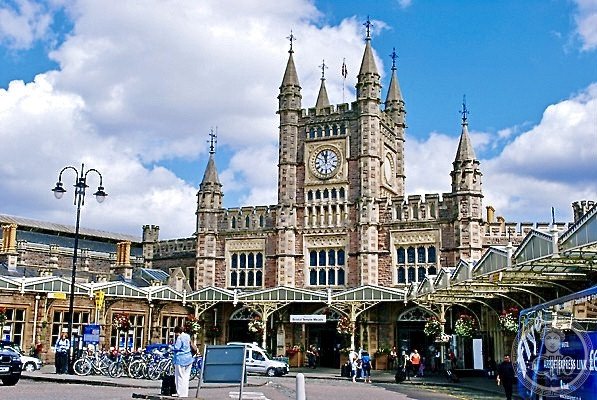
England’s oldest surviving railway terminus, opened by Isambard Kingdom Brunel as the western gateway of the Great Western Railway, now the busiest station in South West England.
At a glance
Bristol Temple Meads serves as the principal railway hub for the southwest, handling 13 active platforms across eight tracks. It functions as a major transport nexus, linking rail services with buses and a ferry to the city centre. The station ranks fifth among the busiest in Southern England outside London.
History
Temple Meads opened on 31 August 1840 as the western terminus of the Great Western Railway, designed by British engineer Isambard Kingdom Brunel. This pioneering railway was the first to bear his design.
The station quickly became essential to Bristol’s expanding network, serving the Bristol and Exeter Railway, Bristol and Gloucester Railway, Bristol Harbour Railway, and Bristol and South Wales Union Railway. Successive expansions—by Francis Fox in the 1870s and Percy Emerson Culverhouse between 1930 and 1935—transformed it to accommodate growing traffic. Brunel’s original terminus structure no longer forms part of the operational station.
What you see
The station’s physical layout reflects its layered history. Most of the site holds Grade I listed status, protecting its architectural and historical fabric. The modern operational station incorporates expanded platforms and track systems from twentieth-century rebuilds alongside surviving nineteenth-century elements that document the station’s evolution.
Cultural significance
Temple Meads stands as a landmark in British railway history—the first terminus designed by Brunel and a pioneering feat of Victorian infrastructure. Its Grade I listing acknowledges both its architectural merit and its role as a touchstone of Bristol’s development as a major port and industrial city.
Key facts
- Opened: 31 August 1840
- Designer: Isambard Kingdom Brunel
- Active platforms: 13 across 8 tracks
- Location: Bristol, United Kingdom
- Coordinates: 51.449°N, 2.58°W
- Listing: Grade I
- Distance from London Paddington: 118.39 miles (190.5 km)
Practical information & getting there
The station is managed by Network Rail and served by Great Western Railway and CrossCountry operators. You can reach it by bus, ferry, or on foot from Bristol city centre. For current train times and ticket information, consult the station operators’ websites.
Sources & resources
Find it on the map
See this place and what’s around it →📷 Become a Cultural Heritage Online photographer
Share your photos of places: they stay published under your name as the author. The more they're seen, the more you get noticed — and soon a contest will reward the most appreciated photos.
Log in or sign up free to add a photoIs this page about you?
This page is read by travellers and heritage enthusiasts who find it on Google. Tell us how you are connected to this place and we will take it from there.