
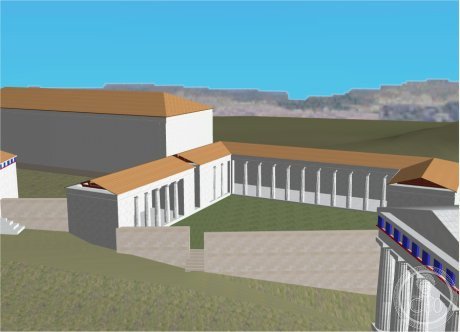
A sanctuary dedicated to Artemis Brauronia on the Athenian Acropolis, distinguished by its unusual trapezoidal design and stoa rather than a formal temple. Women sought the goddess’s protection during pregnancy and childbirth, leaving votive clothing draped around her cult statues.
At a glance
The Brauroneion occupied the southwest corner of the Acropolis plateau, wedged between the Chalkotheke and the Propylaea. Its sanctuary was anchored by a stoa measuring approximately 38 by 6.8 meters, flanked by two wing structures extending from its corners. The site was unusual in housing no formal temple building, a departure from conventional sanctuary architecture.
History
Originally dedicated during the reign of Peisistratos, the sanctuary evolved significantly over centuries. The complex as it stands was probably completed around 430 BC, contemporary with the adjacent Propylaea, with the entrance steps and northern enclosure likely designed by Mnesicles during the Propylaea’s construction.
In 346 BC, a second cult statue—attributed to the sculptor Praxiteles—replaced the earlier wooden xoanon. A bronze Trojan Horse, commissioned by the dedicator Chairedemos and sculpted by Strongylion, was added no later than 415/414 BC. The sanctuary probably remained in use until the late Roman period, when Christian emperors prohibited pagan worship.
What you see
The stoa’s distinctive trapezoidal footprint accommodated the irregular bedrock of the Acropolis summit. Its northern-facing portico measured roughly 38 meters long and 6.8 meters deep, with risalit-like side wings each approximately 9.3 meters in length, creating a complex spatial arrangement. A second, shorter stoa extended from the east wing.
Women who sought Artemis’s aid customarily left clothing as votive offerings, which were draped ceremonially around the goddess’s wooden and later marble statues. The western portion of the sanctuary has been lost; the eastern remains consist of wall foundations cut into bedrock and scattered limestone architectural fragments. Seven rock-cut steps at the northeast corner still mark the precinct’s entrance.
Cultural significance
The Brauroneion served women across Athens, extending the veneration of Artemis Brauronia—whose primary sanctuary stood at Brauron on the east coast of Attica—into the heart of the city’s sacred center. The accumulation of votive clothing transformed the shrine into a material record of women’s prayers and gratitude.
The bronze Trojan Horse was an exceptional sculptural achievement, an over-life-sized narrative artwork depicting Greek heroes emerging from the legendary wooden horse. The presence of such a monumental bronze sculpture demonstrates the Acropolis sanctuary’s standing among Athens’ most significant religious and artistic installations.
Key facts
- Country: Greece
- City: Athens
- Coordinates: 37.9715°N, 23.7255°E
- Date: circa 430 BC (final configuration); founded under Peisistratos (6th century BC)
- Stoa dimensions: approximately 38 × 6.8 meters
Practical information & getting there
The Brauroneion occupied the Acropolis plateau between the Propylaea and Chalkotheke; visitors to the Acropolis archaeological site encounter its remains as part of the broader sanctuary complex. Substantial portions have been lost or heavily damaged, though the entrance steps and foundational elements remain visible to those with knowledge of the site’s topography. Consult site interpretive materials or specialized guides for precise locations.
Sources & resources
Find it on the map
See this place and what’s around it →📷 Become a Cultural Heritage Online photographer
Share your photos of places: they stay published under your name as the author. The more they're seen, the more you get noticed — and soon a contest will reward the most appreciated photos.
Log in or sign up free to add a photoIs this page about you?
This page is read by travellers and heritage enthusiasts who find it on Google. Tell us how you are connected to this place and we will take it from there.