

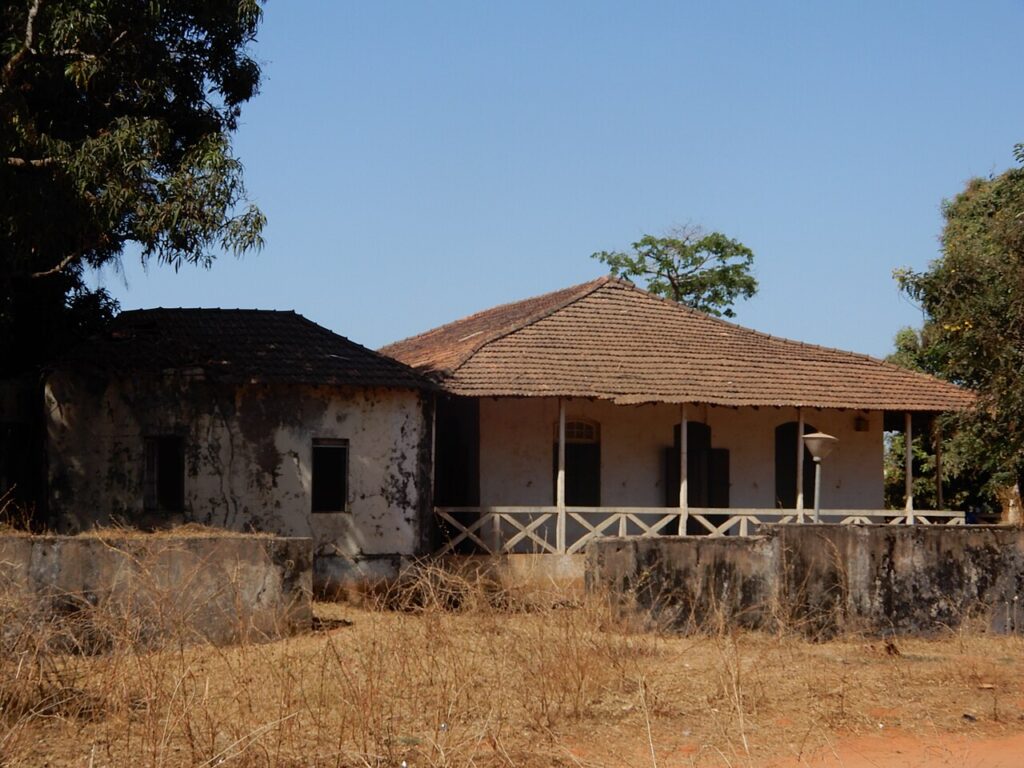
The abandoned first capital of Portuguese Guinea – neoclassical palaces crumbling under mango trees on an island the government left in 1941.
At a glance
- Type
- Historic former capital
- Period
- Capital 1879-1941
- Style
- Portuguese colonial neoclassicism
- Location
- Bolama island, Bijagos archipelago, Guinea-Bissau
- Coordinates
- 11.5772, -15.4761
- Arbiter of dispute
- US President Ulysses Grant, 1870
Overview
Bolama town decays in grandeur at the Bijagos’ edge – the first capital of Portuguese Guinea, its governor’s palace, arcaded ministries, and Praca colonnades surrendered to figs and weather since the administration sailed for Bissau in 1941. The ghost capital’s melancholy makes it West Africa’s most atmospheric colonial relic, on UNESCO’s tentative list with the archipelago’s biosphere.
History
Britain and Portugal disputed the island until 1870, when arbitration by US President Ulysses S. Grant awarded it to Lisbon – a statue of Grant’s memory stood in the square. The capital’s malaria and the mainland’s pull doomed Bolama; independence war and PAIGC’s 1973 declaration nearby passed it over. Inhabitants live among the shells, cashew sacks drying on ministry steps.
Architecture and Design
The governor’s palace’s double stair and pediment, the hospital’s long wards, and the cinema’s deco front line gridded avenues of crumbling plaster – photogenic entropy documented by heritage missions proposing stabilization before collapse wins.
Cultural significance
Bolama embodies colonialism’s impermanence – a capital nature reclaims – and anchors Guinea-Bissau’s heritage hopes with the Bijagos’ matriarchal island culture and biosphere reserve around it.
Visiting today
Canoes and small ferries cross from Bissau or Buba; guesthouses are basic, the wandering unforgettable. The Bijagos’ sacred islands extend the journey for the prepared.
Getting there
Boats leave Bissau’s port on tides for the four-hour crossing; arrangements are informal – allow flexible days.
The Portuguese record gives exact dates: Bolama became capital on 18 March 1879, when Lisbon proclaimed the still ill-defined “Província da Guiné”, and the administration moved to Bissau on 19 December 1941.
Sources and resources
Find it on the map
See this place and what’s around it →Record researched and written by Luigi De Marchi for Cultural Heritage Online, 2026.
At auction this weekArt Deco glass, lighting and furniture are sold at auction every weekPieces from the 1920s and 1930s are open for bidding today on Catawiki, where an expert checks each lot before it goes live.See what is open on Catawiki →
Advertisement. Pictured, from the Cleveland Museum of Art (CC0) and not for sale: three pieces of Lalique glass, 1920 to 1931. How we handle this
📷 Become a Cultural Heritage Online photographer
Share your photos of places: they stay published under your name as the author. The more they're seen, the more you get noticed — and soon a contest will reward the most appreciated photos.
Log in or sign up free to add a photo