

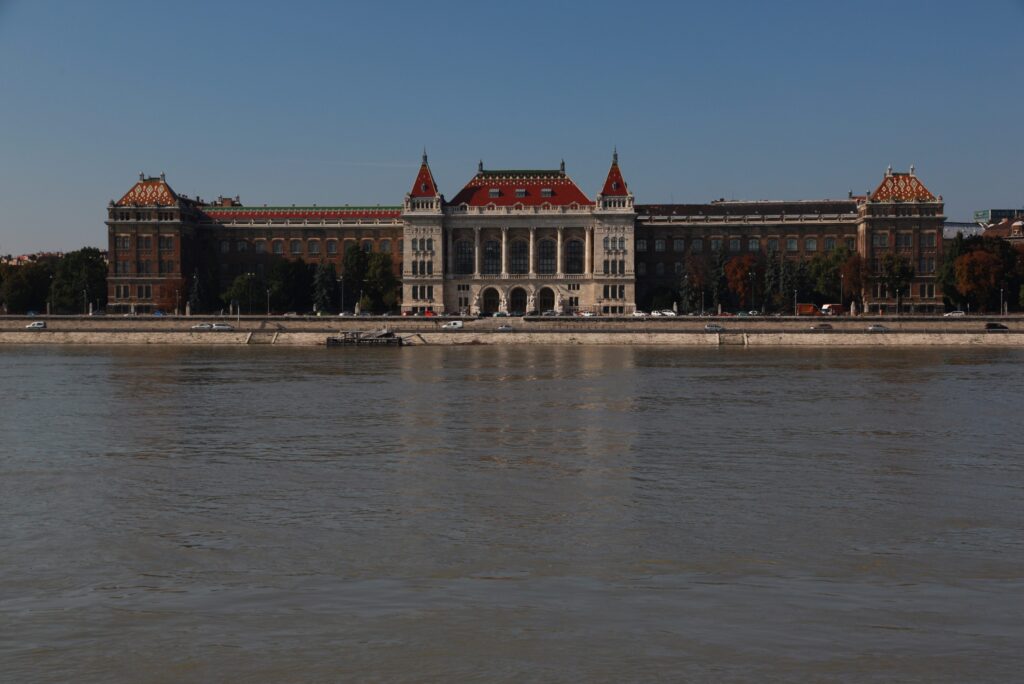
The central building of Budapest's technical university, raised between 1906 and 1909 on the Danube bank, houses the Faculty of Architecture, where architects have trained since 1871.
At a glance
The K Building is the central building of the Budapest University of Technology and Economics, on Műegyetem rakpart in the eleventh district. It was built between 1906 and 1909, after Alajos Hauszmann took over the design from Győző Czigler. The Faculty of Architecture teaches in it. Its roofs carry glazed ceramics from the Zsolnay factory.
Key facts
- Built 1906–1909 at Műegyetem rakpart 3
- Design taken over by Alajos Hauszmann
- Construction led by Lipót Havel, checked by József Benedicty
- Glazed ceramics fired at the Zsolnay factory
- Architecture taught at the Műegyetem since 1871
- Three academicians and three Kossuth Prize winners on the faculty
- Free guided building walk, registration required
History
Architecture was taught at the József Nádor Műegyetem from 1871, in the Department of Architecture and Engineering. The first teachers were the leading architects of the day: Imre Steindl, who designed the Parliament; Alajos Hauszmann, who designed the new wings of the Royal Castle and the university's own buildings; and Frigyes Schulek, master of Matthias Church and the Fisherman's Bastion.
The old premises on Múzeum körút and in rented houses had become unworkable, and the teaching staff pressed the ministry for a new university. Győző Czigler began the planning at Lágymányos and died before it was finished. Hauszmann took over and kept the central building for himself, handing Samu Pecz the library and the engineering pavilions. Lipót Havel directed the construction and József Benedicty checked it. The central building was completed in 1909.
Károly Senyei made the sculptures in front of the main entrance, and the glazed ceramic elements were fired at the Zsolnay factory in Pécs.
The faculty states that almost every significant Hungarian architect has graduated from it, and that its architecture diploma was among the first Hungarian degrees recognised without restriction in the European Union. Three academicians and three Kossuth Prize winners teach there, and staff also built the Gömböc.
What you see
The K Building presents a long, symmetrical front to the Danube, with corner towers and a central block of columns and arches above the entrance steps. The patterned roofs are the most conspicuous thing about it: coloured glazed tiles laid in geometric bands, made in Pécs.
Inside, the first-floor corridor (kerengő) is where the student societies put their fairs and open-day stands, and the lecture rooms carry plain numbers: K250, K275, and the hall K210. The faculty holds an open day in late November, with short lectures on architecture, a drawing briefing and a campus history walk that starts at the neighbouring CH building.
Practical information
- Address: Műegyetem rakpart 3, 1111 Budapest
- Guided building walk (épületséta) of the K Building, free with registration
- The walk is led by Dr Miklós Armuth
- Open day in late November, with lectures and studio exhibitions
- A teaching building in daily use by the Faculty of Architecture
Getting there
The building stands on the Buda bank at Lágymányos. Szabadság híd and Gellért Baths are both about 450 m away, and Gellért Hill about 1 km.
Nearby
- Gellért Baths
- Liberty Bridge (Szabadság híd)
- Petőfi Bridge
- Gellért Hill
Sources
Find it on the map
See this place and what’s around it →📷 Become a Cultural Heritage Online photographer
Share your photos of places: they stay published under your name as the author. The more they're seen, the more you get noticed — and soon a contest will reward the most appreciated photos.
Log in or sign up free to add a photoIs this page about you?
This page is read by travellers and heritage enthusiasts who find it on Google. Tell us how you are connected to this place and we will take it from there.
This entry stays online and free either way — and a free account lets you add to it yourself.