
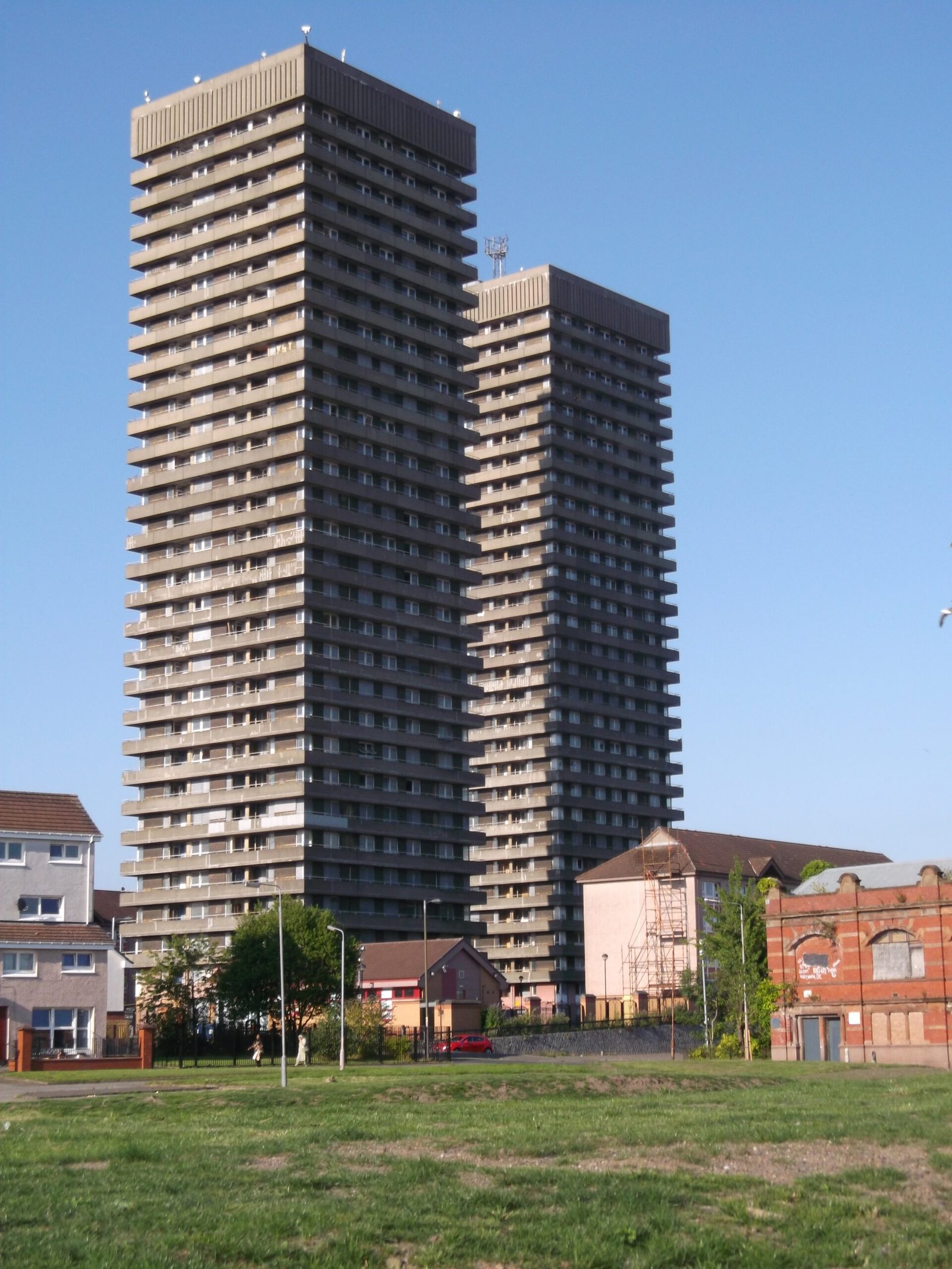
Twin brutalist tower blocks that briefly ranked among the United Kingdom’s tallest public housing schemes before their demolition in 2016.
At a glance
The Bluevale and Whitevale Towers were 31-storey residential buildings in Glasgow’s East End, officially known as 109 Bluevale Street and 51 Whitevale Street. Popularly called the Gallowgate Twins or the Camlachie Twin Towers, they stood as the second-highest public housing schemes in the UK, surpassed only by London’s Barbican Estate. For a period, they were Scotland’s tallest buildings.
History
The towers rose in Glasgow’s Camlachie district during the mid-twentieth century as part of Britain’s ambitious post-war public housing programme. They embodied the era’s faith in modernist solutions to urban density and social need.
After being officially condemned in 2011, both structures were demolished in early 2016, marking the end of their fifty-year presence on the Glasgow skyline.
What you see
The twin towers exemplified brutalism—a style characterised by bold concrete forms and geometric severity. At 31 storeys each, they dominated their East End surroundings through sheer verticality and structural honesty, their facades expressing the weight-bearing systems within.
Cultural significance
The Bluevale and Whitevale Towers represent both the ambitions and contradictions of late-twentieth-century British public housing. As among the tallest council flats ever built in the UK, they symbolised modernist ideals of community and efficiency—yet their eventual condemnation and demolition reflect broader shifts in housing policy and urban design philosophy.
Key facts
- Country: United Kingdom
- City: Glasgow
- Coordinates: 55.85595, −4.21506
- Height: 31 storeys
- Status: Demolished early 2016
Practical information & getting there
The towers no longer stand. The site in Camlachie, Glasgow’s East End, remains accessible to visitors interested in contemporary urban development and the legacy of twentieth-century housing schemes.
Sources & resources
Find it on the map
See this place and what’s around it →📷 Become a Cultural Heritage Online photographer
Share your photos of places: they stay published under your name as the author. The more they're seen, the more you get noticed — and soon a contest will reward the most appreciated photos.
Log in or sign up free to add a photoIs this page about you?
This page is read by travellers and heritage enthusiasts who find it on Google. Tell us how you are connected to this place and we will take it from there.