
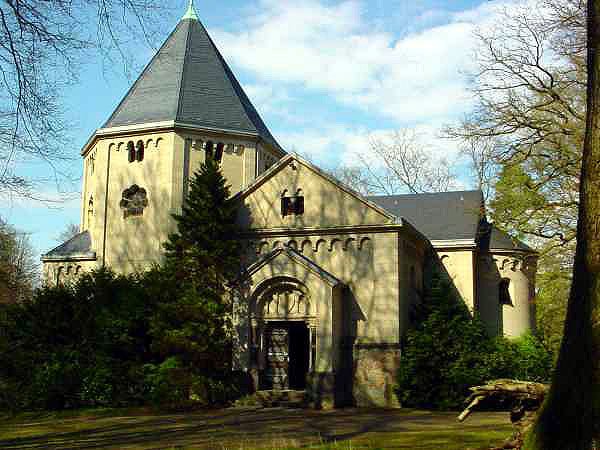
The final resting place of Otto von Bismarck, architect of German unification and the nation’s first Chancellor, stands on a hillside near Friedrichsruh in Schleswig-Holstein.
At a glance
This protected monument honours Prince Otto von Bismarck and his wife Johanna von Puttkamer. Located on Schneckenberg hill just outside Friedrichsruh, the chapel represents a personal memorial to one of Europe’s most influential political figures.
History
Otto von Bismarck served as the first Chancellor of Germany from 1871 to 1890, a period that saw the consolidation and expansion of German power under his direction. The mausoleum was built to commemorate his legacy and provide a final resting place for Bismarck and his wife.
What you see
The structure takes the form of a chapel, situated prominently on the Schneckenberg hill. Its position overlooking the surrounding Schleswig-Holstein landscape emphasizes the stature of those interred within.
Cultural significance
The mausoleum stands as a testament to Bismarck’s central role in nineteenth-century European history. His policies reshaped the political map and established Prussia as the dominant German state. The chapel functions as both a historical monument and a place of remembrance for visitors tracing the legacy of German unification.
Key facts
- Country: Germany
- City: Aumühle
- Coordinates: 53.5277° N, 10.3361° E
- Status: Protected monument
- Notable burials: Prince Otto von Bismarck (first Chancellor of Germany, 1871–1890) and Johanna von Puttkamer
Practical information & getting there
The mausoleum is situated near Friedrichsruh in northern Germany’s Schleswig-Holstein state. For detailed visiting hours, access information, and current conditions, consult local tourism resources or the site itself.
Sources & resources
Find it on the map
See this place and what’s around it →📷 Become a Cultural Heritage Online photographer
Share your photos of places: they stay published under your name as the author. The more they're seen, the more you get noticed — and soon a contest will reward the most appreciated photos.
Log in or sign up free to add a photoIs this page about you?
This page is read by travellers and heritage enthusiasts who find it on Google. Tell us how you are connected to this place and we will take it from there.