
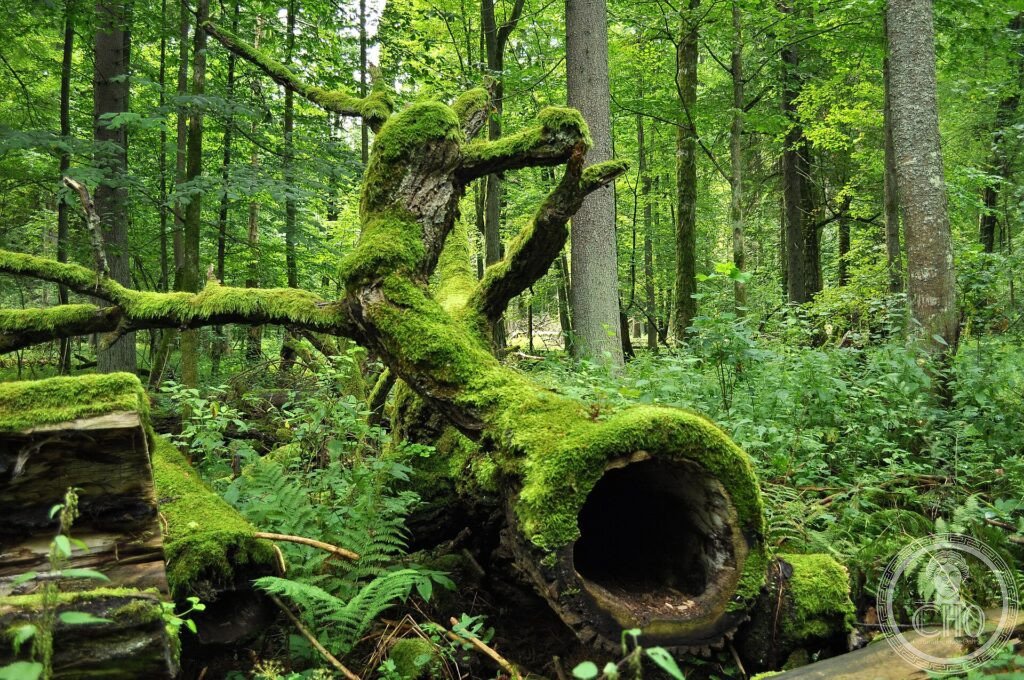
Where once stretched the forests that covered Europe, Białowieża survives almost intact: centuries-old oaks and hornbeams, fallen trunks left to rot, and the European bison, saved from extinction here. A fragment of the wild world on the border between Poland and Belarus.
At a glance
Białowieża Forest is the last large remnant of the primeval lowland forest that once covered much of Europe. Straddling the border of Poland and Belarus, its strictly protected core has never been cleared or managed, so ancient oaks, hornbeams and spruces grow, fall and decay as they would in nature. It is the refuge where the European bison, the continent’s heaviest land animal, was saved from extinction. The transboundary forest was inscribed by UNESCO in 1979.
Key facts
- UNESCO: World Heritage since 1979; a transboundary site shared with Belarus
- Primeval forest: the last large area of old-growth lowland forest in Europe
- European bison: brought back from extinction in the wild here
- Strict reserve: the core is left entirely to natural processes
- Biodiversity: thousands of species, including rare beetles, fungi and birds
- Deadwood: fallen trees are left to decay, vital to the ecosystem
History
Białowieża survived as a hunting forest of Polish kings and Russian tsars, who protected it for the chase and so spared it from clearance. The European bison, which lived in its depths, was nonetheless hunted to extinction in the wild by the early 20th century; the last free-ranging individual was killed around 1919–1921.
From surviving zoo animals the species was painstakingly bred back and reintroduced to the forest, where wild herds again roam. A strict reserve was established to leave part of the forest entirely to nature, and the area became a national park and one of the first natural World Heritage sites, jointly managed across the Polish-Belarusian border.
What you see
In the strict reserve, entered only with a guide, the forest stands as primeval woodland: huge old trees, multiple layers of canopy, and everywhere the fallen, moss-covered trunks that nurse new life. The sense is of a forest left entirely to itself.
In the surrounding park and show reserves, visitors can see European bison and other forest animals, and learn the story of the bison’s rescue.
Practical information
- Strict reserve: entry only on a guided walk from the park
- Bison: seen in the show reserve and, with luck, in the wild at dawn
- Time needed: a full day for guided walks and the reserve
- Note: stay on marked paths; much of the core is off-limits to protect it
Getting there
Białowieża village lies in north-eastern Poland, near the Belarusian border, about 60 km south-east of Białystok. It is reached by road or bus from Białystok and Hajnówka. GPS: 52.75° N, 23.87° E.
Nearby
- Hajnówka — the gateway town, with Orthodox churches
- Podlaskie countryside — a region of wooden architecture and marshes
- Belarusian side — Belovezhskaya Pushcha, the other half of the forest
Sources
- UNESCO World Heritage Centre — “Białowieża Forest” (ref. 33)
- Białowieża National Park — official park authority
- Encyclopaedia Britannica — Białowieża Forest; European bison
Find it on the map
See this place and what’s around it →📷 Become a Cultural Heritage Online photographer
Share your photos of places: they stay published under your name as the author. The more they're seen, the more you get noticed — and soon a contest will reward the most appreciated photos.
Log in or sign up free to add a photo