
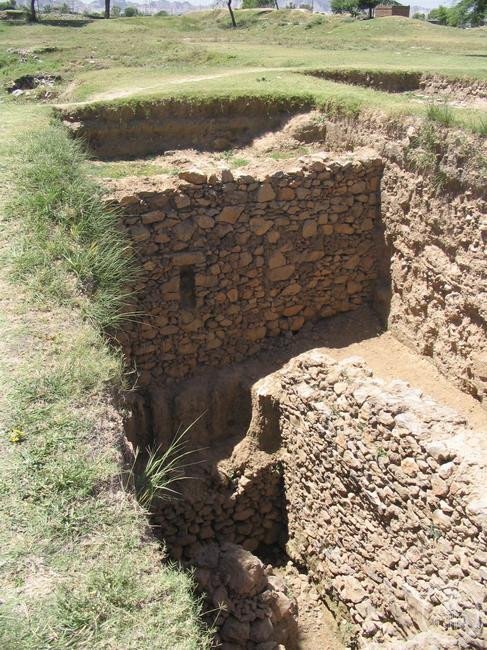
One of the earliest archaeological layers at Taxila, this mound preserves pottery and structures from the first centuries of the ancient city’s occupation, offering rare evidence of pre-Mauryan settlement in the Punjab.
At a glance
Bhir Mound is an excavated archaeological site within the larger Ruins of Taxila complex. Its earliest deposits—marked by distinctive grooved Red Burnished Ware—date to around 800–525 BC, making it among the oldest known layers at this historically significant location in Punjab.
History
The mound documents the earliest phases of Taxila’s occupation. Its Red Burnished Ware pottery provides crucial evidence of pre-Mauryan settlement patterns in the region. Later periods saw Taxila develop into a major center under successive empires, but Bhir Mound preserves this crucial foundational phase, offering insight into early urban development in the Punjab.
What you see
Visitors encounter stratified archaeological deposits revealing domestic structures and ceramic assemblages. The distinctive grooved Red Burnished Ware—finely crafted pottery burnished to a lustrous finish—dominates the earliest layers and provides the site’s most recognizable artifact type.
Cultural significance
Bhir Mound is integral to understanding ancient Taxila’s chronology and the broader settlement history of the Indus region. Its earliest phases predate the Mauryan period, helping scholars reconstruct patterns of early urban occupation and craft production in the Punjab during the first millennium BC.
Key facts
- Country: Pakistan
- Location: Taxila, Punjab
- Coordinates: 33.74°N, 72.82°E
- Period: circa 800–525 BC (earliest layers)
- UNESCO World Heritage Site: Ruins of Taxila (inscribed 1980)
- Distinctive artifact: Red Burnished Ware pottery
Practical information & getting there
Bhir Mound is part of the Ruins of Taxila archaeological zone, accessible near the city of Taxila in Punjab. The site is managed as part of the UNESCO World Heritage complex; visitor facilities and current access conditions should be confirmed with local authorities before planning a visit.
Sources & resources
Find it on the map
See this place and what’s around it →📷 Become a Cultural Heritage Online photographer
Share your photos of places: they stay published under your name as the author. The more they're seen, the more you get noticed — and soon a contest will reward the most appreciated photos.
Log in or sign up free to add a photoIs this page about you?
This page is read by travellers and heritage enthusiasts who find it on Google. Tell us how you are connected to this place and we will take it from there.