
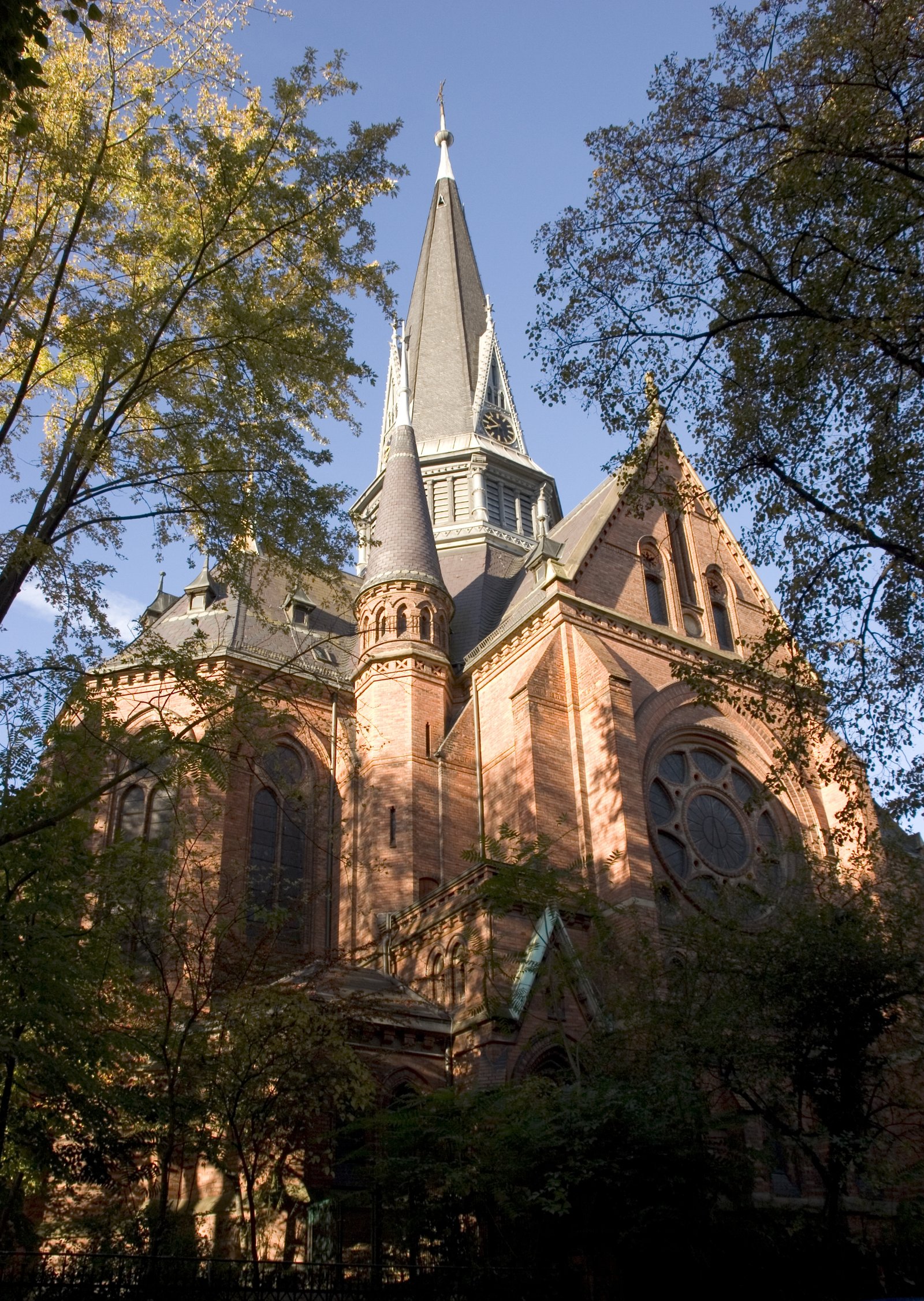
A Gothic Revival Protestant church completed in 1879, designed by Johannes Otzen to place altar and pulpit within intimate reach of the congregation—embodying Luther’s doctrine of universal priesthood.
At a glance
The Bergkirche (Mountain Church) ranks among Wiesbaden’s four principal Protestant churches. Its architectural vision prioritizes congregational participation, bringing the pulpit and altar forward rather than distant and elevated. Today it remains active both for worship and as a venue for church music performances.
History
Completed in 1879, the Bergkirche emerged from Johannes Otzen’s design during a period of Protestant church construction across Hesse. The building reflects nineteenth-century Reformed theology that emphasized direct access to clergy and scripture for all believers, a principle traceable to Martin Luther’s concept of the priesthood of all the faithful.
What you see
The church embodies Gothic Revival aesthetics characteristic of its era. Its interior arrangement—with altar and pulpit positioned close to worshippers rather than remote—distinguishes it functionally from medieval cathedral design. This spatial hierarchy reflects theological conviction as much as aesthetic choice.
Cultural significance
The Bergkirche represents a crucial moment in Protestant architectural philosophy, where building design became an instrument for theological expression. Its dual role as worship space and concert hall connects sacred music performance to community life, sustaining the church’s cultural footprint beyond liturgical functions.
Key facts
- Country: Germany
- City: Wiesbaden (Mitte district)
- Completed: 1879
- Architect: Johannes Otzen
- Coordinates: 50.08666667, 8.23972222
- Architectural style: Gothic Revival
Practical information & getting there
The Bergkirche is located in central Wiesbaden. Information on visiting hours, services, and current concert programming should be confirmed through local tourism resources or the church’s official contacts.
Sources & resources
Find it on the map
See this place and what’s around it →📷 Become a Cultural Heritage Online photographer
Share your photos of places: they stay published under your name as the author. The more they're seen, the more you get noticed — and soon a contest will reward the most appreciated photos.
Log in or sign up free to add a photoIs this page about you?
This page is read by travellers and heritage enthusiasts who find it on Google. Tell us how you are connected to this place and we will take it from there.