
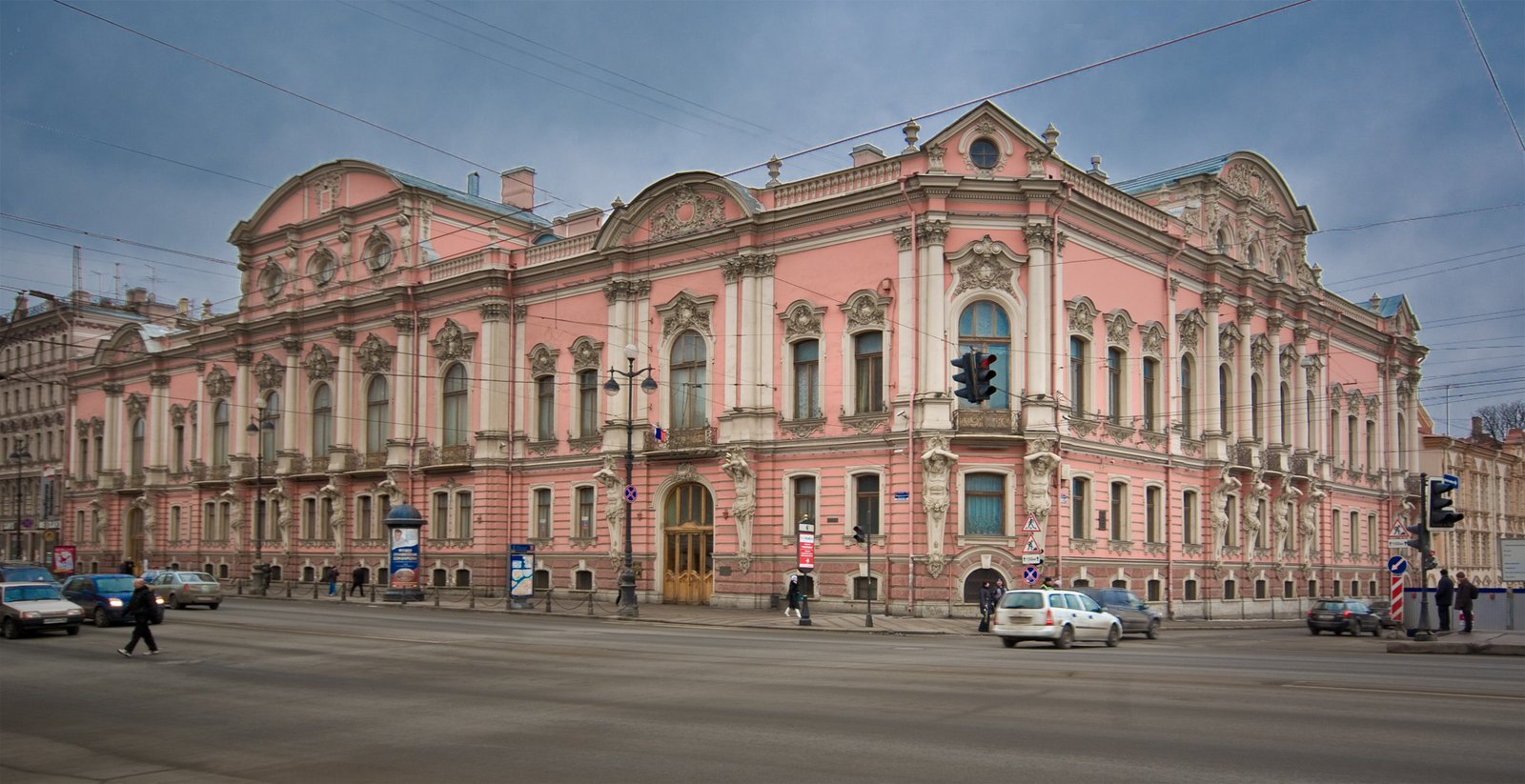
At the junction of the Fontanka River and Nevsky Prospekt stands a rococo revival palace whose red facade has watched over princes, a wartime hospital, and a Soviet cultural center.
At a glance
The Beloselsky-Belozersky Palace is a baroque revival mansion built for one of St. Petersburg’s wealthiest noble families. Its present form dates to 1846–48, when architect Andrei Stackenschneider rebuilt an earlier 18th-century house on the same site. The building later became a grand ducal residence, then a wartime hospital, and today functions as a municipal cultural center hosting chamber concerts.
History
A smaller palace first rose here in 1747 for Prince Mikhail Andreevich Beloselsky, styled after Parisian townhouses with a private garden reaching the canal. His descendants prospered through Ural mining fortunes and marriages into the Bibikov and Kozitsky families. Princess Elena Pavlovna Beloselskaya-Belozerskaya, having inherited vast wealth, petitioned Nicholas I for permission to commission his court architect. Stackenschneider demolished the old house and built anew between 1846 and 1848, in what became his only private commission in the city. The family later sold the drain on their resources; in 1884 Grand Duke Sergei Alexandrovich and his wife Elisabeth of Hesse purchased it as their principal St. Petersburg residence. Sergei repainted the exterior red and added a library and a Slavic revival chapel. After his assassination in 1905, the palace passed to his foster son, Grand Duke Dmitri Pavlovich, who sold it shortly before the Revolution. It was nationalized in 1918.
What you see
The palace presents a dense rococo revival facade in deep red, its ornament recalling the nearby Stroganov Palace by Bartolomeo Rastrelli. Inside, a piano nobile carries the visitor through a sequence of gilded rooms toward a concert hall. Paintings attributed to the Van Loo workshop once hung among the interiors. War damage in the 1940s destroyed much original decoration; a 1954 restoration returned the rooms to something close to their prerevolutionary state. A small palace church survives among the sequence of halls.
Cultural significance
Under Elena Pavlovna, the palace earned a reputation as the most lavish private venue in the capital, its balls and concerts rivaling those of the imperial court. During the First World War it briefly served humanitarian purposes, housing the Anglo-Russian Hospital under Lady Muriel Paget and Lady Sybil Grey between 1916 and 1918. Decades of Soviet administrative use followed. The building’s survival through revolution, war, and a 2012 roof fire testifies to its resilience as a civic landmark.
Key facts
- Location: intersection of Nevsky Prospekt and the Fontanka River, St. Petersburg
- Architect: Andrei Stackenschneider (rebuilding, 1846–48)
- Style: baroque/rococo revival
- Earlier structure on site dates from 1747; present form traces to circa 1799–1848
- Heritage-listed cultural monument
- Former uses: princely residence, grand ducal palace, WWI hospital, Soviet regional headquarters
- Current use: municipal cultural center with chamber concerts and a waxworks exhibition
Practical information & getting there
The palace sits on Nevsky Prospekt at its crossing with the Fontanka, easily reached on foot from Gostiny Dvor metro station. You can attend scheduled concerts in the restored halls; check the official website for current programs. The exterior alone rewards a stop while walking the avenue.
Sources & resources
Find it on the map
See this place and what’s around it →📷 Become a Cultural Heritage Online photographer
Share your photos of places: they stay published under your name as the author. The more they're seen, the more you get noticed — and soon a contest will reward the most appreciated photos.
Log in or sign up free to add a photoIs this page about you?
This page is read by travellers and heritage enthusiasts who find it on Google. Tell us how you are connected to this place and we will take it from there.