
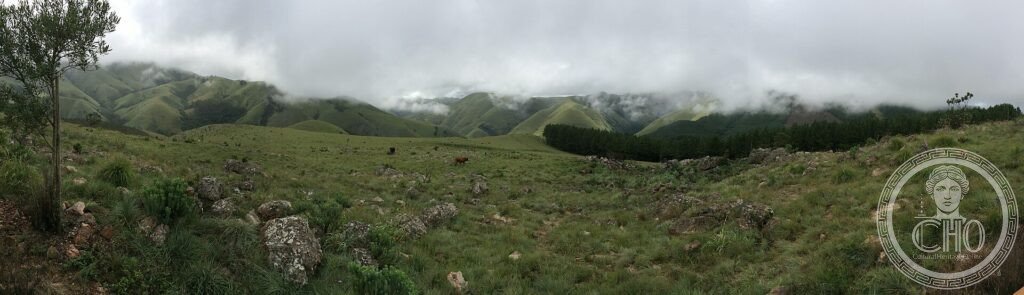
Sotto le verdi colline di Barberton affiorano alcune delle rocce più antiche e meglio conservate del pianeta: una “cintura di pietre verdi” formatasi oltre tre miliardi e mezzo di anni fa, quando la Terra era giovane. I Monti Makhonjwa sono un libro aperto sull’infanzia del nostro mondo e sulle origini della vita.
At a glance
The Barberton Makhonjwa Mountains, in the Mpumalanga province of eastern South Africa, contain one of the oldest and best-preserved sequences of rocks on Earth — a “greenstone belt” formed between about 3.6 and 3.25 billion years ago, when the planet was young. These ancient rocks record the early Earth: its first continents, meteorite impacts, and some of the earliest traces of life. A landscape of green, rounded mountains, it was inscribed by UNESCO in 2018 for its outstanding geological value.
Key facts
- UNESCO: World Heritage since 2018 (Barberton Makhonjwa Mountains)
- Ancient rocks: among the oldest and best-preserved on Earth
- Greenstone belt: formed about 3.6–3.25 billion years ago
- Early Earth: records the planet’s first continents and impacts
- Origins of life: some of the earliest traces of life on Earth
- Geotrail: a scenic road reveals the rock formations
History
The rocks of the Makhonjwa Mountains formed in the Archean eon, when the Earth was barely a billion years old, and have survived with remarkably little alteration ever since. They preserve evidence of the planet’s earliest crust, of ancient volcanic and sedimentary processes, of meteorite strikes, and of microbial life from a time when the atmosphere held almost no oxygen.
Long mined for gold around the town of Barberton, the range later became famous among geologists worldwide as a unique natural archive of the young Earth. Recognised for this exceptional record, the Barberton Makhonjwa Mountains were inscribed by UNESCO in 2018.
What you see
A scenic geotrail road climbs through the green, grassy mountains, with marked stops where the ancient rock formations — banded ironstones, pillow lavas, sediments — can be seen and explained, against sweeping views over the ranges. The historic gold-mining town of Barberton lies at their foot.
The beauty of the misty green mountains, holding within them a record of the early Earth, is the appeal of the Makhonjwa.
Practical information
- Area: seen mainly along the Barberton Geotrail road
- Time needed: half a day to a day
- Note: the geotrail has interpretive stops; combine with Barberton
- Setting: on the border of Mpumalanga and Eswatini
Getting there
The Barberton Makhonjwa Mountains are in eastern Mpumalanga, South Africa, around the town of Barberton, near the border with Eswatini, reached by road from Mbombela (Nelspruit). GPS: 25.80° S, 31.00° E.
Nearby
- Barberton — the historic gold-rush town at the mountains’ foot
- Kruger National Park — the great wildlife park to the north
- Eswatini — the kingdom across the nearby border
Sources
- UNESCO World Heritage Centre — “Barberton Makhonjwa Mountains” (ref. 1575)
- Mpumalanga Tourism / SANParks — official body
- Encyclopaedia Britannica — Archean Eon
Find it on the map
See this place and what’s around it →📷 Become a Cultural Heritage Online photographer
Share your photos of places: they stay published under your name as the author. The more they're seen, the more you get noticed — and soon a contest will reward the most appreciated photos.
Log in or sign up free to add a photo