

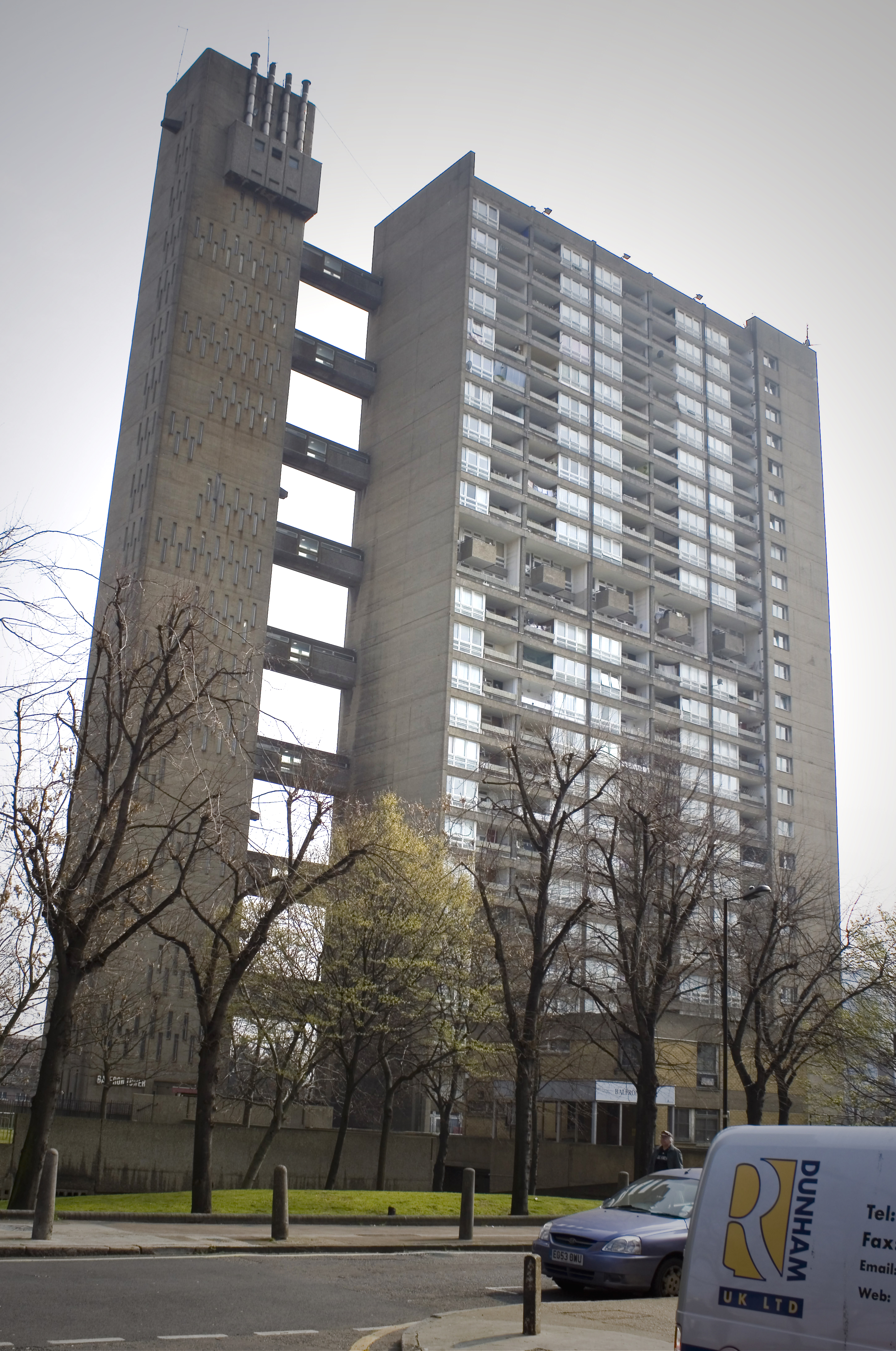
A 27-storey Brutalist residential tower designed by Ernő Goldfinger for the London County Council, Balfron Tower stands as a landmark of post-war social housing in East London.
At a glance
Balfron Tower rises from the Brownfield Estate in Poplar, a pioneering scheme of social housing positioned between Chrisp Street Market and the A12 approach to the Blackwall Tunnel. Its bold geometric form and exposed concrete structure exemplify Brutalist design principles of the 1960s.
History
Ernő Goldfinger designed the tower in 1963 for the London County Council. Construction by the Greater London Council lasted from 1965 to 1967, delivering housing for hundreds of residents in an era of ambitious urban renewal. The building earned Grade II* listed status in 1996, upgraded from its original Grade II designation, recognizing its architectural and historical importance.
What you see
The tower’s 27 storeys express Brutalism through raw concrete, geometric volume, and functional clarity. Goldfinger’s design prioritizes livable space and structural honesty, with a dramatic vertical emphasis and carefully proportioned fenestration. Stylistically, it anticipates his later masterwork, Trellick Tower in North Kensington, refined through subsequent design evolution.
Cultural significance
Balfron Tower represents a pivotal moment in British public housing, when architects and planners believed that modernist design could improve urban life. Goldfinger’s vision—combining housing density with human scale—influenced a generation of residential towers. Today it stands as a testament to post-war optimism and remains a defining presence in East London’s skyline.
Key facts
- Designer: Ernő Goldfinger (1963)
- Completed: 1967
- Height: 27 storeys
- Location: Poplar, London Borough of Tower Hamlets
- Listed status: Grade II* (since 1996)
- Coordinates: 51.5136, -0.0088
Practical information & getting there
Balfron Tower is located in Poplar, East London, accessible by the District Line and DLR. The tower remains residential and is not open to the public interior, but its exterior and setting are visible from surrounding streets and public spaces within the Brownfield Estate.
Sources & resources
Find it on the map
See this place and what’s around it →📷 Become a Cultural Heritage Online photographer
Share your photos of places: they stay published under your name as the author. The more they're seen, the more you get noticed — and soon a contest will reward the most appreciated photos.
Log in or sign up free to add a photoIs this page about you?
This page is read by travellers and heritage enthusiasts who find it on Google. Tell us how you are connected to this place and we will take it from there.