
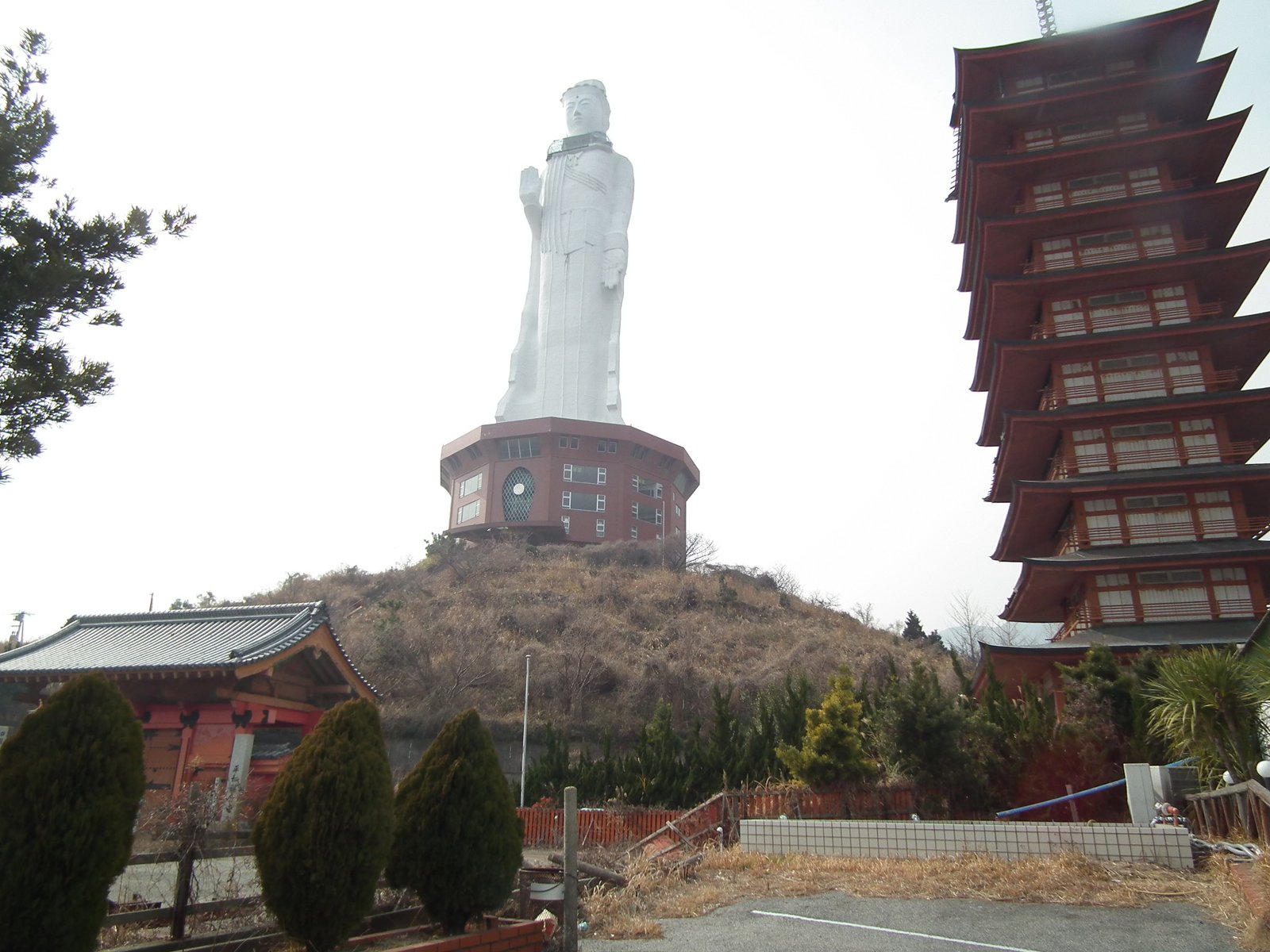
A gypsum giant once rose over Awaji Island, its observation deck promising views for sightseers. Today the hill is bare.
At a glance
Awaji Kannon, also called the World Peace Giant Kannon, was a colossal statue, museum and temple complex in Hyogo Prefecture. Among the tallest statues ever built, it opened to the public in 1982 and closed in 2006. The Japanese government demolished it, completing site clearance by March 2023.
History
The statue was the private ambition of real estate magnate Toyokichi Okuuchi. Construction began in 1977 and took five years. Okuuchi ran the complex until his death in 1988; his wife then managed it until she died in 2006. A structural inspection soon after revealed the gypsum shell needed extensive repair. The site closed that year and never reopened.
Typhoons in 2012 and 2014 tore at the statue’s outer wall. Locals came to regard the abandoned monument as haunted. By 2020 safety fears had grown acute, sharpened by a suicide from the observation deck. The government invoked eminent domain in March 2020, acquired the land, and announced demolition the following month.
What you see
Nothing remains standing. The statue sat atop a five-story pedestal building roughly 20 metres tall, with a sixth-floor viewing platform inside the figure itself. Visitors once climbed through the Kannon’s body to look out over the Inland Sea. The ¥880 million demolition, about US$6.8 million, cleared the whole complex by early 2023, leaving a hillside site now returned to bare ground.
Cultural significance
Awaji Kannon belonged to a wave of oversized religious monuments built across Japan during decades of postwar and bubble-era prosperity. Its rise and fall trace a familiar arc: a private dream, high visitor numbers at first, then decades of neglect. The statue’s decay and eventual demolition made it a case study in what happens when such privately funded landmarks outlive their founders’ care. Its story now circulates chiefly through lists of the world’s tallest statues and accounts of Japan’s abandoned attractions.
Key facts
- Location: Awaji Island, Hyogo Prefecture, Japan
- Construction started: 1977; opened 1982
- Founder: Toyokichi Okuuchi
- Closed: 2006, after a structural inspection
- Demolition completed: March 2023, at a cost of about ¥880 million (US$6.8 million)
Practical information & getting there
The statue no longer exists, so there is nothing to visit at the site itself. If you want to see the location, the coordinates place it on Awaji Island at roughly 34.5029, 134.9767. Check current land use and access before travelling, since the government-cleared site may not be open to the public.
Sources & resources
Find it on the map
See this place and what’s around it →📷 Become a Cultural Heritage Online photographer
Share your photos of places: they stay published under your name as the author. The more they're seen, the more you get noticed — and soon a contest will reward the most appreciated photos.
Log in or sign up free to add a photoIs this page about you?
This page is read by travellers and heritage enthusiasts who find it on Google. Tell us how you are connected to this place and we will take it from there.