

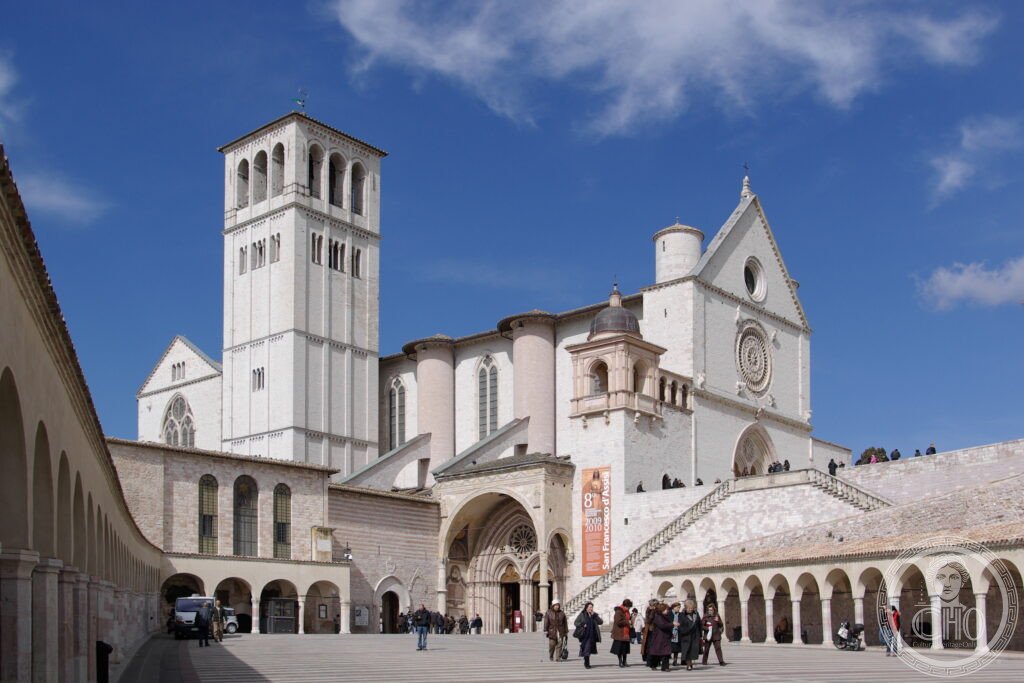
The Basilica di San Francesco, raised on the hill where Francis of Assisi asked to be buried, is built as two churches stacked one above the other. Its upper nave holds Giotto’s cycle on the life of the saint, a work credited with introducing depth, landscape and human emotion into Western painting.
At a glance
The Basilica di San Francesco stands on what medieval Assisi called the Colle del Paradiso, a hill once used for executions and renamed at the town’s own decision after Francis chose it as his burial place. The building is really two churches: the Basilica Inferiore, begun in 1228, and the Basilica Superiore raised above it between 1230 and 1253. A bell tower completed in 1239 is visible across the Umbrian valley, and the facade faces west with a Gothic rose window while the sanctuary faces east.
The UNESCO World Heritage inscription of 2000, reference 990, covers the Basilica together with eight other Franciscan sites in and around Assisi, among them the Convento di San Francesco, the Basilica di Santa Chiara, the Rocca Maggiore and the Eremo delle Carceri.
Key facts
- Dedication: Francis of Assisi, 1181/82–1226, canonised in 1228, two years after his death
- Structure: double basilica, Lower Basilica 1228–1230 and Upper Basilica 1230–1253, attributed to Frate Elia da Cortona
- Painted decoration: apse and transept by Cimabue, 1280–1285; nave cycle of 28 scenes by Giotto, 1296–1304; Chapel of San Martino by Simone Martini, 1315–1320
- UNESCO listing: inscribed 2000, reference 990, covering the Basilica and eight further Franciscan sites
- Coordinates: 43.0746° N, 12.6105° E, Piazza di San Francesco, Assisi
History
Francis died on 3 October 1226. His canonisation followed within two years, one of the fastest in medieval history, and construction of the basilica began almost immediately afterwards. The project was overseen by Frate Elia da Cortona, then General Minister of the Franciscan Order. The Lower Basilica, with its low ribbed vaults and Romanesque proportions, was built first over the saint’s tomb; the Upper Basilica followed in a French Gothic idiom, with pointed arches and large lancet windows that were among the first of their kind in Italy.
The painted decoration was added over several generations. Cimabue worked on the apse and transept of the Upper Basilica in the 1280s, Giotto painted the nave cycle at the turn of the fourteenth century, and Simone Martini frescoed the Chapel of San Martino in the Lower Basilica in the 1310s. The whole complex, together with other Franciscan sites in the town, was inscribed on the UNESCO World Heritage List in 2000.
What you see
The Lower Basilica is entered from a side door rather than the main facade and feels close and dim, its Romanesque vaults sheltering the crypt where Francis is buried; the tomb was rediscovered in 1818 after the friars had concealed it soon after the saint’s death. Above it, the Upper Basilica opens into a tall Gothic nave lit by large windows, its walls carrying Giotto’s 28 scenes from the life of Francis. The Gift of the Cloak shows Assisi’s city gate rendered with early perspective and the hills of Monte Subasio behind it, one of the first naturalistic landscapes in medieval painting. Elsewhere in the cycle, the Death of the Knight of Celano gives individual, grieving faces to the mourners rather than the fixed expressions of earlier Byzantine-influenced painting, and the portrait of Pope Innocent III in the Approval of the Franciscan Rule has the specific features of an identifiable old man.
The attached convent, said to have 365 rooms, one for each day of the year, is the largest in Italy. From the hill the view opens across the Umbrian valley towards Santa Maria degli Angeli and the plain of Perugia.
Practical information
- Access: the Basilica is entered free of charge; visitors should check the Franciscan Order’s official channels for current opening times
- Visit length: allow around four hours for the Basilica alone, longer for the wider circuit of Franciscan sites in Assisi
- Entrance: the Lower Basilica is reached through a side door in Piazza di San Francesco, not the main facade
Getting there
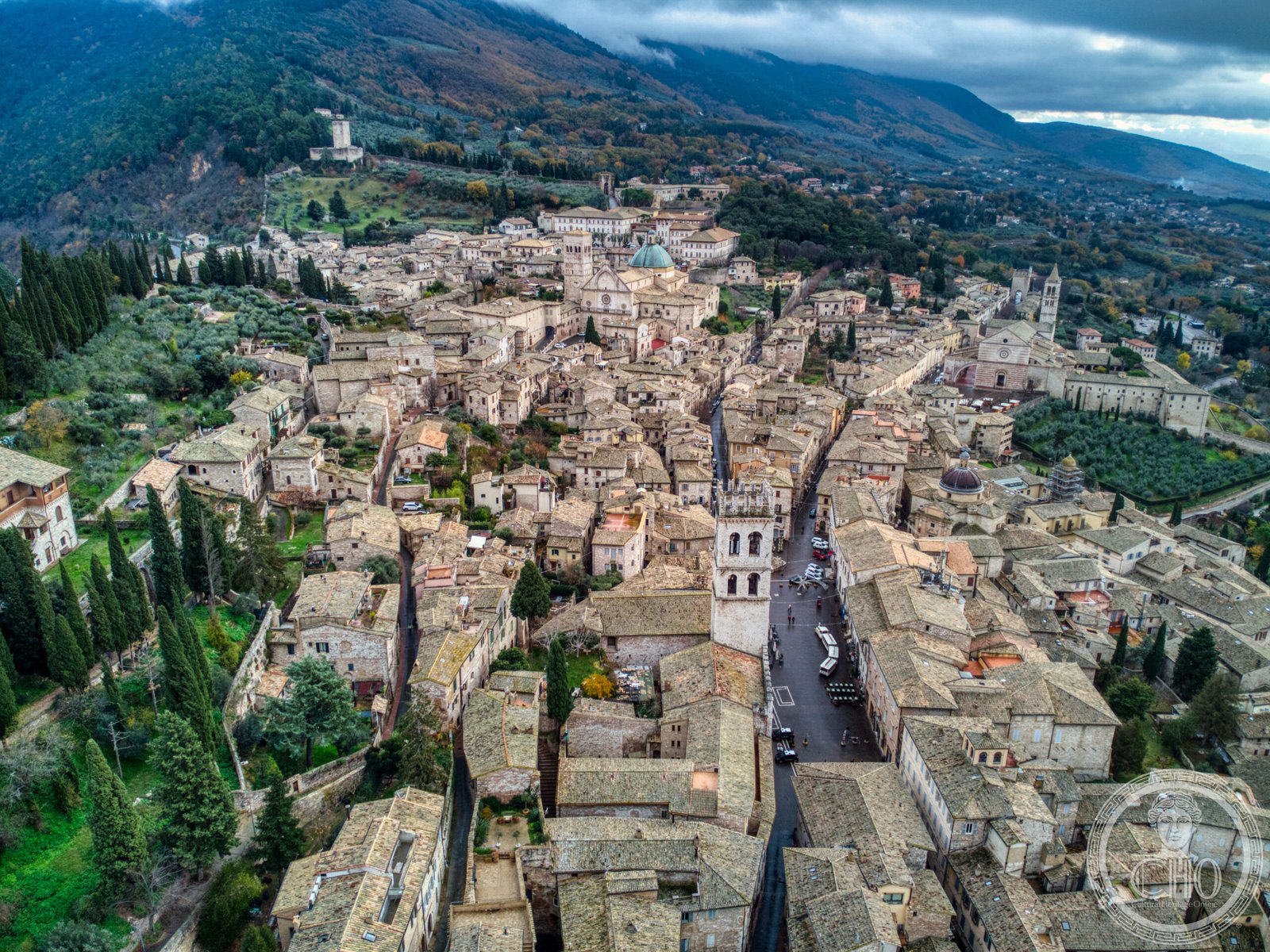
The Basilica stands in Piazza di San Francesco, within the walled town of Assisi on the slopes of Monte Subasio, overlooking the Umbrian valley. It is reached on foot through the historic centre; further Franciscan sites associated with the UNESCO listing lie a short distance below the town.
Nearby
- Basilica di Santa Chiara — within Assisi, built 1257–1265, burial place of Clare of Assisi, founder of the Poor Clares
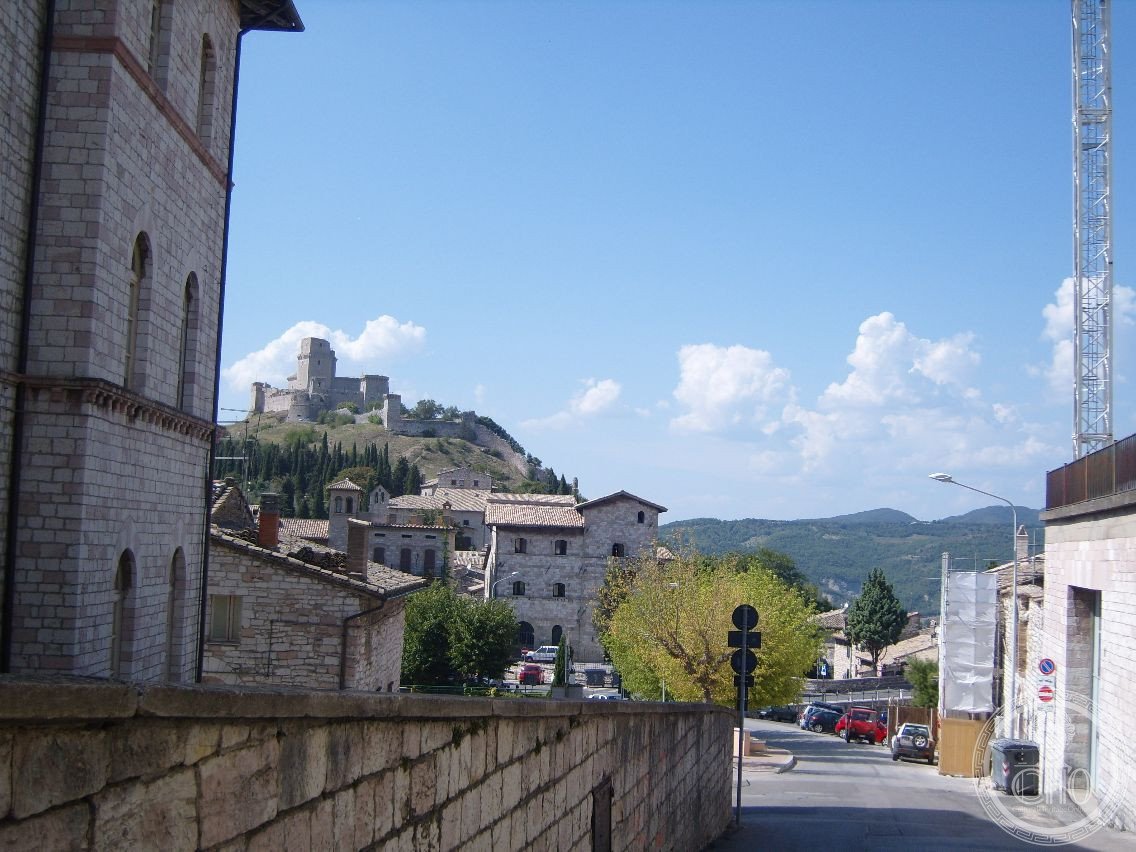
- Rocca Maggiore — above Assisi, a fourteenth-century fortress overlooking the town
- Eremo delle Carceri — about 4 km from Assisi, the hermitage where Francis went to pray, with the rock cave where he is said to have slept
- Santa Maria degli Angeli — about 4 km below Assisi, site of the Porziuncola chapel where Francis died on 3 October 1226
Sources
- UNESCO World Heritage List
Gallery
Find it on the map
See this place and what’s around it →📷 Become a Cultural Heritage Online photographer
Share your photos of places: they stay published under your name as the author. The more they're seen, the more you get noticed — and soon a contest will reward the most appreciated photos.
Log in or sign up free to add a photoIs this page about you?
This page is read by travellers and heritage enthusiasts who find it on Google. Tell us how you are connected to this place and we will take it from there.