
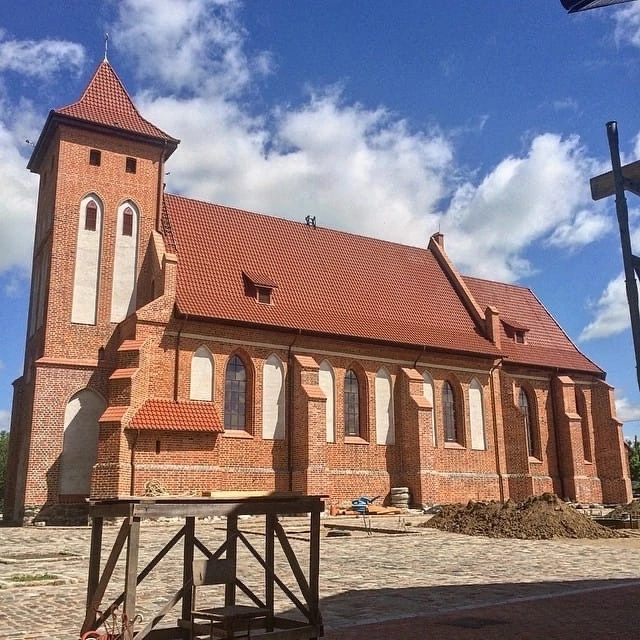
A Brick Gothic parish church east of Kaliningrad once held one of East Prussia’s richest cycles of medieval wall painting. Most of it is now gone.
At a glance
Standing 8 km east of Kaliningrad near the Pregolya River, close to the Russian-Lithuanian border, the Church of St. Catherine of Alexandria is a Brick Gothic building begun around 1301 in the East Prussian village of Arnau, today Rodniki. Built as a Catholic church, it passed to Lutheran use after the Reformation. Its interior once carried more than 200 medieval frescoes.
History
The church served the local Catholic parish from its foundation. The Reformation brought Lutheran worship and, with it, whitewash over the frescoes. They stayed hidden for centuries. Restorers uncovered them in the early 20th century, revealing a cycle rare in scale for the region.
The graveyard holds the tomb of Theodor von Schön, the Prussian statesman. After 1945, when the territory became Soviet Kaliningrad Oblast, the building lost its religious function entirely. It stored grain for decades. A restoration campaign finally began in 2003, by which point the church belonged to the Kaliningrad History Museum, which used the space for exhibitions and, at times, Orthodox liturgy.
What you see
The church is a compact Brick Gothic hall, its red masonry typical of the Teutonic Order’s building tradition along the Baltic coast. Inside, the walls once carried a dense medieval painting scheme spanning the 14th century. What remains today is fragmentary. Experts estimate only 2 to 3 percent of the original frescoes survive.
Cultural significance
Few East Prussian churches preserved so extensive a medieval fresco cycle into modern times. That made Arnau a reference point for scholars of Baltic Gothic art. In 1992 the Kuratorium Arnau formed in Germany specifically to conserve the church and its paintings.
In 2010 local legislators transferred ownership to the Russian Orthodox Church. The renovation that followed caused damage described by conservation specialist Nicole Riedl, of Hawk University of Applied Sciences and Arts in Hildesheim, as leaving the frescoes “irretrievably lost.” Her 2014 report, prepared for Kuratorium Arnau, prompted the Kaliningrad Diocese to sever ties with the organization. Riedl later told The Art Newspaper the Church had “deliberately destroyed” what remained. The episode turned a modest parish church into a case study in the risks facing shared, contested heritage.
Key facts
- Dedication: St. Catherine of Alexandria
- Location: Rodniki (formerly Arnau), 8 km east of Kaliningrad, Russia
- Style: Brick Gothic
- Construction began: around 1301
- Original confession: Catholic, later Lutheran
- Notable grave: Theodor von Schön
- Current ownership: Russian Orthodox Church, Kaliningrad Diocese
- Heritage status: listed
Practical information & getting there
The church sits in Rodniki, a short drive east of central Kaliningrad, near the Pregolya River. As an active Orthodox parish building, access and opening times can vary. Check current visiting conditions locally before travelling, since the site’s status has shifted repeatedly over the past two decades.
Sources & resources
Find it on the map
See this place and what’s around it →📷 Become a Cultural Heritage Online photographer
Share your photos of places: they stay published under your name as the author. The more they're seen, the more you get noticed — and soon a contest will reward the most appreciated photos.
Log in or sign up free to add a photoIs this page about you?
This page is read by travellers and heritage enthusiasts who find it on Google. Tell us how you are connected to this place and we will take it from there.